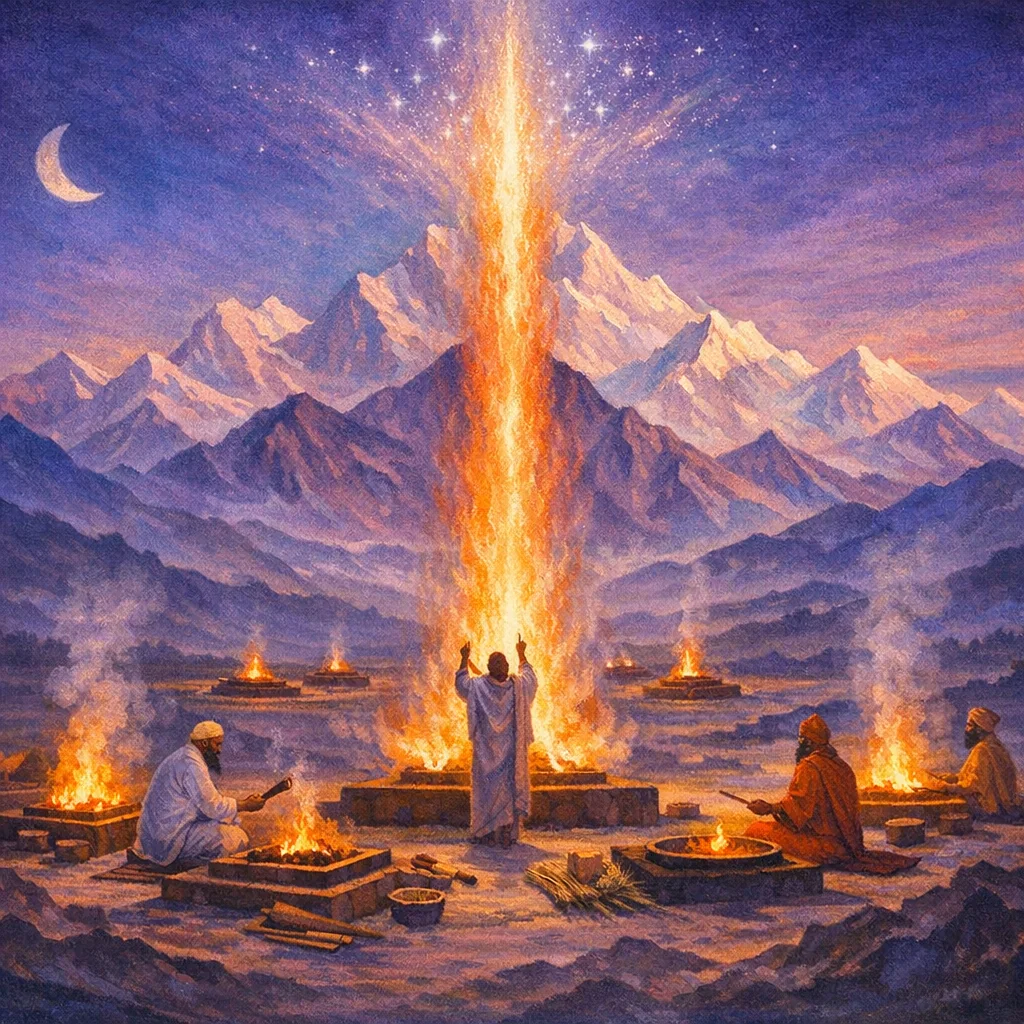
Prapathaka 5
Darśa–Paurṇamāsa (New- and Full-Moon sacrifices) within the Agnyādheya/Agnihotra continuum: establishment and regulation of the three sacred fires, their protection, and the preparatory/ancillary acts (aṅgas) that make the fortnightly iṣṭis possible.
Kṛṣṇa Yajurveda 1.5 continues the early Śrauta program by consolidating the ritual ecology required for the Darśa–Paurṇamāsa cycle. The chapter is concerned less with a single oblation than with the stable conditions under which recurring iṣṭis can be performed: the sacralization of space, the disciplined handling of fire, and the priestly speech-acts that convert domestic fuel into a cosmic principle (Agni as mouth of the gods). The mantras articulate a theology of mediation—Agni as carrier, purifier, and boundary-keeper—while simultaneously encoding procedural constraints (placement, guarding, and sequencing). The text’s pragmatics show the Yajurvedic style: mantra and act are interlocked, so that recitation functions as authorization, protection, and transformation. In exegetical terms, the prapāṭhaka advances from mere ignition to a regulated sacrificial regime, aligning household order, seasonal time, and divine reciprocity through repeated, correctly bounded performance.
Anuvakas
Anuvakas for this prapathaka are loading. Please check back soon.