
Bhagavad Gita — Vishwarupa Darshana Yoga, Shloka 55
Vishwarupa Darshana Yoga
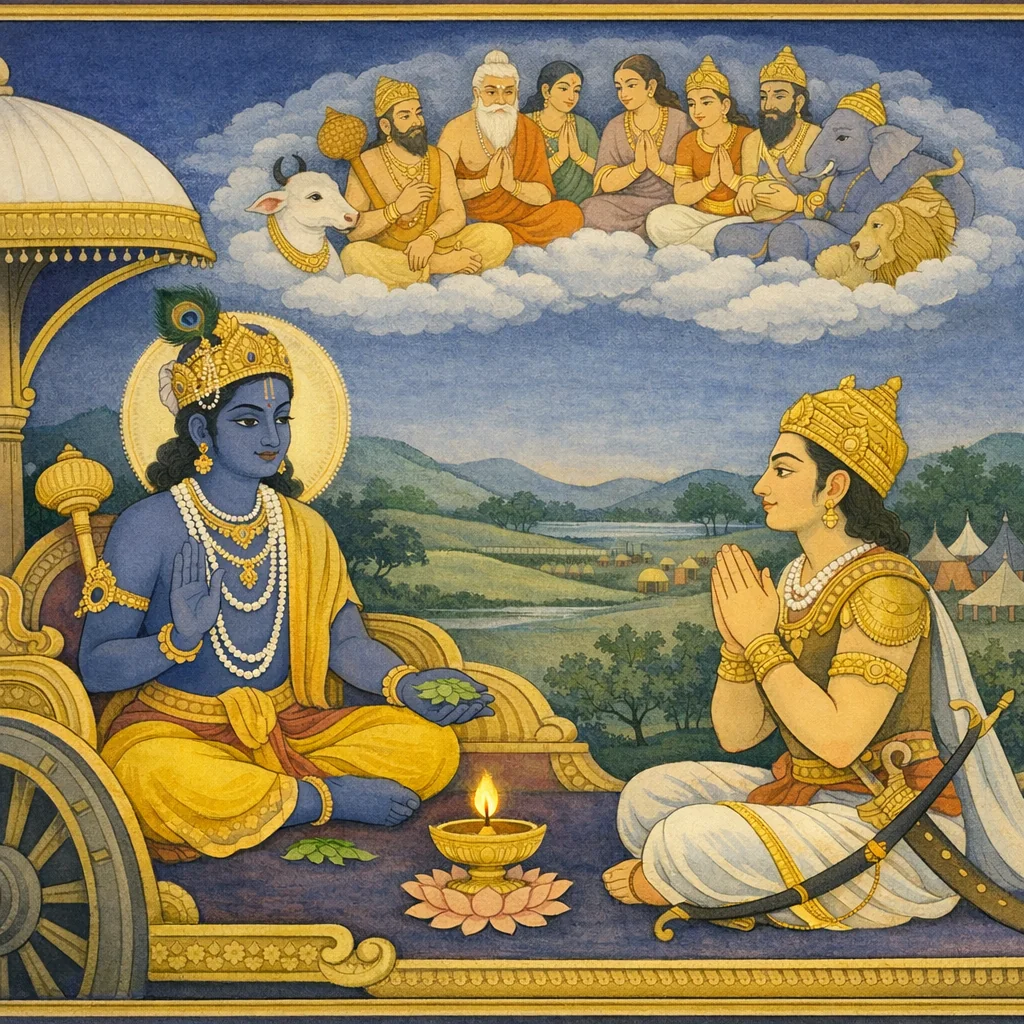
मत्कर्मकृन्मत्परमो मद्भक्तः सङ्गवर्जितः । निर्वैरः सर्वभूतेषु यः स मामेति पाण्डव ॥ ११.५५ ॥
matkarmakṛn matparamo madbhaktaḥ saṅgavarjitaḥ | nirvairaḥ sarvabhūteṣu yaḥ sa mām eti pāṇḍava || 11.55 ||

Sesiapa yang melakukan pekerjaan-Ku, yang menjadikan Aku matlamat tertinggi, yang berbhakti kepada-Ku, bebas daripada keterikatan, dan tidak bermusuhan terhadap semua makhluk—dialah yang datang kepada-Ku, wahai Pandava.
He who does My work, who holds Me as the supreme goal, who is devoted to Me, free from attachment, and free from hostility toward all beings—he comes to Me, O Pandava.
Who does actions for me, who is devoted to me as the highest, who is my devotee, devoid of attachment, without enmity toward all beings—he comes to me, O son of Pāṇḍu.
This verse integrates karma-yoga and bhakti: ‘matkarmakṛt’ is sometimes translated as ‘does work for me’ or ‘does my work’ (i.e., duty offered to the divine). ‘nirvairaḥ’ is ethically universalizing, tempering the martial setting with non-hostility as an inner stance.
FAQs
The verse links well-being to reduced attachment and reduced antagonism, suggesting a stable inner posture that supports purposeful action without corrosive resentment.
‘He comes to me’ can be read as attaining closeness/communion with the divine, or liberation framed theistically, where the ultimate goal is personal yet transcendent.
As the chapter closes, Krishna converts the extraordinary vision into a practical program: dedicate action, center the highest goal, cultivate devotion, and maintain non-hostility.
In daily life it supports working with dedication and ethical regard for others, while minimizing ego-driven clinging and interpersonal antagonism.