
Shloka 40
Vishwarupa Darshana Yoga — Vishwarupa Darshana Yoga
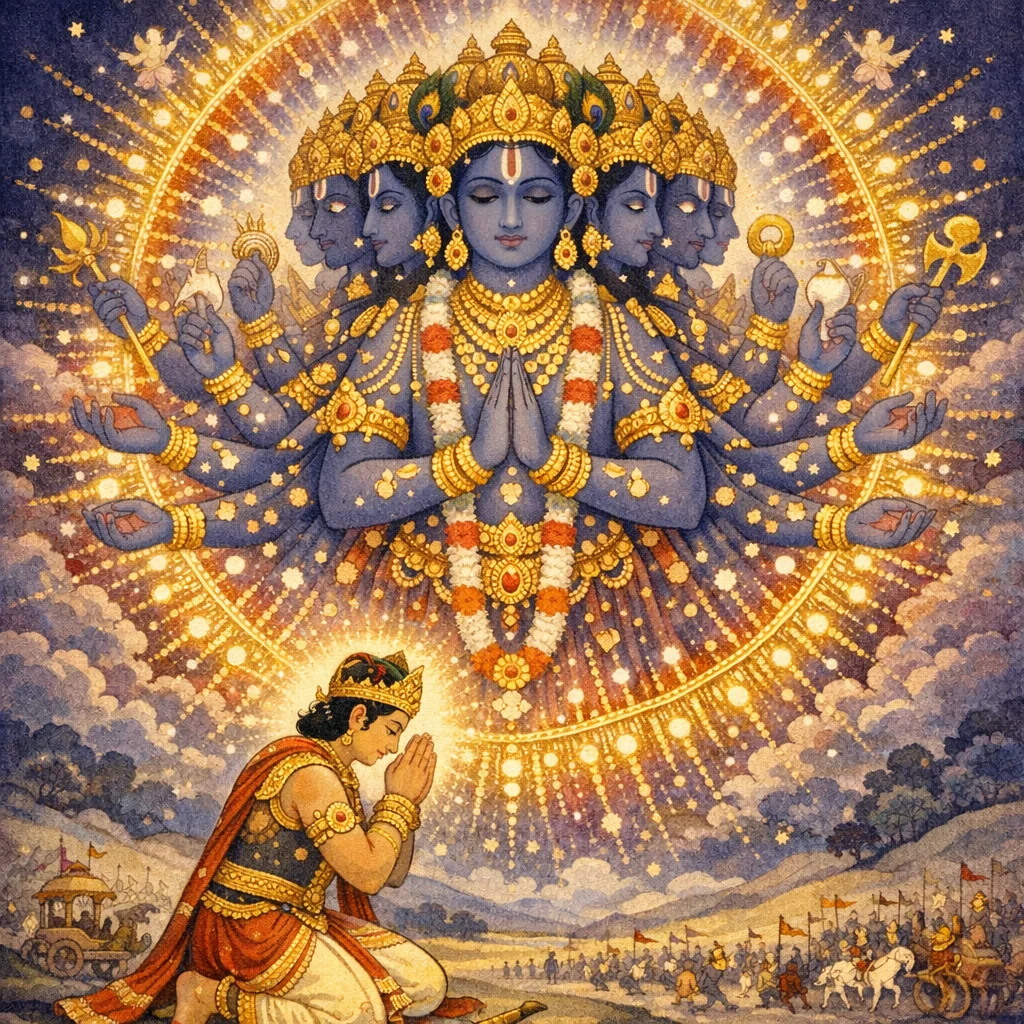
नमः पुरस्तादथ पृष्ठतस्ते नमोऽस्तु ते सर्वत एव सर्व ।
अनन्तवीर्यामितविक्रमस्त्वं सर्वं समाप्नोषि ततोऽसि सर्वः ॥ ११.४० ॥
namaḥ purastād atha pṛṣṭhatas te namo 'stu te sarvata eva sarva |
ananta-vīryāmita-vikramas tvaṃ sarvaṃ samāpnoṣi tato 'si sarvaḥ || 11.40 ||

Sembah sujud kepada-Mu dari hadapan dan dari belakang; wahai Yang Berwujud sebagai segala-galanya, sembah sujud kepada-Mu dari segenap arah. Engkau berdaya tanpa batas dan berkeperkasaan yang tiada terukur; Engkau meliputi semuanya; maka Engkaulah segala-galanya.
हे अनन्त! आपको आगे से तथा पीछे से नमस्कार है; हे सर्वरूप! आपको सब ओर से नमस्कार हो। अनन्त पराक्रम और अपरिमित सामर्थ्यवाले आप ही सबको व्याप्त किये हुए हैं, इसलिए आप ही सब कुछ हैं।
Salutation to you from the front and also from behind; salutation to you, O All, from every side. You are of endless power and immeasurable might; you pervade everything—therefore you are everything.
Both traditional and academic renderings construe the verse as Arjuna’s comprehensive salutation to the cosmic form. Traditional translations often add devotional vocatives (e.g., “हे अनन्त”) and interpretive emphasis (“आप ही सब कुछ हैं”), while a more literal translation stays close to the syntax: salutations in all directions; the deity’s limitless potency; pervasive identity with the totality. No major variant is implied by the provided pāṭha; minor sandhi/orthographic differences (namo 'stu / namo’stu) are editorial.
FAQs
The verse reflects a shift from ordinary, self-centered perception to an experience of overwhelming vastness. Arjuna’s repeated salutations in every direction can be read as a cognitive and emotional reorientation: the mind acknowledges that no single viewpoint contains the whole, and responds with humility and reverence.
The language of “pervading everything” and “therefore you are everything” expresses a theistic metaphysics in which the divine is not merely one being among others but the ground and totality of phenomena. It also resonates with non-dual idioms, while remaining framed as address to a personal cosmic Lord.
Chapter 11 narrates Arjuna’s vision of the universal form. This verse is part of his praise and submission after witnessing a reality that exceeds human scale, marking a transition from request and wonder to comprehensive veneration.
As a practice-oriented reading, it can support cultivating intellectual humility and a wider ethical horizon: recognizing interdependence, reducing rigid egocentrism, and responding to complexity with respect rather than control.