
Shloka 29
Vishwarupa Darshana Yoga — Vishwarupa Darshana Yoga
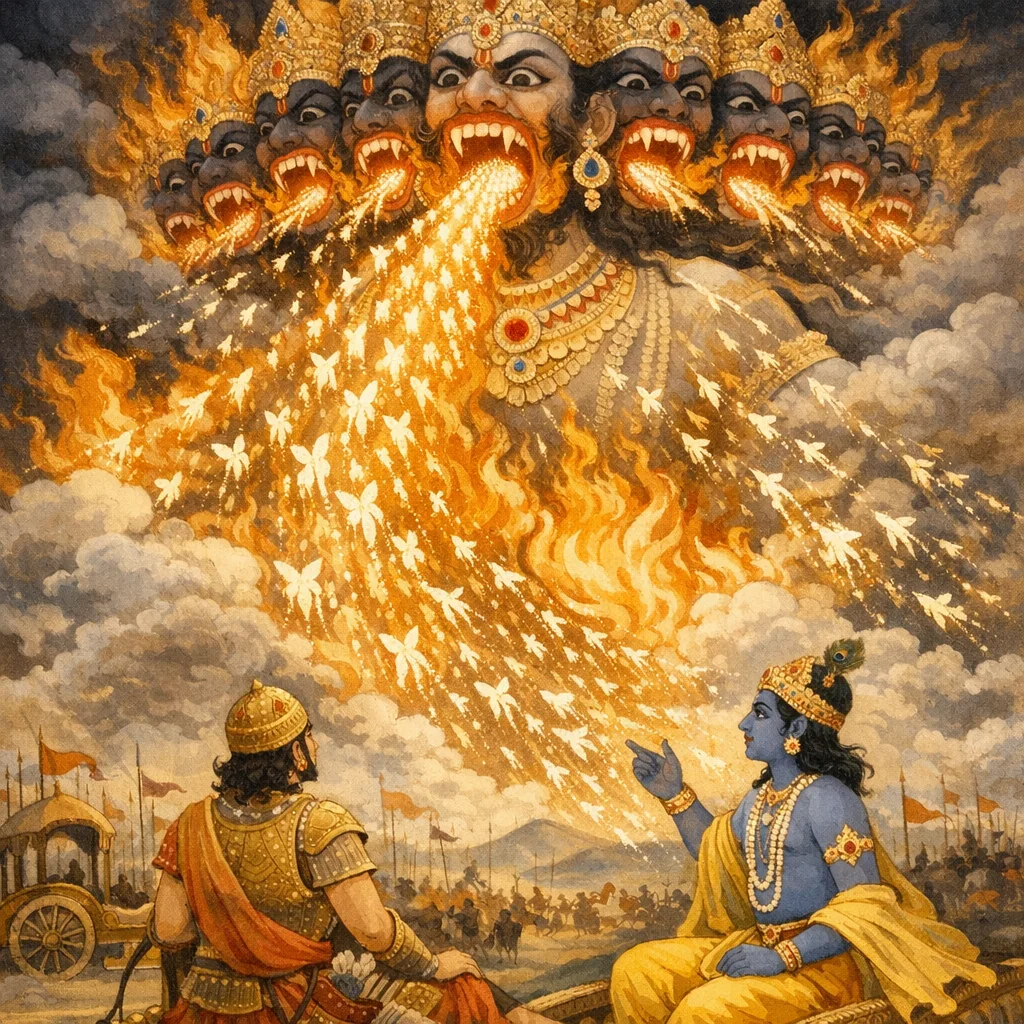
यथा प्रदीप्तं ज्वलनं पतङ्गा विशन्ति नाशाय समृद्धवेगाः । तथैव नाशाय विशन्ति लोका- स्तवापि वक्त्राणि समृद्धवेगाः ॥
yathā pradīptaṁ jvalanaṁ pataṅgā viśanti nāśāya samṛddhavegāḥ | tathaiva nāśāya viśanti lokās tavāpi vaktrāṇi samṛddhavegāḥ ||

Sebagaimana rama-rama memasuki api yang menyala-nyala dengan laju yang besar menuju kebinasaan, demikianlah juga makhluk-makhluk di dunia ini memasuki mulut-mulut-Mu dengan laju yang besar menuju kebinasaan.
जैसे पतंगे तेज वेग से प्रज्वलित अग्नि में नाश के लिए प्रवेश करते हैं, वैसे ही ये लोक भी आपके मुखों में नाश के लिए प्रवेश कर रहे हैं।
As moths enter a blazing fire for destruction, rushing with full force, so worlds too enter your mouths for dissolution, rushing with full force.
The key term nāśa can be read as 'destruction' or more philosophically as 'dissolution/cessation of a form'; many academic readings emphasize transformation within cyclic time rather than sensational literalism.
FAQs
The image conveys compulsive attraction and helpless momentum—how the mind can perceive events as rushing toward an outcome beyond personal control.
It points to dissolution as an aspect of cosmic order: forms arise and pass within time, while the underlying reality is not exhausted by any single form.
This verse continues Arjuna’s attempt to articulate the cosmic vision through vivid similes that communicate speed, inevitability, and scale.
It can encourage discernment about compulsive drives—personal or collective—and the need for reflective action rather than being swept along by momentum.