
Shloka 26
Vishwarupa Darshana Yoga — Vishwarupa Darshana Yoga
अमी च त्वां धृतराष्ट्रस्य पुत्राः सर्वे सहैवावनिपालसंघैः । भीष्मो द्रोणः सूतपुत्रस्तथासौ सहास्मदीयैरपि योधमुख्यैः ॥
amī ca tvāṃ dhṛtarāṣṭrasya putrāḥ sarve sahaivāvanipāla-saṅghaiḥ | bhīṣmo droṇaḥ sūta-putras tathāsau sahāsmadīyair api yodha-mukhyaiḥ ||

Dan putera-putera Dhṛtarāṣṭra ini semuanya, bersama rombongan para raja; Bhīṣma, Droṇa, serta Karṇa putera sais, juga para pahlawan utama dari pihak kami—(kelihatan di hadapan-Mu).
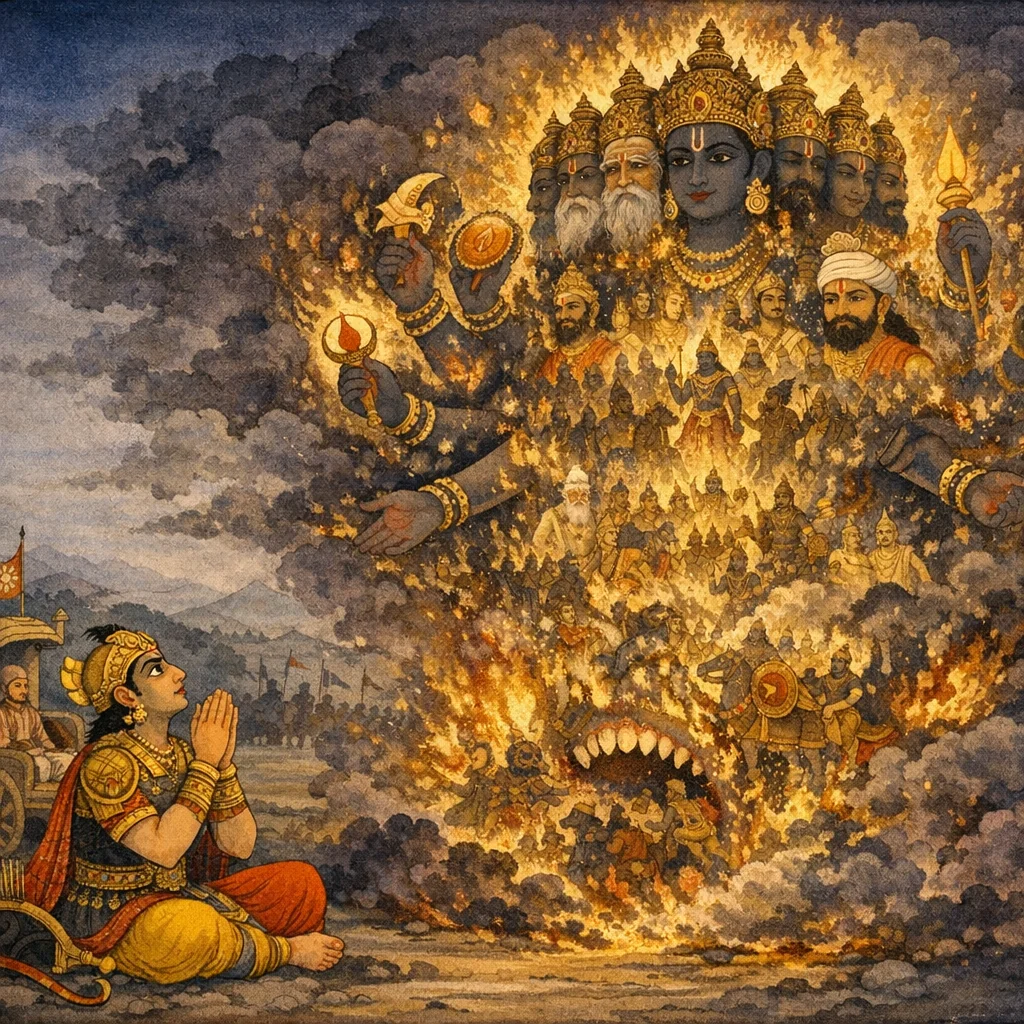
And these sons of Dhṛtarāṣṭra, together with the hosts of kings—Bhīṣma, Droṇa, and Karṇa (the charioteer’s son), along with our own leading warriors—(are seen in relation to You).
And these sons of Dhṛtarāṣṭra, all together with the companies of rulers; Bhīṣma, Droṇa, and that son of a charioteer (Karṇa), along with our own foremost fighters—(appear within/enter toward you in the vision).
This verse is syntactically connected to the following verses in which figures are described as moving toward the cosmic form; for neutral presentation, it may be tagged as ‘battlefield persons within the revelation’ rather than foregrounding physical harm.
FAQs
By seeing familiar leaders within the cosmic vision, Arjuna’s personal conflict is reframed: private anxiety is placed against a larger horizon of meaning and inevitability.
The appearance of all parties within the divine form suggests a non-dual or integrative perspective in which human divisions are encompassed by a larger order.
The verse links the revelation back to the epic setting by naming key participants, preparing for the subsequent depiction of their movement within the vision.
It can be read as an invitation to view interpersonal or social conflicts through wider lenses—systems, history, and ethics—without denying individual responsibility.