
Shloka 23
Shraddhatraya Vibhaga Yoga — Shraddhatraya Vibhaga Yoga
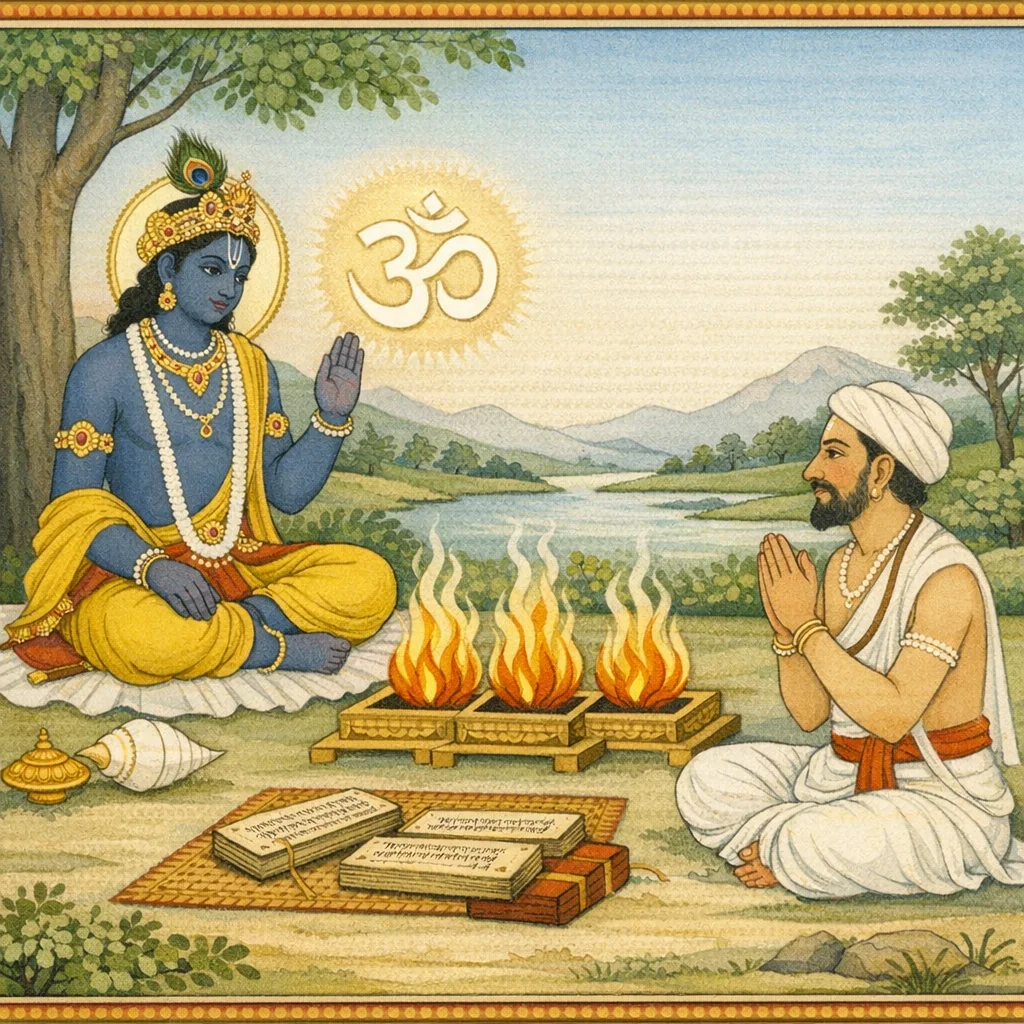
ॐतत्सदिति निर्देशो ब्रह्मणस्त्रिविधः स्मृतः । ब्राह्मणास्तेन वेदाश्च यज्ञाश्च विहिताः पुरा ॥ १७.२३ ॥
oṁ tat sad iti nirdeśo brahmaṇas tri-vidhaḥ smṛtaḥ | brāhmaṇās tena vedāś ca yajñāś ca vihitāḥ purā || 17.23 ||

‘Om, Tat, Sat’—demikianlah penunjukan tiga serangkai bagi Brahman yang diingati; dengannya pada zaman dahulu ditetapkan para Brahmana, Weda, dan yajña (korban suci).
‘Om, Tat, Sat’—this threefold designation of Brahman is remembered; by that were ordained in ancient times the Brahmins, the Vedas, and the sacrifices.
The threefold expression designating Brahman is remembered as ‘oṁ, tat, sat’; by means of it, in former times, the Brahmins, the Vedas, and the sacrificial rites were prescribed/established.
Interpretations vary on whether the verse is primarily etymological/ritual (formulae used in Vedic acts) or theological (names indicating aspects of ultimate reality). The reference to “Brahmins, Vedas, sacrifices” is often read as locating the formula historically within Vedic liturgical culture.
FAQs
Sacred formulae can function as attentional and intentional markers, framing actions within a larger value-orientation and reducing ego-centered motivation.
The triad is presented as pointing to Brahman; later Vedāntic readings often treat these terms as indicating facets like the Absolute, its transcendence (“tat”), and truth/being (“sat”).
After classifying tapas and dāna by guṇa, the chapter turns to how actions are consecrated through traditional utterances connected with the Vedic sacrificial world.
One may interpret this as using brief intentional phrases (religious or secular) to clarify purpose and align conduct with truthfulness and non-egoic aims.