
Shloka 56
Sankhya Yoga — Sankhya Yoga
दुःखेष्वनुद्विग्नमनाः सुखेषु विगतस्पृहः । वीतरागभयक्रोधः स्थितधीर्मुनिरुच्यते ॥ २.५६ ॥
duḥkheṣv anudvignamanāḥ sukheṣu vigataspṛhaḥ | vītarāgabhayakrodhaḥ sthitadhīr munir ucyate || 2.56 ||

Sesiapa yang hatinya tidak gundah dalam duka, tidak bernafsu dalam suka, serta bebas daripada rāga (keterikatan), bhaya (ketakutan) dan krodha (kemarahan)—dialah mūni yang berketeguhan budi (sthiradhī).
दुःखों में जिसका मन उद्विग्न नहीं होता, सुखों में जिसकी स्पृहा नहीं रहती, तथा जो राग, भय और क्रोध से रहित है—वह स्थिरबुद्धि मुनि कहलाता है।
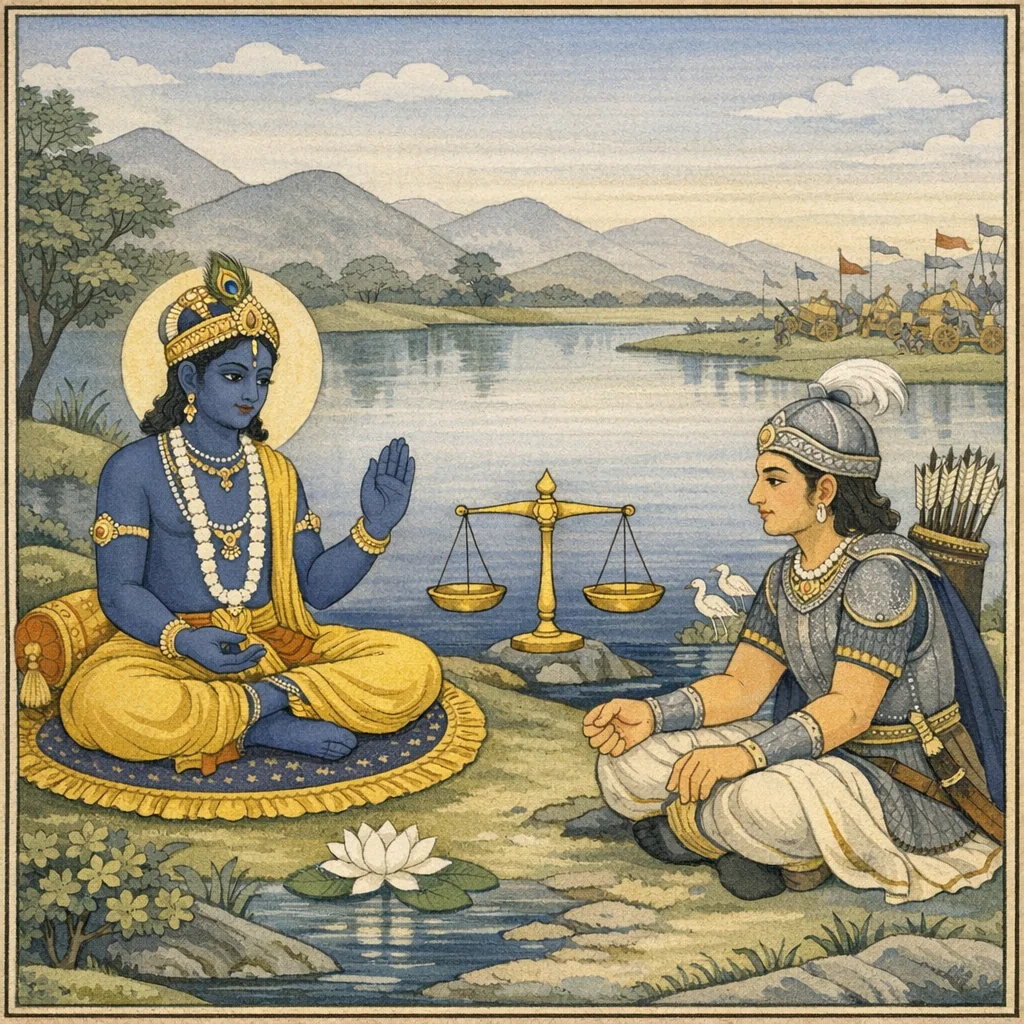
One whose mind is not agitated in suffering, who is free from longing in pleasures, and who is devoid of attachment, fear, and anger—such a sage is said to be steady-minded.
Traditional translations often emphasize ‘muni’ as a spiritually disciplined person; academic renderings keep it as ‘sage.’ The triad ‘rāga-bhaya-krodha’ is sometimes interpreted psychologically (reactivity patterns) rather than as moral condemnation.
FAQs
It describes resilience: reduced agitation under stress and reduced compulsive pursuit of pleasure, alongside diminished fear-anger reactivity.
Steady insight is presented as compatible with embodied experience of pleasure and pain, but not governed by them—implying a deeper self not identical with mental fluctuations.
Continuing the ‘sthitaprajña’ portrait, it specifies observable traits—how wisdom appears in affect and motivation.
Emotional regulation, reflective pause before reacting, and reducing dependency on external rewards align with the described stability.