
Shloka 19
Sankhya Yoga — Sankhya Yoga
य एनं वेत्ति हन्तारं यश्चैनं मन्यते हतम् । उभौ तौ न विजानीतो नायं हन्ति न हन्यते ॥ २.१९ ॥
ya enaṃ vetti hantāraṃ yaś cainaṃ manyate hatam | ubhau tau na vijānīto nāyaṃ hanti na hanyate || 2.19 ||

Sesiapa yang menyangka (Diri) ini sebagai pembunuh dan sesiapa yang menyangka ia dibunuh—kedua-duanya tidak mengetahui. Ia tidak membunuh dan tidak dibunuh.
He who thinks this (Self) a slayer and he who thinks it slain—both do not know. It neither slays nor is slain.
Whoever knows it as an agent of killing, and whoever imagines it as killed—both fail to understand: it does not kill, nor is it killed.
The verse denies agency and passivity with respect to the self (ātman), not necessarily denying empirical causation in the world. In philosophical reception, it supports non-doership of the self while leaving room for action at the level of body-mind.
FAQs
It challenges identification with actions and outcomes, encouraging a perspective where the deepest self is not reducible to events.
The self is presented as beyond causal alteration; agency belongs to embodied processes, while the self remains unchanged.
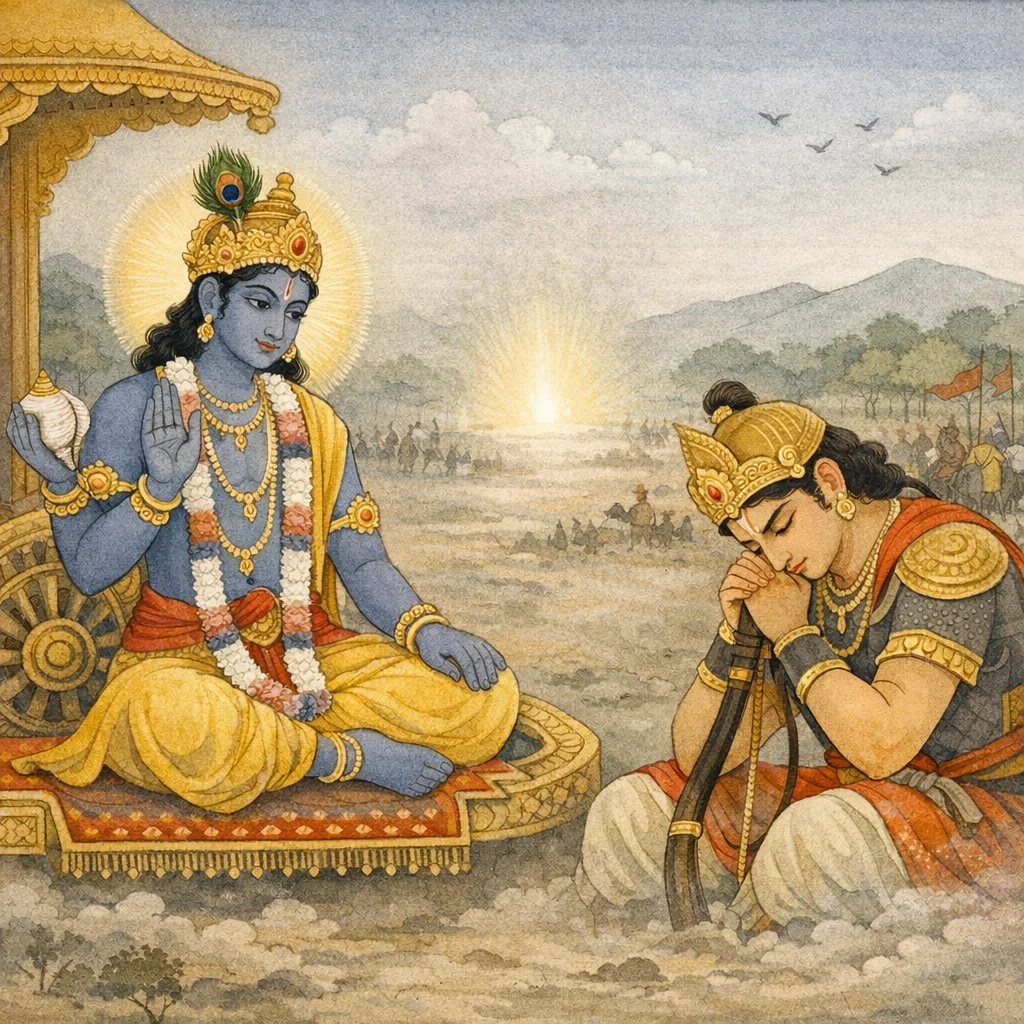
Krishna reframes Arjuna’s fear and guilt by distinguishing bodily events from the status of the self.
Can inform ethical reflection: act responsibly while avoiding a crushing, identity-level fusion with outcomes.