
Shloka 16
Sankhya Yoga — Sankhya Yoga
नासतो विद्यते भावो नाभावो विद्यते सतः । उभयोरपि दृष्टोऽन्तस्त्वनयोस्तत्त्वदर्शिभिः ॥ २.१६ ॥
nāsato vidyate bhāvo nābhāvo vidyate sataḥ | ubhayor api dṛṣṭo 'ntas tv anayos tattva-darśibhiḥ || 2.16 ||

Yang tidak nyata (asat) tiada mempunyai kewujudan; yang nyata (sat) tiada mempunyai ketiadaan. Hakikat kedua-duanya telah dilihat oleh para resi yang melihat kebenaran.
The unreal has no being; the real has no non-being. The truth of both has been seen by the seers of reality.
There is no becoming/existence of what is not; there is no non-existence of what is. The boundary/settled conclusion regarding both has been discerned by those who see the truth.
‘Sat/asat’ can be read ontologically (real/unreal) or temporally (enduring/non-enduring). ‘Bhāva’ may mean ‘existence’ or ‘becoming.’ The verse is often linked to Sāṅkhya-Vedānta debates, but its wording allows a more general epistemic claim about discerning permanence versus change.
FAQs
It encourages cognitive reframing: distinguishing stable values/identity from fleeting states can reduce anxiety tied to change.
A classical reading: the imperishable (sat) cannot be negated, while the perishable (asat, in the sense of non-enduring) lacks lasting being; sages discern this distinction.
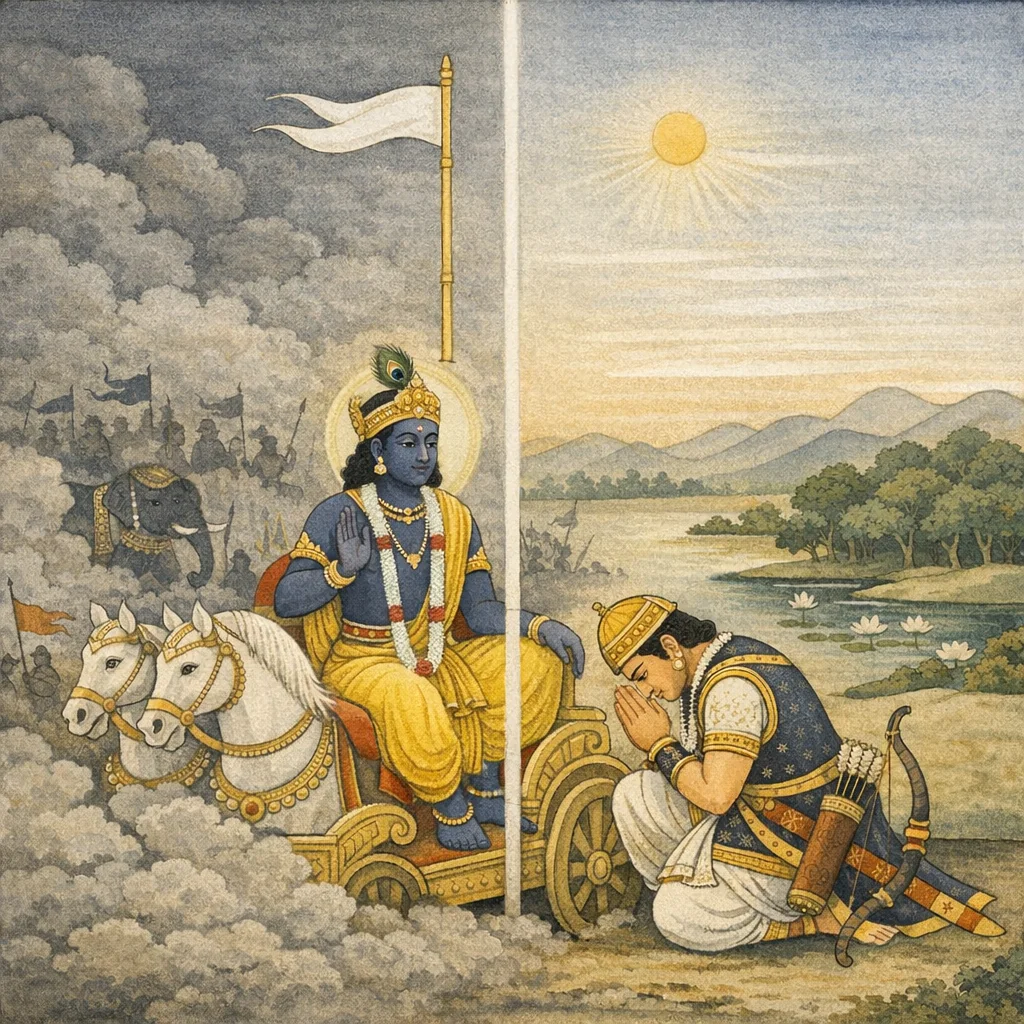
The verse supports Krishna’s argument that grief based on bodily change misunderstands what is enduring versus what is transient.
Useful as a framework for prioritizing long-term principles over short-lived impulses or external fluctuations.