
Shloka 14
Purushottama Yoga — Purushottama Yoga
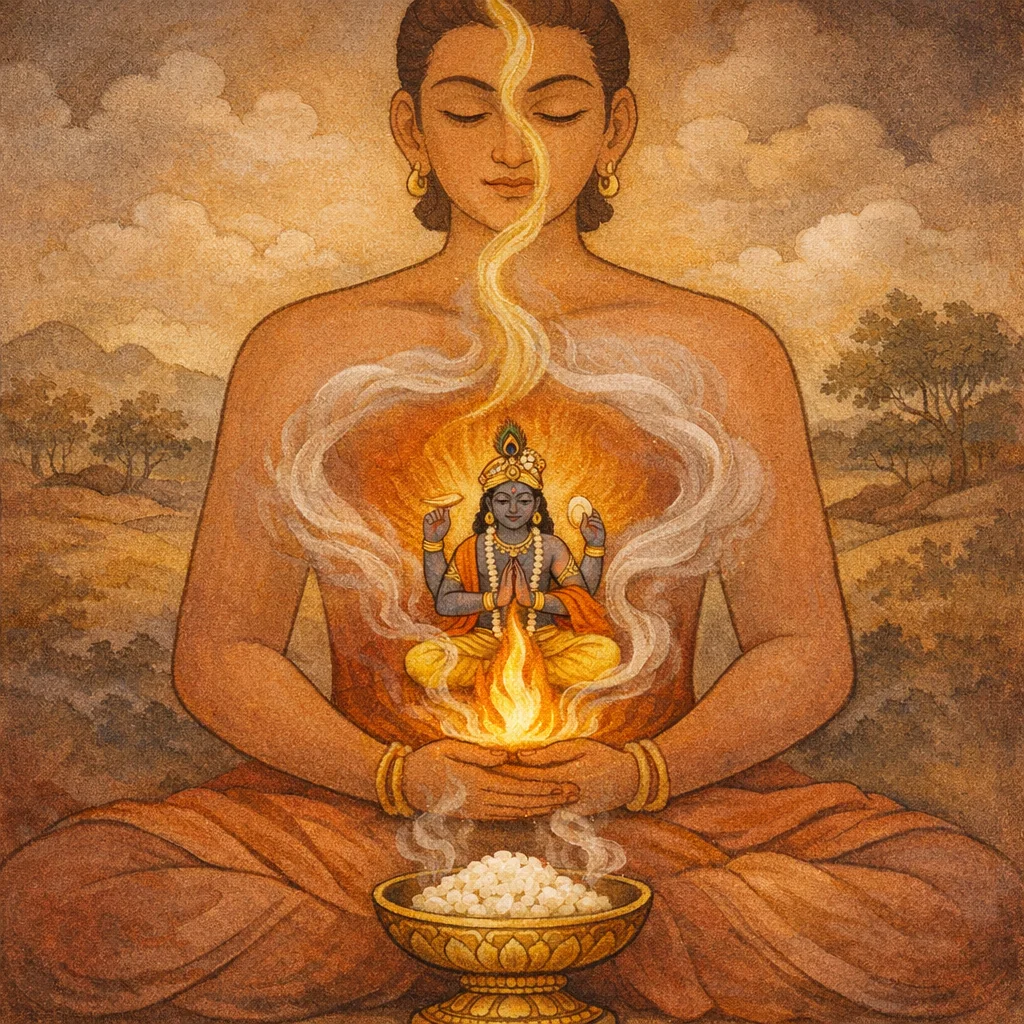
अहं वैश्वानरो भूत्वा प्राणिनां देहमाश्रितः ।
प्राणापानसमायुक्तः पचाम्यन्नं चतुर्विधम् ॥ १५.१४ ॥
ahaṃ vaiśvānaro bhūtvā prāṇināṃ deham āśritaḥ |
prāṇāpāna-samāyuktaḥ pacāmy annaṃ caturvidham || 15.14 ||

Aku menjadi api Vaiśvānara, bersemayam dalam tubuh makhluk; bersatu dengan prāṇa dan apāna, Aku mencerna makanan yang empat jenis.
मैं वैश्वानर अग्नि बनकर प्राणियों के शरीर में स्थित होकर प्राण और अपान से संयुक्त होकर चार प्रकार के अन्न को पचाता हूँ।
Becoming Vaiśvānara, abiding in the bodies of living beings, conjoined with inhalation and exhalation, I digest the fourfold food.
‘Vaiśvānara’ is often understood as the digestive/metabolic fire (jāṭharāgni) and also as a cosmic fire; ‘fourfold food’ is interpreted variously (chewed, sucked, licked, drunk; or other traditional taxonomies).
FAQs
It can be read as emphasizing embodied spirituality: mental clarity and ethical life are linked to care for basic functions like breath and nourishment.
The supreme is described as operating within embodied processes, suggesting that the divine is an inner principle enabling organic order, not only an external creator.
The verse strengthens the chapter’s immanence theme by locating the divine within everyday bodily functions familiar to all listeners.
It supports reflective practices around eating and breathing—moderation, attention, and gratitude—without requiring sectarian commitments.