
Bhagavad Gita — Gunatraya Vibhaga Yoga, Shloka 2
Gunatraya Vibhaga Yoga
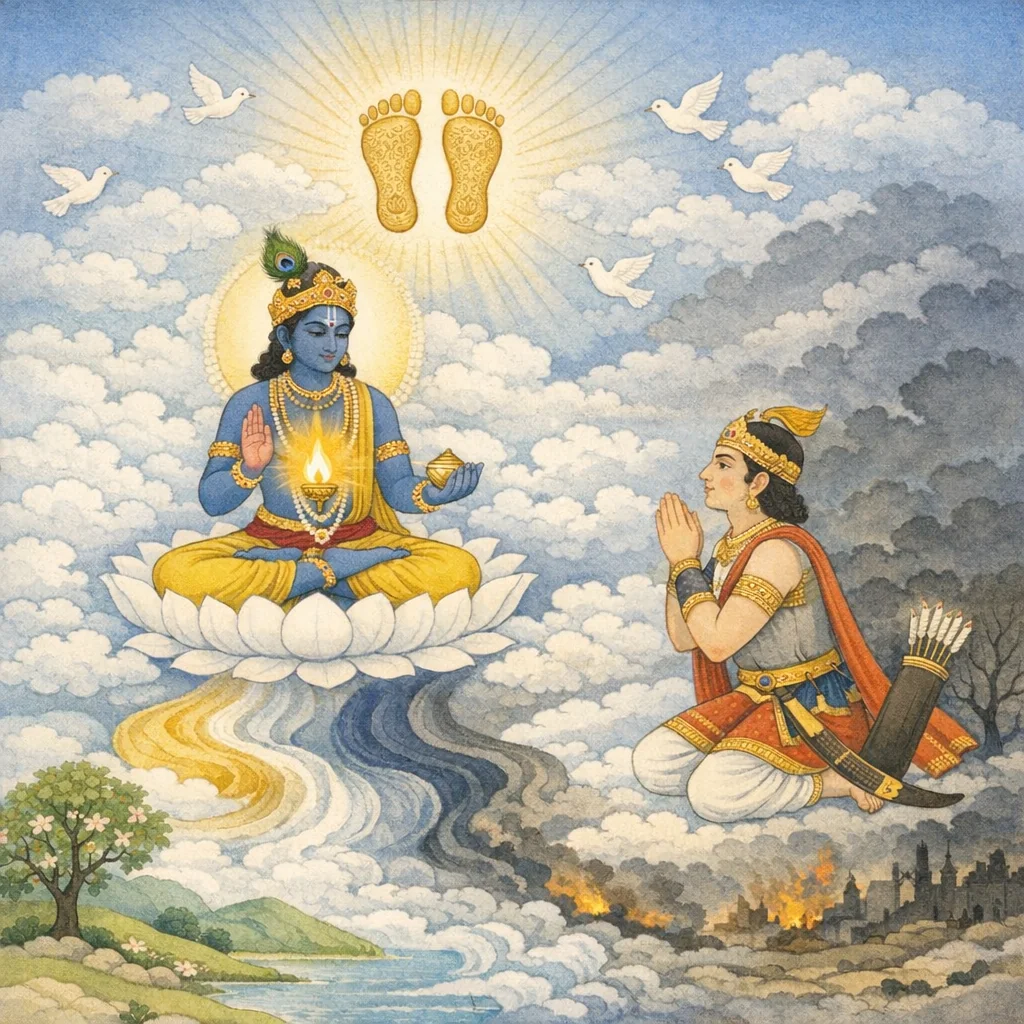
इदं ज्ञानमुपाश्रित्य मम साधर्म्यमागताः । सर्गेऽपि नोपजायन्ते प्रलये न व्यथन्ति च ॥ १४.२ ॥
idaṃ jñānam upāśritya mama sādharmyam āgatāḥ | sarge 'pi nopajāyante pralaye na vyathanti ca || 14.2 ||

Bersandar pada pengetahuan ini, mereka mencapai keserupaan dengan-Ku; bahkan pada saat penciptaan mereka tidak lahir, dan pada saat pralaya mereka tidak gentar.
Relying on this knowledge, they attain likeness to Me; they are not born even at creation, nor do they tremble at dissolution.
Taking refuge in this knowledge, they reach conformity/likeness with Me; even in (a new) creation they are not (re)born, and at dissolution they are not distressed.
‘Sādharmya’ is variously glossed as sharing divine nature, attaining similar status, or realizing identity (depending on theological commitments). ‘Not born’ is often read as freedom from rebirth, not denial of empirical continuity.
FAQs
It portrays mature insight as reducing fear of major change and loss; one becomes less shaken by life transitions when identity is grounded in what is not transient.
The verse links liberating knowledge with release from rebirth and with equanimity regarding cosmic dissolution, implying a standpoint beyond cyclical time.
Early in Chapter 14, it states the promise of the teaching on guṇas: understanding their operation enables one to transcend their binding effects.
It can be read as cultivating a values-based identity and contemplative stability so that one responds to upheaval with less panic and more clarity.