
Shloka 1
Purushottama Yoga — Purushottama Yoga
श्रीभगवानुवाच ।
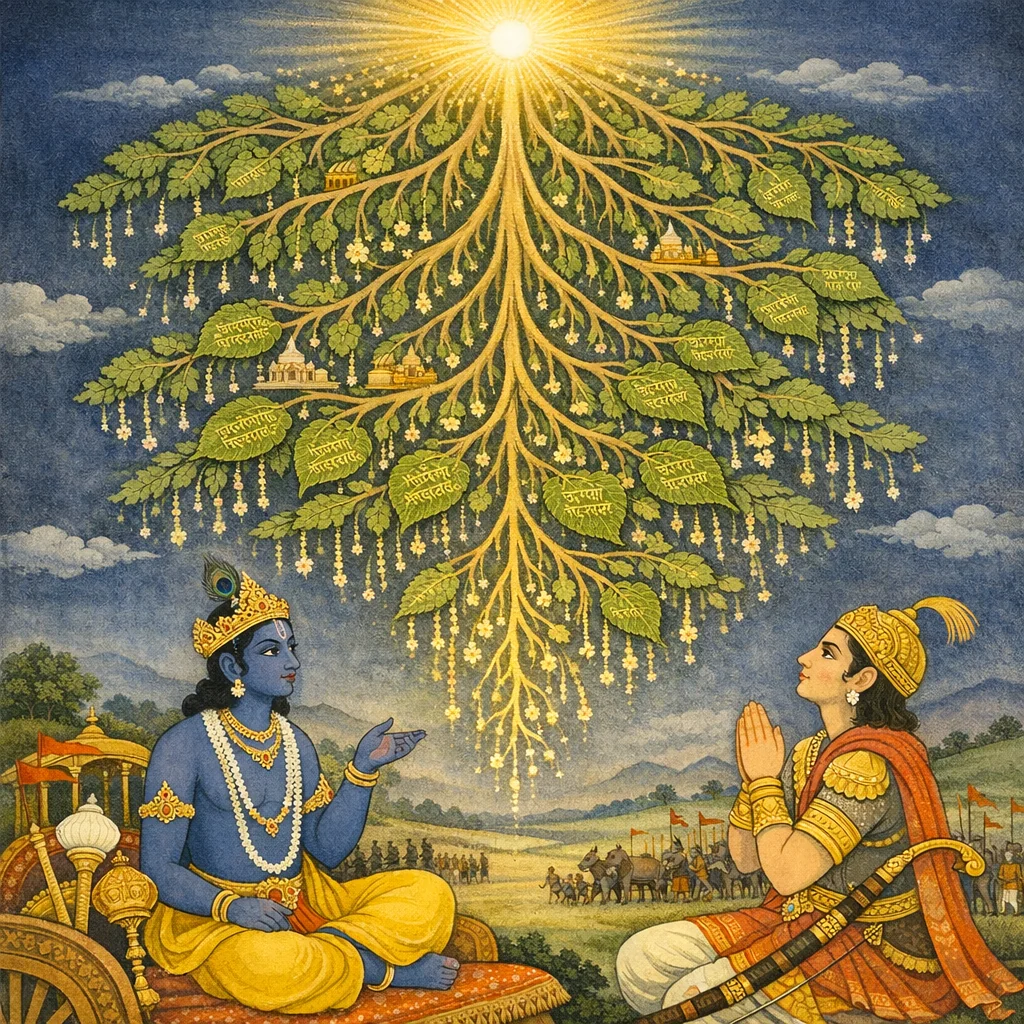
ऊर्ध्वमूलमधःशाखमश्वत्थं प्राहुरव्ययम् ।
छन्दांसि यस्य पर्णानि यस्तं वेद स वेदवित् ॥ १५.१ ॥
śrī-bhagavān uvāca |
ūrdhva-mūlam adhaḥ-śākham aśvatthaṃ prāhur avyayam |
chandāṃsi yasya parṇāni yas taṃ veda sa veda-vit || 15.1 ||

श्रीभगवान म्हणाले: मूळ वर आणि शाखा खाली असलेला, अव्यय असा अश्वत्थ-वृक्ष आहे असे सांगितले जाते. वेदमंत्र हेच त्याची पाने आहेत. जो त्या (वृक्ष) तत्त्वाला जाणतो, तो वेदांचा खरा जाणकार होय.
The Blessed Lord said: They speak of an imperishable aśvattha tree with its root above and branches below; its leaves are the Vedic hymns. One who knows that (tree) is a knower of the Vedas.
The Lord said: They describe an undecaying aśvattha (fig) tree whose root is above and whose branches extend downward; the Vedic metres/hymns are its leaves. Whoever knows it, knows the Veda.
Most recensions agree closely on the imagery: aśvattha with an upper root and lower branches, and chandāṃsi as leaves. Interpretive differences center on (a) whether 'chandāṃsi' is taken primarily as metrical forms or as Vedic hymns more generally, and (b) whether 'avyaya' is read as describing the tree’s seeming perpetuity in saṃsāra or as a rhetorical marker for its deep entrenchment rather than absolute eternality. Minor orthographic variants (e.g., spacing/sandhi) occur across printings.
FAQs
The 'inverted tree' can be read as a model of how attention and desire flow outward into multiplicity (branches below), while the sustaining source is subtler and 'above' ordinary awareness. Knowing the structure symbolizes developing insight into how experience is conditioned, which supports detachment and clearer self-understanding.
The aśvattha functions as an emblem of conditioned existence: a vast, branching field of phenomena dependent on an underlying source. The 'root above' suggests a higher ontological ground (often aligned with the unmanifest or the supreme principle), while the downward branches indicate manifested worlds and experiences. Calling the Vedic hymns/metres its leaves links sacred revelation and ritual language to the maintenance and intelligibility of this order.
This verse opens Chapter 15, which develops a framework for distinguishing the perishable field of experience from the imperishable principle and ultimately the 'supreme person' (puruṣottama). The tree image introduces the chapter’s method: mapping lived reality as a structured, knowable system that can be transcended through discernment.
As a reflective tool, the image encourages examining one’s 'branches'—habits, commitments, and identities—and tracing them back to their sustaining assumptions and motivations. In practice this can support ethical clarity, reduced reactivity, and a more deliberate relationship to tradition, learning, and meaning-making.