
Bhagavad Gita — Karma Sannyasa Yoga, Shloka 14
Karma Sannyasa Yoga
नादत्ते कस्यचित्पापं न चैव सुकृतं विभुः । अज्ञानेनावृतं ज्ञानं तेन मुह्यन्ति जन्तवः ॥ ५.१५ ॥
nādattē kasyacit pāpaṃ na caiva sukṛtaṃ vibhuḥ | ajñānenāvṛtaṃ jñānaṃ tena muhyanti jantavaḥ || 5.15 ||

विभू कोणाचेही पाप स्वीकारत नाही, तसेच पुण्यही नाही. ज्ञान अज्ञानाने आच्छादित झालेले आहे; म्हणूनच प्राणी मोहात पडतात.
विभु न किसी का पाप ग्रहण करता है और न पुण्य ही; ज्ञान अज्ञान से ढका हुआ है, इसलिए प्राणी मोहित होते हैं।
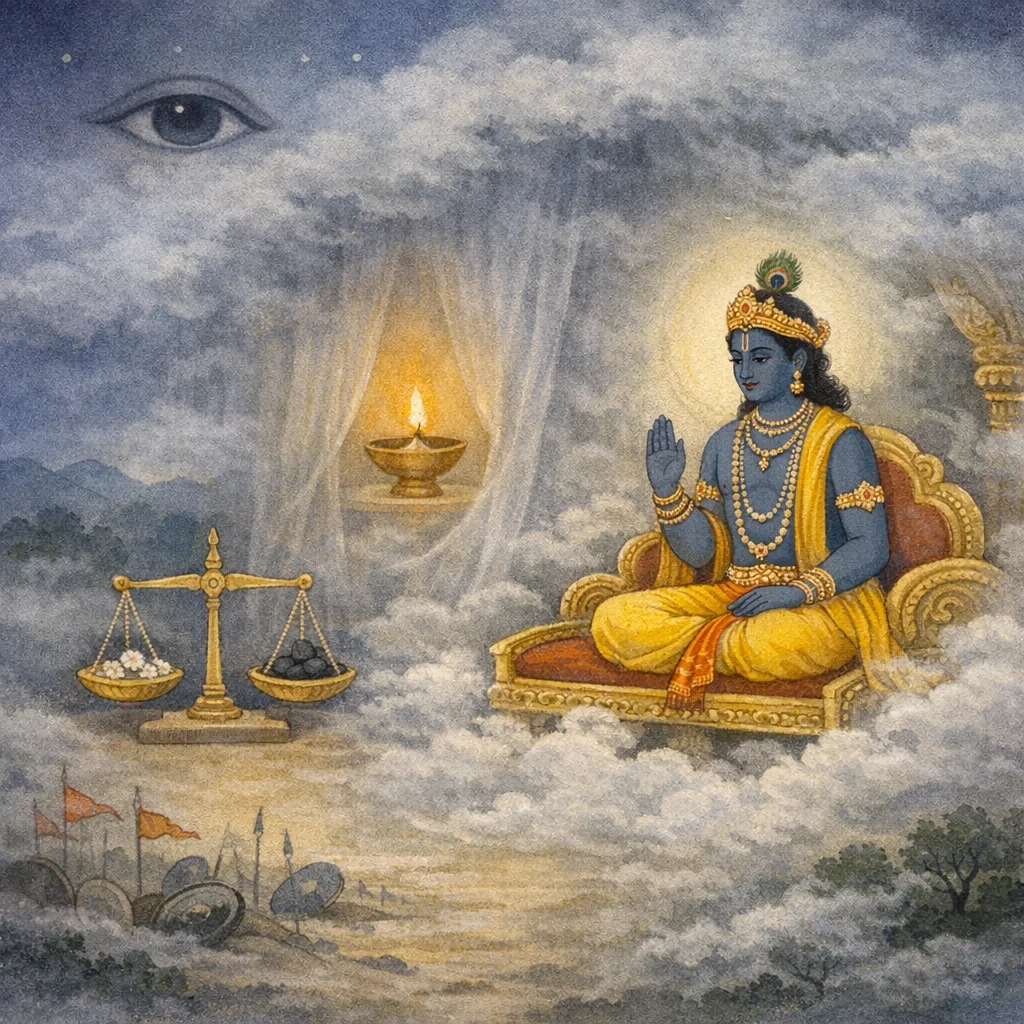
The all-pervading one takes neither anyone’s wrongdoing nor merit; knowledge is covered by ignorance—therefore beings are deluded.
The verse is frequently used to argue against divine partiality: moral qualities are not transferred to God. “Knowledge covered by ignorance” is a general anthropological claim about cognitive obscuration, interpreted variously as māyā/avidyā (Vedānta) or misidentification with prakṛti (Sāṃkhya-yoga).
FAQs
The verse explains harmful behavior and suffering primarily through distorted understanding rather than through an externally imposed fate, highlighting the role of clarity, education, and self-inquiry.
It asserts that the ultimate reality (or Lord) is not a receptacle for individual moral qualities; delusion arises because cognition is obscured by ignorance.
It supports the chapter’s emphasis on knowledge and inner renunciation: liberation is linked to removing ignorance rather than negotiating with a deity for altered outcomes.
When evaluating actions, focus on correcting misunderstandings and biases (in oneself and institutions) rather than assuming moral failure is fixed or divinely assigned.