
Bhagavad Gita — Karma Sannyasa Yoga, Shloka 1
Karma Sannyasa Yoga
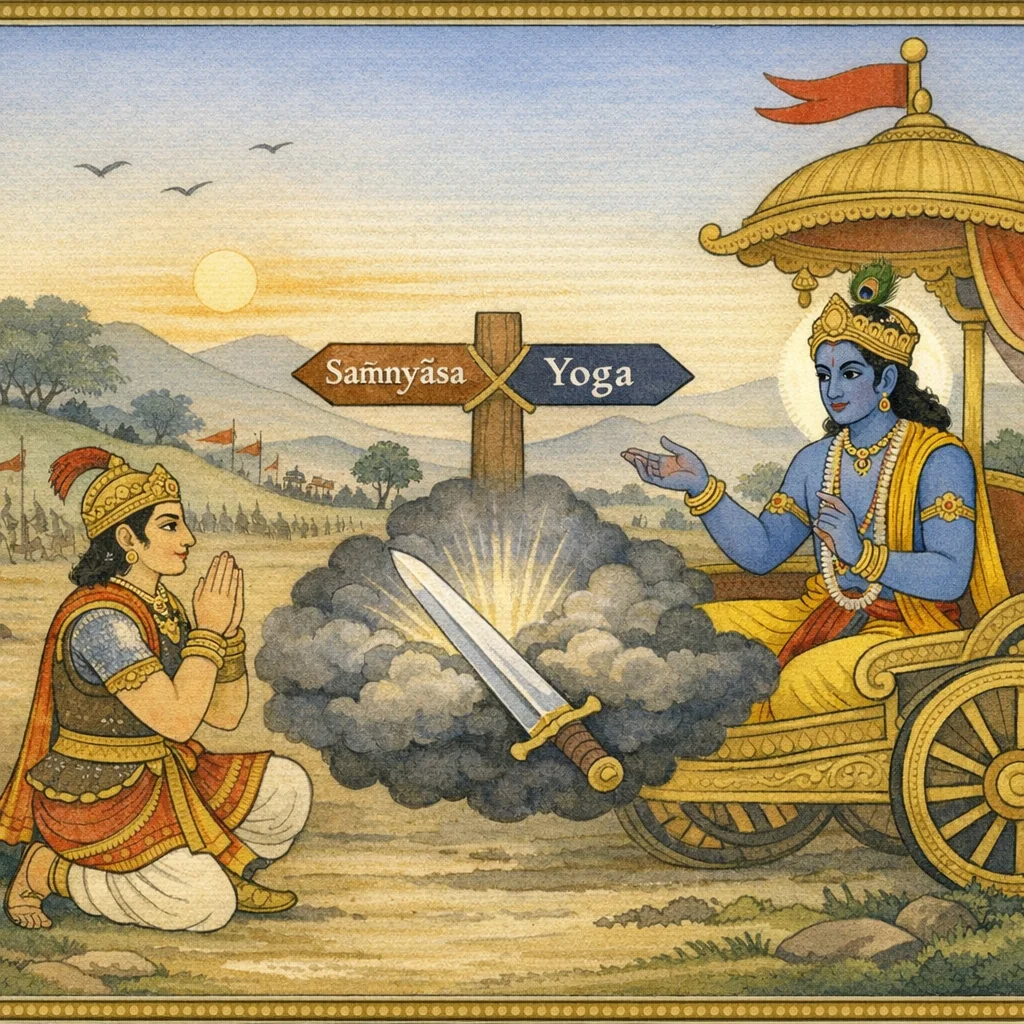
अर्जुन उवाच । संन्यासं कर्मणां कृष्ण पुनर्योगं च शंससि यच्छ्रेय एतयोरेकं तन्मे ब्रूहि सुनिश्चितम् ॥ ५.१ ॥
arjuna uvāca | saṁnyāsaṁ karmaṇāṁ kṛṣṇa punar yogaṁ ca śaṁsasi | yac chreya etayor ekaṁ tan me brūhi suniścitam || 5.1 ||

अर्जुन म्हणाला: हे कृष्णा, तू कर्मांचा संन्यासही आणि पुन्हा योगही प्रशंसित करतोस; या दोघांपैकी एक कोणता श्रेष्ठ आहे ते मला निश्चितपणे सांग.
Arjuna said: O Krishna, you praise renunciation of actions and also yoga; tell me decisively which one of the two is better.
Arjuna said: You commend renunciation of actions, Krishna, and again you commend yoga. Tell me with certainty which one of these two is the better.
This verse frames a classical interpretive tension in the Gītā: whether liberation is best pursued through formal renunciation (saṁnyāsa) or through disciplined action (karma-yoga).
FAQs
Arjuna articulates a common dilemma: conflicting recommendations can create uncertainty. The verse models a constructive response—asking for a clear, actionable synthesis.
The question concerns means (sādhana) rather than the ultimate reality itself: whether withdrawal from action or purified action more directly conduces to liberation.
Chapter 5 begins as a clarification section, responding to the prior chapter’s integration of knowledge and action and addressing Arjuna’s lingering confusion.
It encourages informed decision-making when facing competing life philosophies: request criteria, understand tradeoffs, and seek a coherent plan rather than oscillating.