
Bhagavad Gita — Gunatraya Vibhaga Yoga, Shloka 26
Gunatraya Vibhaga Yoga
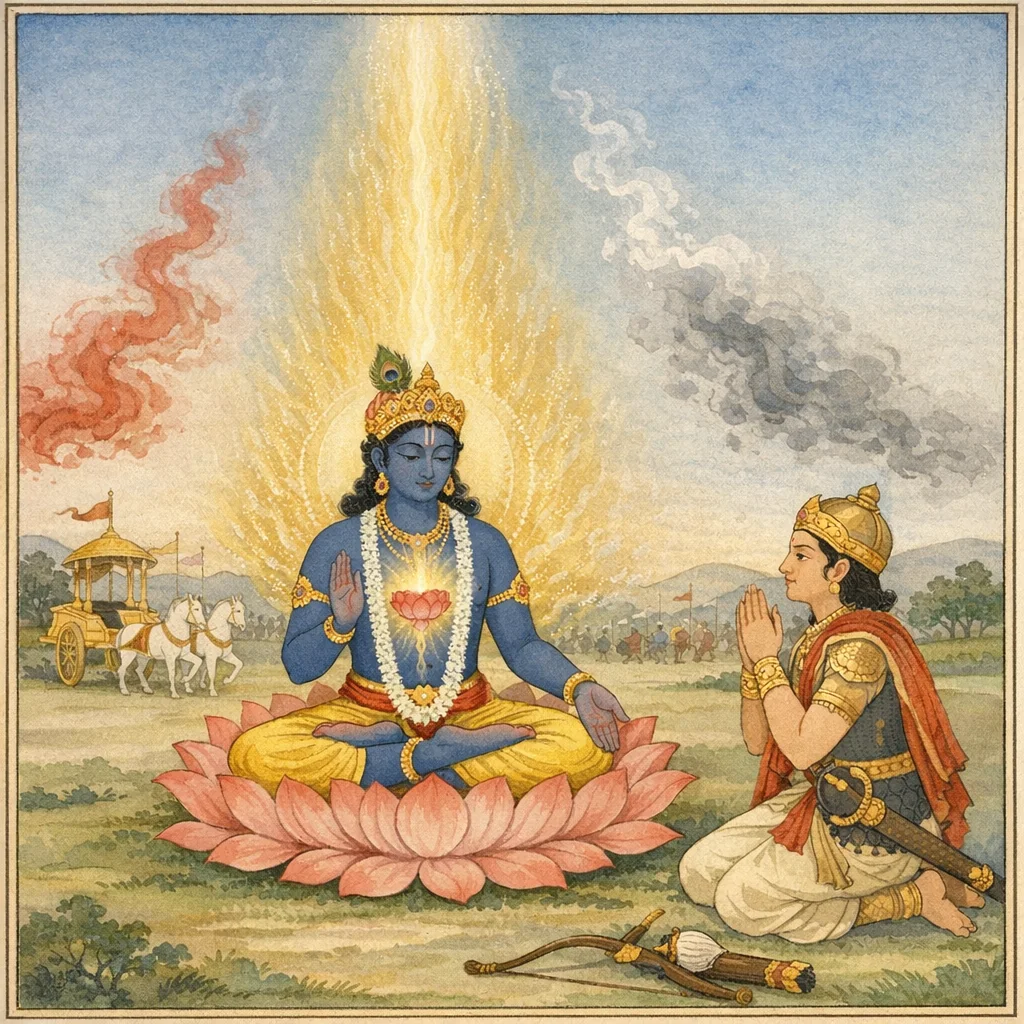
मां च योऽव्यभिचारेण भक्तियोगेन सेवते । स गुणान्समतीत्यैतान्ब्रह्मभूयाय कल्पते ॥ १४.२६ ॥
māṃ ca yo ’vyabhicāreṇa bhakti-yogena sevate | sa guṇān samatītyaitān brahma-bhūyāya kalpate || 14.26 ||

आणि जो अव्यभिचारी भक्तियोगाने माझी सेवा करतो—तो या गुणांना सम्यक् अतिक्रमून ब्रह्मभूयासाठी योग्य ठरतो.
And he who serves Me with unwavering devotion through bhakti-yoga—he, having transcended these guṇas, becomes fit for Brahman (brahma-bhūya).
And whoever attends upon me with undeviating devotion (bhakti-yoga), he transcends these guṇas and is suited for becoming Brahman (brahma-bhūya).
Traditional theistic readings foreground devotion to Krishna as the direct means to transcendence. Academic readings note the chapter’s synthesis: Sāṃkhya-like guṇa theory is integrated with bhakti as a soteriological method; “brahma-bhūya” can be read as realization/participation in Brahman or entry into a Brahman-like state.
FAQs
“Undeviating devotion” can be read as sustained orientation of attention and values toward an ultimate ideal, stabilizing the mind and reducing oscillation among competing impulses.
The verse links bhakti to transcendence of prakṛti’s guṇas and to “brahma-bhūya,” suggesting a culminating shift in identity from conditioned modes to participation in the unconditioned (Brahman), framed theistically through Krishna.
After listing signs of the guṇātīta (14.22–25), Krishna states a practical path: devotion to him functions as the efficacious means for surpassing the guṇas and attaining the Brahman-state.
It can be applied as committed practice—devotional, contemplative, or ethical—maintained consistently over time. The emphasis is on steadiness (avyabhicāra) rather than intermittent inspiration.