
Bhagavad Gita — Raja Vidya Raja Guhya Yoga, Shloka 15
Raja Vidya Raja Guhya Yoga
ज्ञानयज्ञेन चाप्यन्ये यजन्तो मामुपासते । एकत्वेन पृथक्त्वेन बहुधा विश्वतोमुखम् ॥ ९.१५ ॥
jñāna-yajñena cāpy anye yajanto mām upāsate | ekatvena pṛthaktvena bahudhā viśvato-mukham || 9.15 ||

മറ്റുചിലർ ജ്ഞാനയജ്ഞത്തിലൂടെ എന്നെ യജിച്ച് ഉപാസിക്കുന്നു; അവർ എന്നെ ഏകത്വമായി, വേറിട്ടതായി, പലവിധമായി—സകലദിക്കുകളിലേക്കും മുഖമുള്ളവനായി—ആരാധിക്കുന്നു.
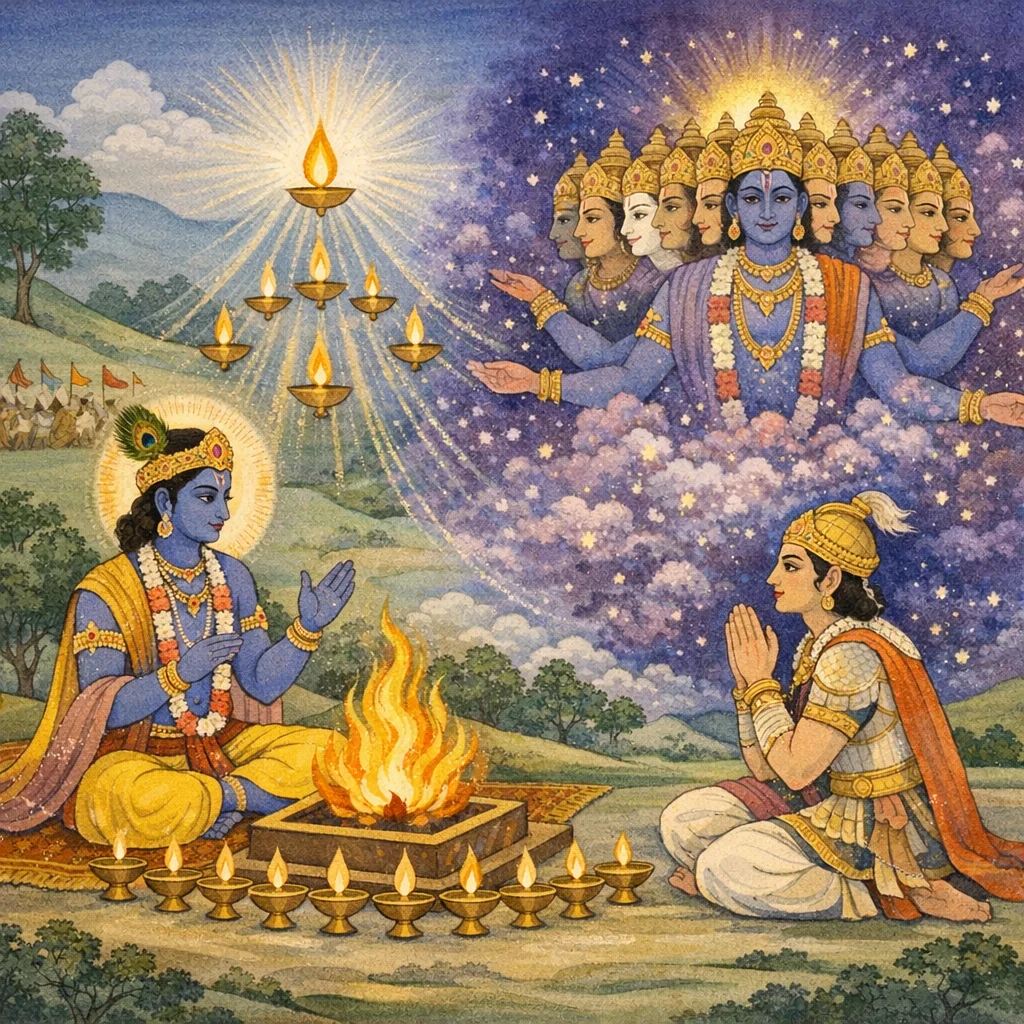
Others, worshipping Me through the sacrifice of knowledge, adore Me as one, as distinct, and as manifold, facing all directions.
Others, offering the ‘knowledge-sacrifice,’ worship Me—(some) in oneness, (some) in separateness, (some) in many ways—(Me) whose face is toward all (i.e., the all-facing).
The verse accommodates multiple theological-philosophical standpoints: nondual (ekatva), dualist/separative (pṛthaktva), and plural or many-formed devotion (bahudhā). “viśvato-mukham” is interpreted as omniform/omnipresent rather than a literal physical image.
FAQs
It recognizes diverse cognitive styles: some relate through unity, others through distinction, and others through multiple symbolic forms—each can stabilize meaning-making.
Krishna is portrayed as compatible with both monistic and theistic frameworks, suggesting a layered ontology (one reality, many relations/forms).
Chapter 9 broadens devotion beyond ritual, presenting knowledge-oriented contemplation as a sacrificial offering.
The verse can support inter-philosophical dialogue: differing metaphysical models may be treated as complementary lenses rather than purely rival claims.