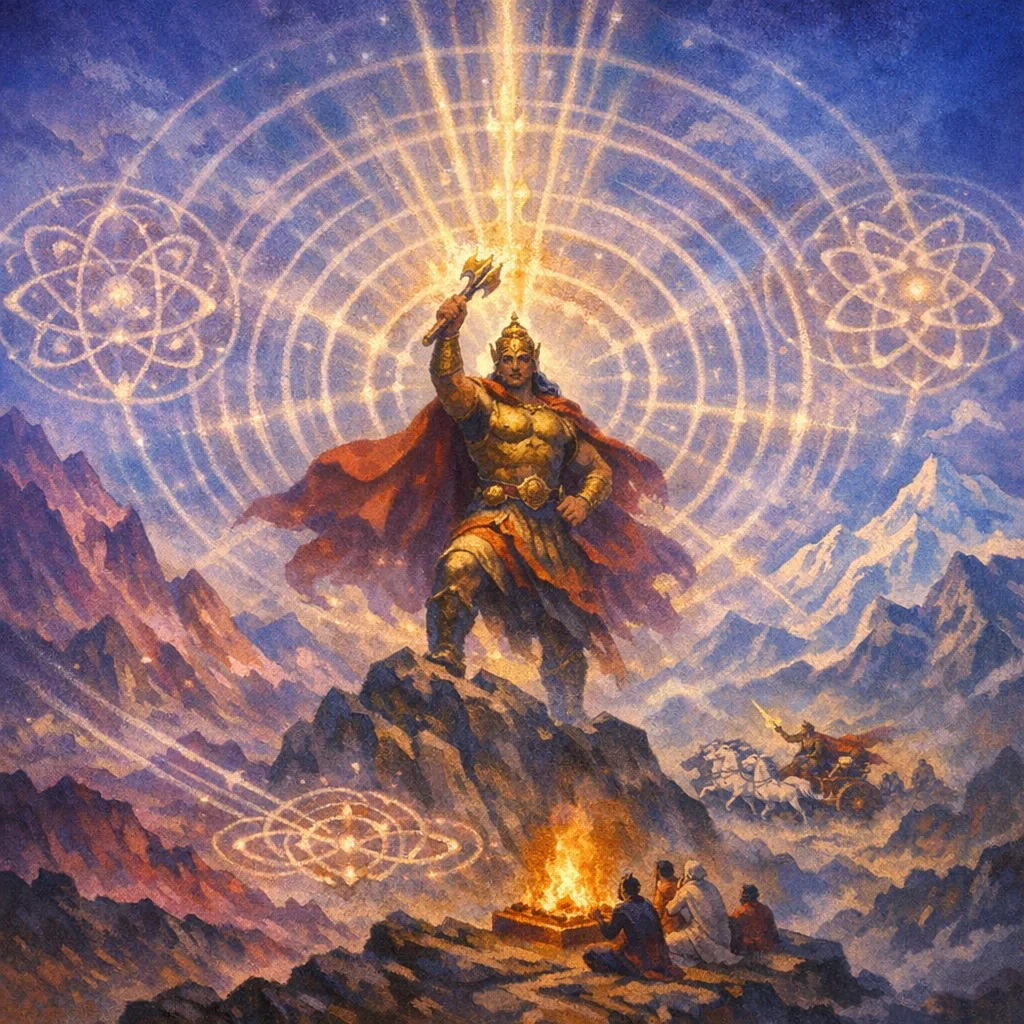
Dashati 10
Aindra praise: Indra as unstoppable helper, victor, and giver of wealth/protection to the sacrificer
Indra
Vīra–stuti (heroic energizing praise) with a closing tone of intimate reliance and protection
Rṣi not provided in the input. The verses reflect common RV-style Indra and Varuṇa diction; firm attribution requires the underlying Saṃhitā/Anukramaṇī mapping.
Soma-stotra setting implied by Arcika 1 Aindra selection; used to strengthen Indra-invocation for soma acceptance and gift-bestowal
Mantras
Mantra 1
इत ऊती वो अजरं प्रहेतारमप्रहितम् आशुं जेतारं हेतारं रथीतममतूर्तं तुग्रियावृधम्
Hence (comes) to you the aid—unaging, the impeller, unrepelled; swift, the conqueror, the mover, car-borne, unsubdued, the increaser of Tugriya.
Mantra 2
मो षु त्वा वाघतश्च नारे अस्मन्नि रीरमन् आरात्ताद्वा सधमादं न आ गहीह वा सन्नुप श्रुधि
Do not, O hero, drive away from us the singer; nor (remain) afar: come to our common banquet; come hither indeed, and, being present, listen near.
Mantra 3
सुनोत सोमपाव्ने सोममिन्द्राय वज्रिणे पचता पक्तीरवसे कृणुध्वमित्पृणन्नित्पृणते मयः
Press out the Soma for the Soma-drinker, the Soma for Indra the thunderbolt-bearer; cook the viands for (his) succour; do ye (these rites): verily, in satisfying (him), delight is bestowed upon the satisfier.
Mantra 4
यः सत्राहा विचर्षणिरिन्द्रं तं हूमहे वयम् सहस्रमन्यो तुविनृम्ण सत्पते भवा समत्सु नो वृधे
We invoke that Indra, the perpetual slayer (of foes), the all-discerning; thou of thousandfold energies, of vast manly might, lord of the righteous, be thou in our conflicts for our increase.
Mantra 5
शचीभिर्नः शचीवसू दिवानक्तं दिशस्यतम् मा वां रातिरुप दसत्कदा च नास्मद्रातिः कदा च न
O ye powerful and opulent (in Śacī), be gracious unto us by day and by night; let not your bounty ever fall short, nor at any time let our portion (of your gift) be wanting.
Mantra 6
यदा कदा च मीढुषे स्तोता जरेत मर्त्यः आदिद्वन्देत वरुणं विपा गिरा धर्त्तारं विव्रतानाम्
Whensoever, at any time, a mortal worshipper would praise the bountiful (deity), then let the wise man with his hymn adore Varuṇa, the sustainer of manifold ordinances.
Mantra 7
पाहि गा अन्धसो मद इन्द्राय मेध्यातिथे यः सम्मिश्लो हर्योर्यो हिरण्यय इन्द्रो वज्री हिरण्ययः
Drink, O exhilaration, of the Soma-juice for Indra, O guest meet for sacrifice; (he) who is attended by the tawny steeds, the golden Indra, the thunderbolt-bearer, is golden (in splendour).
Mantra 8
उभयं शृणवच्च न इन्द्रो अर्वागिदं वचः सत्राच्या मघवान्त्सोमपीतये धिया शविष्ठ आ गमत्
May Indra hear us in both (respects), and may the bountiful one come hither to this our hymn; may the most mighty, by our devout intention, come for the drinking of the Soma.
Mantra 9
महे च न त्वाद्रिवः परा शुल्काय दीयसे न सहस्राय नायुताये वज्रिवो न शताय शतामघ
Not for a hire, O stone-wielder, do we seek thee for our greatness; not for a thousand, nor for ten thousand, O thunderbolt-bearer, O bestower of hundredfold gifts (do we invoke thee as a mercenary).
Mantra 10
वस्यां इन्द्रासि मे पितुरुत भ्रातुरभुञ्जतः माता च मे छदयथः समा वसो वसुत्वनाय राधसे
Thou, Indra, art a more excellent benefactor to me than my father, or my brother who would share (my goods); and thou, O opulent one, coverest me as a mother, for the attainment of wealth and bounty.
Frequently Asked Questions
It praises Indra as the swift, unaging, unconquered power who drives the sacrifice forward and gives victory, protection, and wealth to the worshipper.
Varuṇa appears as the sustainer of many ordinances (vivratāni), reminding that effective praise and reward rest on ṛta—cosmic and ritual order—alongside Indra’s might.
They are sung as a stotra to invigorate the Indra-invocation in the soma context, using melodic expansion (often via stobhas) to highlight epithets and petitions for aid and prosperity.