
Bhagavad Gita — Moksha Sannyasa Yoga, Shloka 25
Moksha Sannyasa Yoga
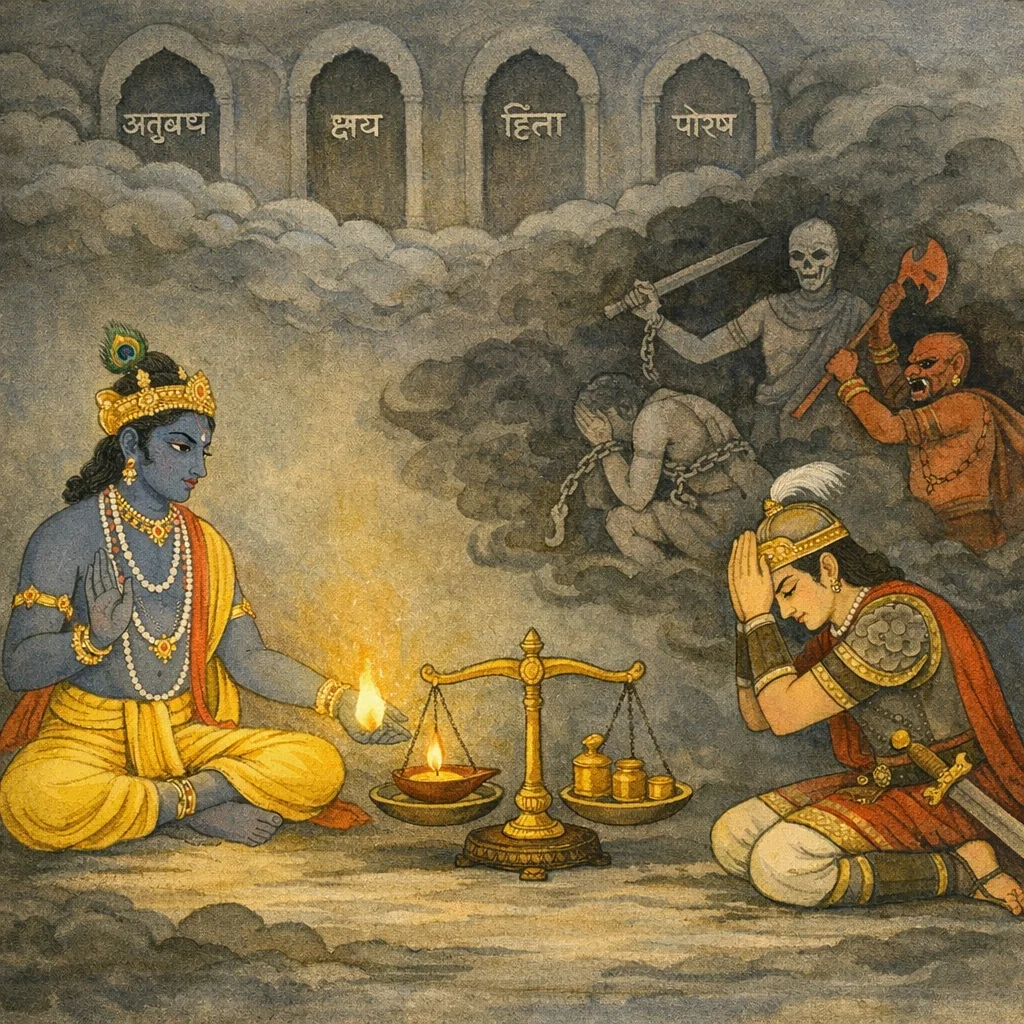
अनुबन्धं क्षयं हिंसामनवेक्ष्य च पौरुषम् । मोहादारभ्यते कर्म यत्तत्तामसमुच्यते ॥ १८.२५ ॥
anubandhaṁ kṣayaṁ hiṁsām anavekṣya ca pauruṣam | mohād ārabhyate karma yat tat tāmasam ucyate || 18.25 ||

That action which is begun in delusion, without regard to consequences, loss, injury, and one’s own capacity—such is said to be tamasic.
जो कर्म परिणाम (अनुबन्ध), हानि (क्षय), दूसरों को कष्ट (हिंसा) और अपनी क्षमता (पौरुष) को न देखकर मोह से आरम्भ किया जाता है—वह तामस कहा जाता है।
That action which is undertaken out of delusion, without considering consequences, loss, harm, and one’s capacity—this is called tamasic.
Traditional translations frequently soften ‘hiṁsā’ as ‘injury’ or ‘causing suffering’, and interpret the verse as warning against reckless or confused undertakings. Academic translations similarly render it as ‘harm’ in a broad ethical sense, not necessarily physical violence.
FAQs
Tamasic action is characterized by impaired foresight: acting under confusion without assessing downstream effects, costs, potential harm to others, or personal limits.
It exemplifies tamas as obscuration that clouds discernment (viveka), leading to action that increases bondage through ignorance and avoidable suffering.
Completing the triad on action, it identifies the lowest-quality action as that lacking reflective awareness and proportionality.
It supports ethical planning: consider consequences, risks, and capacity before acting—especially in high-impact decisions—so that initiative is not driven by confusion or impulse.