
Bhagavad Gita — Moksha Sannyasa Yoga, Shloka 18
Moksha Sannyasa Yoga
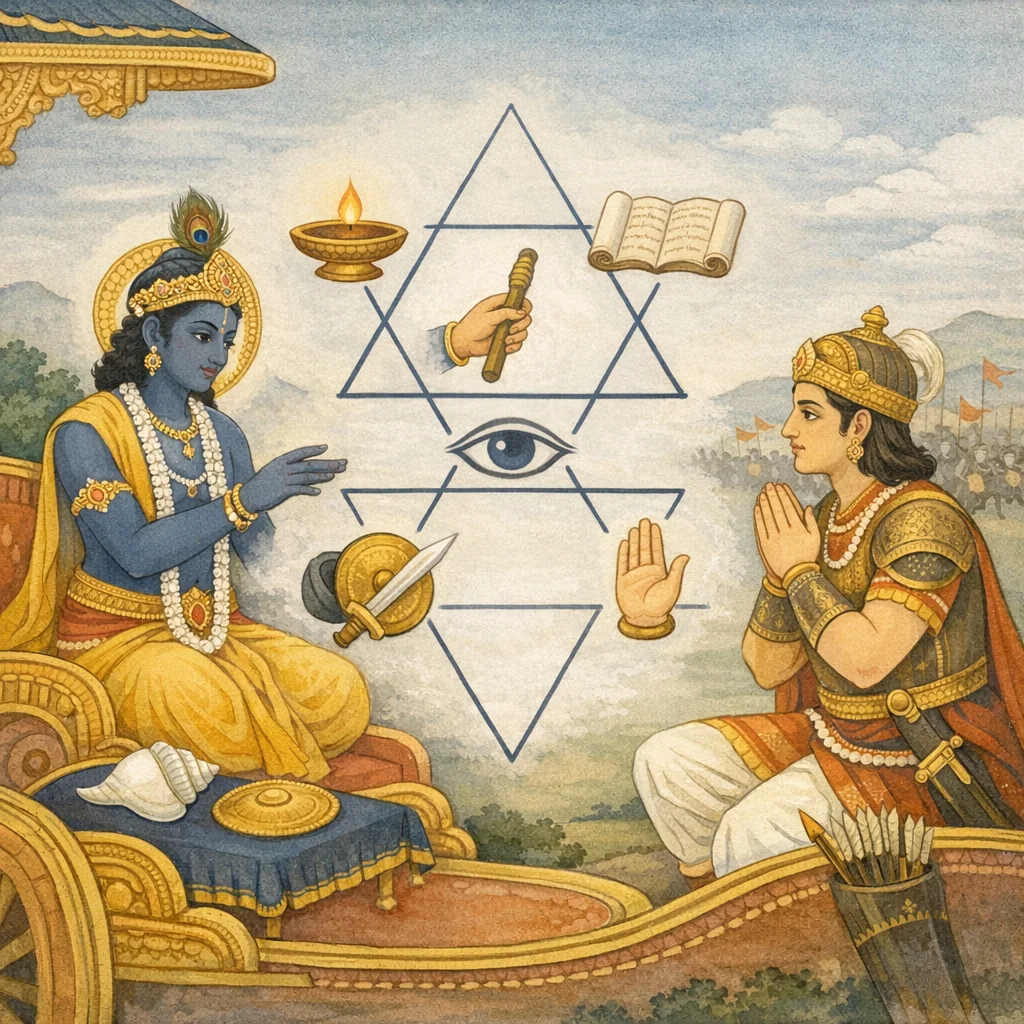
ज्ञानं ज्ञेयं परिज्ञाता त्रिविधा कर्मचोदना । करणं कर्म कर्तेति त्रिविधः कर्मसंग्रहः ॥ १८.१८ ॥
jñānaṁ jñeyaṁ parijñātā trividhā karmacodanā | karaṇaṁ karma karte ti trividhah karmasaṅgrahaḥ || 18.18 ||

Knowledge, the knowable, and the knower—these three are the impulse to action; instrument, action, and doer—these three constitute the aggregate of action.
ज्ञान, ज्ञेय (जानने योग्य वस्तु) और ज्ञाता—ये तीन प्रकार की कर्म-प्रेरणा हैं; तथा करण, कर्म और कर्ता—ये तीन प्रकार का कर्म-संग्रह (कर्म का समुच्चय) है।
Knowledge, the knowable, and the knower—this is the threefold impelling (basis) of action; instrument, action, and agent—this is the threefold compendium of action.
Traditional renderings often gloss ‘karmacodanā’ as ‘that which impels one to act’ and ‘karmasaṅgraha’ as ‘the aggregate/constituents of action’. Academic-literal translations keep the technical triads without interpretive expansion; no major variant is typically noted for this verse in standard critical presentations.
FAQs
The verse frames action as arising from a cognitive triad (knower, known, knowledge) and being executed through a practical triad (agent, action, instruments). This supports a psychological reading in which intention and perception shape behavior, while capacities and tools condition how behavior manifests.
It distinguishes epistemic factors (jñāna/jñeya/parijñātā) from the components of action (kartā/karma/karaṇa), allowing later discussion of how the guṇas qualify knowledge and agency without reducing consciousness to mere action.
In Chapter 18’s systematic recap, Krishna begins a taxonomy that will classify knowledge, action, and agent according to the three guṇas, providing a framework for ethical discernment and disciplined conduct.
For decision-making, it encourages separating (1) what you know, (2) what you aim to know, (3) your standpoint as knower, from (4) your tools/resources, (5) the task, and (6) your role as doer—helpful for reflective practice and accountability.
Read Bhagavad Gita in the Vedapath app
Scan the QR code to open this directly in the app, with audio, word-by-word meanings, and more.