
Bhagavad Gita — Moksha Sannyasa Yoga, Shloka 58
Moksha Sannyasa Yoga
मच्चित्तः सर्वदुर्गाणि मत्प्रसादात्तरिष्यसि । अथ चेत्त्वमहंकारान्न श्रोष्यसि विनङ्क्ष्यसि ॥ १८.५८ ॥
maccittaḥ sarvadurgāṇi matprasādāt tariṣyasi | atha cet tvam ahaṅkārān na śroṣyasi vinaṅkṣyasi || 18.58 ||

ನನ್ನಲ್ಲೇ ಚಿತ್ತವನ್ನು ಸ್ಥಿರಗೊಳಿಸಿದರೆ, ನನ್ನ ಪ್ರಸಾದದಿಂದ ನೀನು ಎಲ್ಲ ದುರ್ಗತಿಗಳನ್ನು ದಾಟುವೆ; ಆದರೆ ಅಹಂಕಾರದಿಂದ (ನನ್ನ ಮಾತನ್ನು) ಕೇಳದೆ ಹೋದರೆ, ನೀನು ನಾಶವಾಗುವೆ.
मन को मुझमें लगाकर तुम मेरी कृपा से सब कठिनाइयों को पार कर जाओगे; परन्तु यदि अहंकार के कारण मेरी बात न सुनोगे, तो तुम्हारा पतन होगा।
With your mind fixed on me, you will cross over all difficulties by my favor; but if, out of egoism, you will not listen, you will come to ruin.
‘सर्वदुर्गाणि’ is often rendered as ‘all obstacles/dangers’ (ethical and spiritual impediments), not necessarily external threats. ‘विनङ्क्ष्यसि’ is interpreted as ‘perish/come to ruin’ and in commentarial traditions may mean spiritual downfall (loss of discernment) rather than physical destruction.
FAQs
The verse frames egoism (ahaṅkāra) as a key psychological barrier: refusing guidance due to self-assertion leads to impaired judgment and self-defeating choices, whereas sustained attention on a stabilizing ideal (maccittaḥ) supports resilience.
It presents a theistic soteriology: liberation-oriented progress is enabled by divine favor (prasāda) when the practitioner’s consciousness is oriented toward the divine; egoism disrupts receptivity to that transformative knowledge.
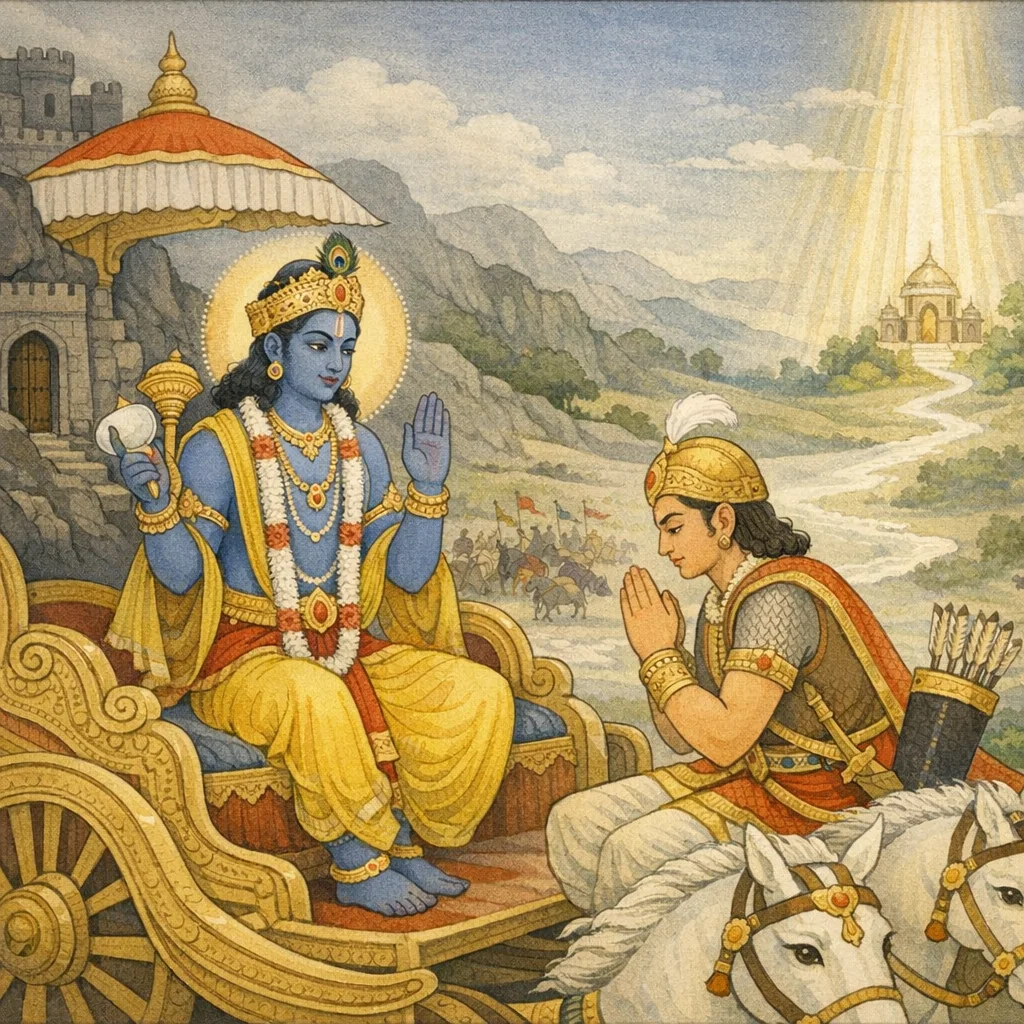
Near the conclusion of the dialogue, Krishna summarizes the practical condition for Arjuna’s success: inner alignment and receptivity to instruction, contrasted with the destabilizing force of ego-driven refusal.
As a nonsectarian practice, it can be read as: keep attention anchored in a higher value or disciplined framework, seek mentorship, and watch for ego-based resistance that blocks learning and constructive action.
Ask anything about this verse
Curious about the meaning, context, or a word? Ask, and continue the conversation in the Vedapath app.
A free Google sign-in keeps your chat saved across web and the app.
Read Bhagavad Gita in the Vedapath app
Scan the QR code to open this directly in the app, with audio, word-by-word meanings, and more.