
Shloka 40
Karma Yoga — Karma Yoga
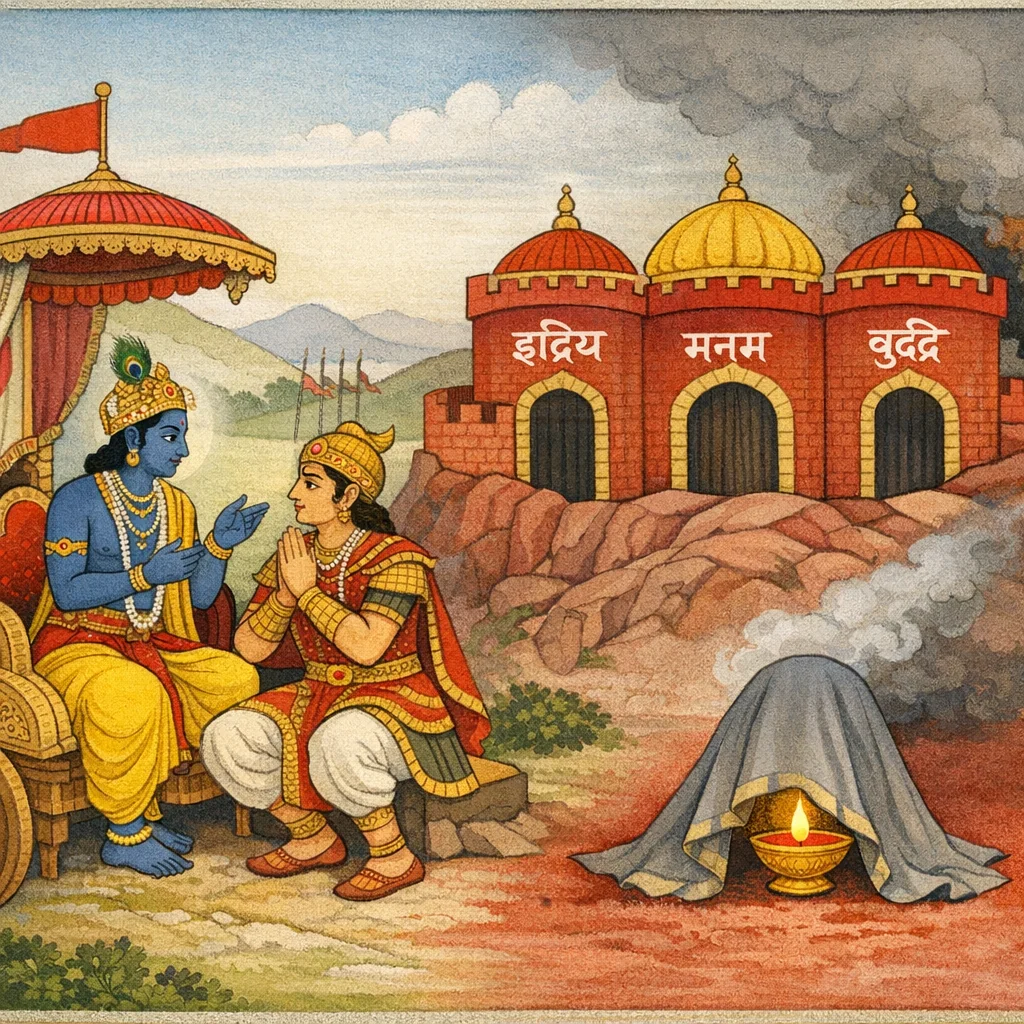
इन्द्रियाणि मनो बुद्धिरस्याधिष्ठानमुच्यते । एतैर्विमोहयत्येष ज्ञानमावृत्य देहिनम् ॥ ३.४० ॥
indriyāṇi mano buddhir asyādhiṣṭhānam ucyate | etair vimohayaty eṣa jñānam āvṛtya dehinam || 3.40 ||

ಇಂದ್ರಿಯಗಳು, ಮನಸ್ಸು, ಬುದ್ಧಿ—ಇವೇ ಇದರ (ಕಾಮದ) ಅಧಿಷ್ಠಾನವೆಂದು ಹೇಳಲ್ಪಡುತ್ತದೆ; ಇವುಗಳ ಮೂಲಕ ಇದು ಜ್ಞಾನವನ್ನು ಮುಚ್ಚಿ ದೇಹಿಯನ್ನು ಮೋಹಗೊಳಿಸುತ್ತದೆ.
The senses, mind, and intellect are said to be its seat; through these it deludes the embodied one by veiling knowledge.
Its locus is said to be the senses, mind, and intellect; by means of these it confuses the embodied person, covering discernment.
Interpretations vary on whether these are ‘seats’ where desire operates or ‘instruments’ it uses; both fit the Sanskrit adhiṣṭhāna and the instrumental etaiḥ.
FAQs
It maps craving onto a system: sensory input, mental processing, and evaluative judgment can all be colored by desire.
The ‘embodied one’ (dehin) is distinct from these faculties, yet experiences delusion when knowledge is covered at the level of instruments.
It explains how the obstacle operates, setting up the next verse’s practical counsel to regulate the senses first.
Work on multiple levels: manage sensory triggers, train attention, and refine beliefs/values that guide decisions.