
Bhagavad Gita — Shraddhatraya Vibhaga Yoga, Shloka 25
Shraddhatraya Vibhaga Yoga
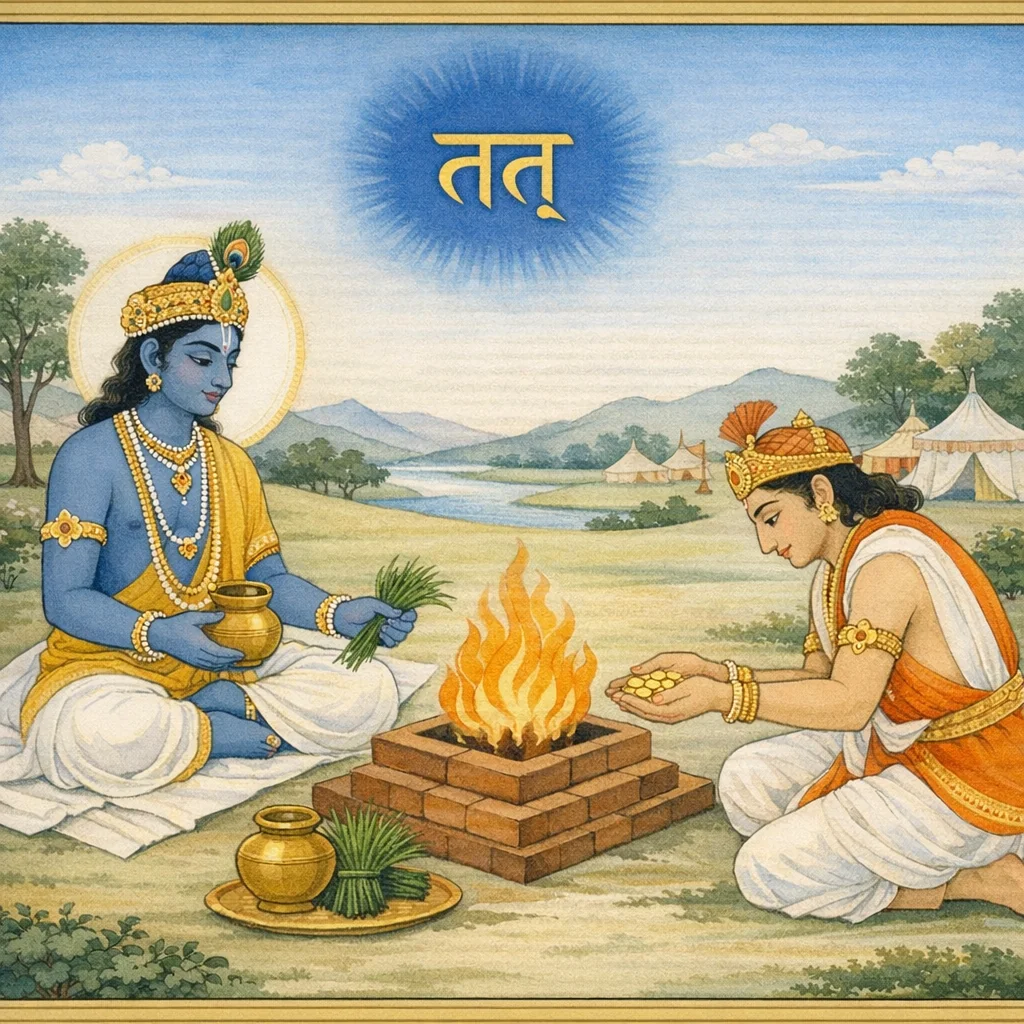
तदित्यनभिसन्धाय फलं यज्ञतपःक्रियाः । दानक्रियाश्च विविधाः क्रियन्ते मोक्षकाङ्क्षिभिः ॥ १७.२५ ॥
tad ity anabhisandhāya phalaṁ yajña-tapaḥ-kriyāḥ | dāna-kriyāś ca vividhāḥ kriyante mokṣa-kāṅkṣibhiḥ || 17.25 ||

Uttering ‘Tat,’ without aiming at the fruit, acts of sacrifice and austerity, and various acts of charity, are performed by those who seek liberation.
Saying ‘Tat’ and without aiming at reward, acts of sacrifice and austerity and various acts of charity are performed by those desiring liberation.
With ‘tat’ (that) and without intending the fruit, sacrificial and ascetic acts, and diverse acts of giving, are performed by seekers of liberation.
anabhisandhāya phalam is consistently taken as “without (self-interested) intention toward results.” ‘Tat’ is interpreted either as a ritual utterance or as a philosophical reminder of the transcendent (‘that’), reinforcing non-appropriation of action.
FAQs
It promotes outcome-independent practice, which can reduce performance anxiety and self-centered evaluation, supporting sustained ethical and contemplative habits.
For liberation-seekers, ‘Tat’ can function as a pointer beyond the ego to the ultimate, helping reframe action as offering rather than possession.
Continuing the ‘Om Tat Sat’ section, it explains the use of ‘Tat’ specifically to mark non-attachment to results in yajña, tapas, and dāna.
Approach service, discipline, and generosity as practices aligned with values rather than as strategies for reward, recognition, or control.