
Bhagavad Gita — Raja Vidya Raja Guhya Yoga, Shloka 19
Raja Vidya Raja Guhya Yoga
तपाम्यहमहं वर्षं निगृह्णाम्युत्सृजामि च । अमृतं चैव मृत्युश्च सदसच्चाहमर्जुन ॥ ९.१९ ॥
tapāmy aham ahaṃ varṣaṃ nigṛhṇāmy utsṛjāmi ca | amṛtaṃ caiva mṛtyuś ca sad asac cāham arjuna || 9.19 ||

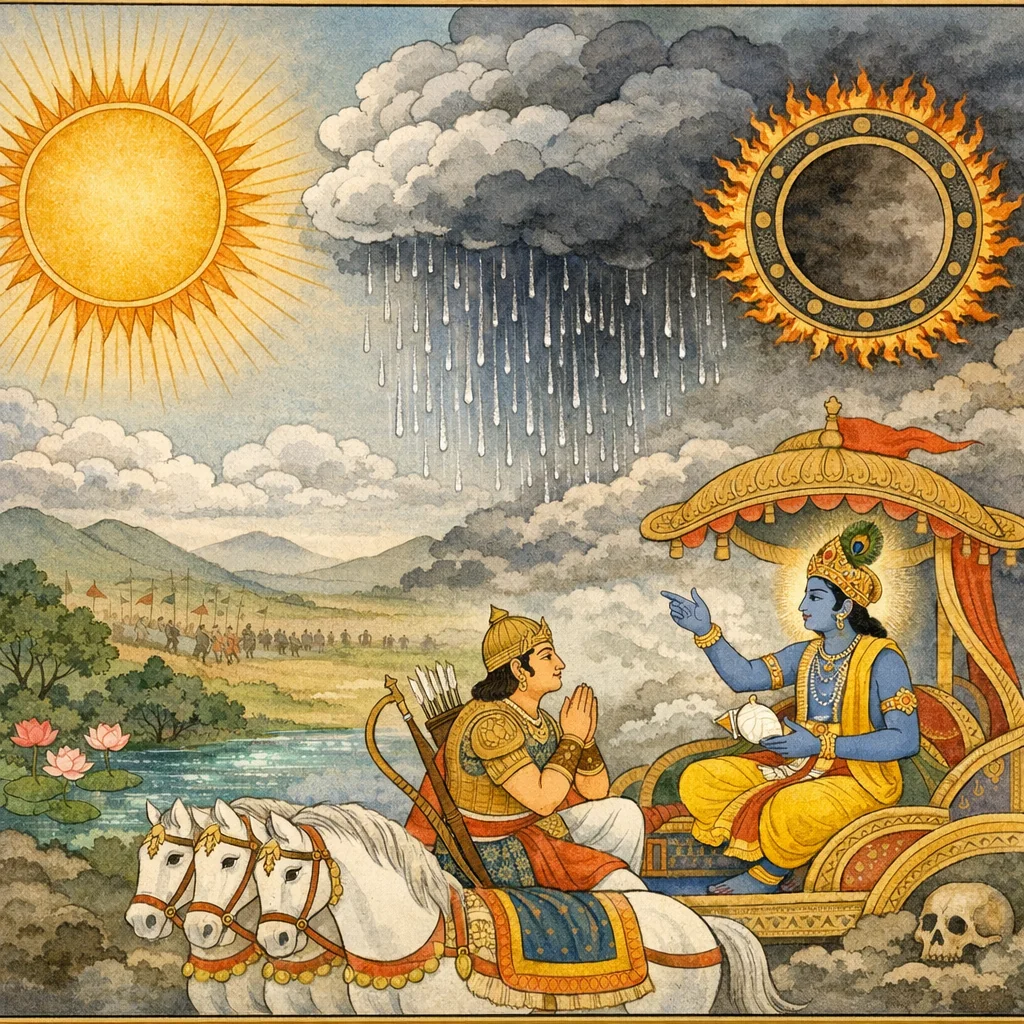
I give heat; I withhold and release the rain. I am immortality and also death; I am being and non-being, O Arjuna.
I give heat; I withhold and send forth rain; I am immortality and also death; I am being and non-being, O Arjuna.
I heat; I (am) rain; I restrain and I release (it). I am immortality and also death; I am the existent and the non-existent, O Arjuna.
“अहं वर्षं” can be read as ‘I am rain’ or ‘I cause rain’; the paired verbs ‘withhold/release’ evoke cosmic regulation. “sat/asat” is interpreted variously: ontological categories, manifest/unmanifest, or truth/appearance depending on school.
FAQs
The verse can be read as training non-reactivity to opposites (gain/loss, life/death), by situating them within a broader, meaningful order.
It asserts that the ultimate includes and grounds polarities—natural processes and existential categories—without being reduced to any single one.
This continues the chapter’s ‘I am’ declarations, extending them to environmental cycles and the deepest ontological contrasts.
It can encourage ecological and existential humility: human life depends on larger cycles, and wisdom involves aligning conduct with those realities.