
Shloka 23
Sankhya Yoga — The Yoga of Knowledge
नैनं छिन्दन्ति शस्त्राणि नैनं दहति पावकः । न चैनं क्लेदयन्त्यापो न शोषयति मारुतः ॥ २.२३ ॥
nainaṃ chindanti śastrāṇi nainaṃ dahati pāvakaḥ | na cainaṃ kledayanty āpo na śoṣayati mārutaḥ || 2.23 ||

武器はこれを断ち切れず、火はこれを焼かず、水はこれを濡らさず、風はこれを乾かさない。
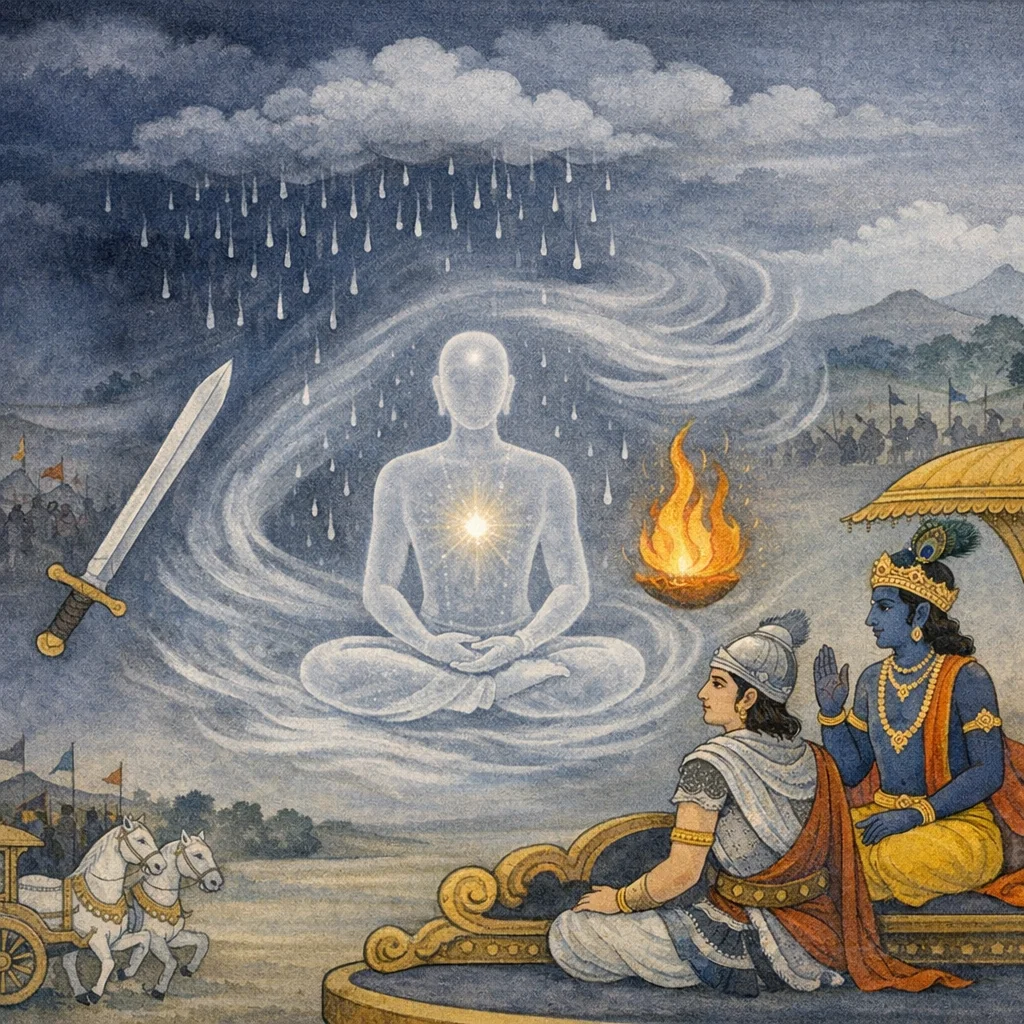
Weapons do not cut it, fire does not burn it; water does not wet it, and wind does not dry it.
It is not cut by weapons, not burned by fire; it is not moistened by waters, not dried by wind.
These are elemental negations emphasizing the self’s non-physicality. Read historically, the imagery uses familiar forces to deny that the self is an object among objects.
FAQs
It can function as reassurance: what one most essentially is need not be equated with physical vulnerability.
The self is characterized as not belonging to the domain of material causation (elemental transformation).
The verse intensifies Krishna’s argument by listing multiple kinds of physical alteration and denying their applicability to the self.
Useful for contemplative practice that distinguishes awareness from bodily sensations and environmental conditions.