
Bhagavad Gita — Raja Vidya Raja Guhya Yoga, Shloka 22
Raja Vidya Raja Guhya Yoga
अनन्याश्चिन्तयन्तो मां ये जनाः पर्युपासते । तेषां नित्याभियुक्तानां योगक्षेमं वहाम्यहम् ॥ ९.२२ ॥
ananyāś cintayanto māṃ ye janāḥ paryupāsate | teṣāṃ nityābhiyuktānāṃ yoga-kṣemaṃ vahāmy aham || 9.22 ||

ただ我のみを念じ、一心にあらゆる方より我を礼拝する者たち——常に専念する彼らのために、我はヨーガとクシェーマ(得ることと護ること)を担う。
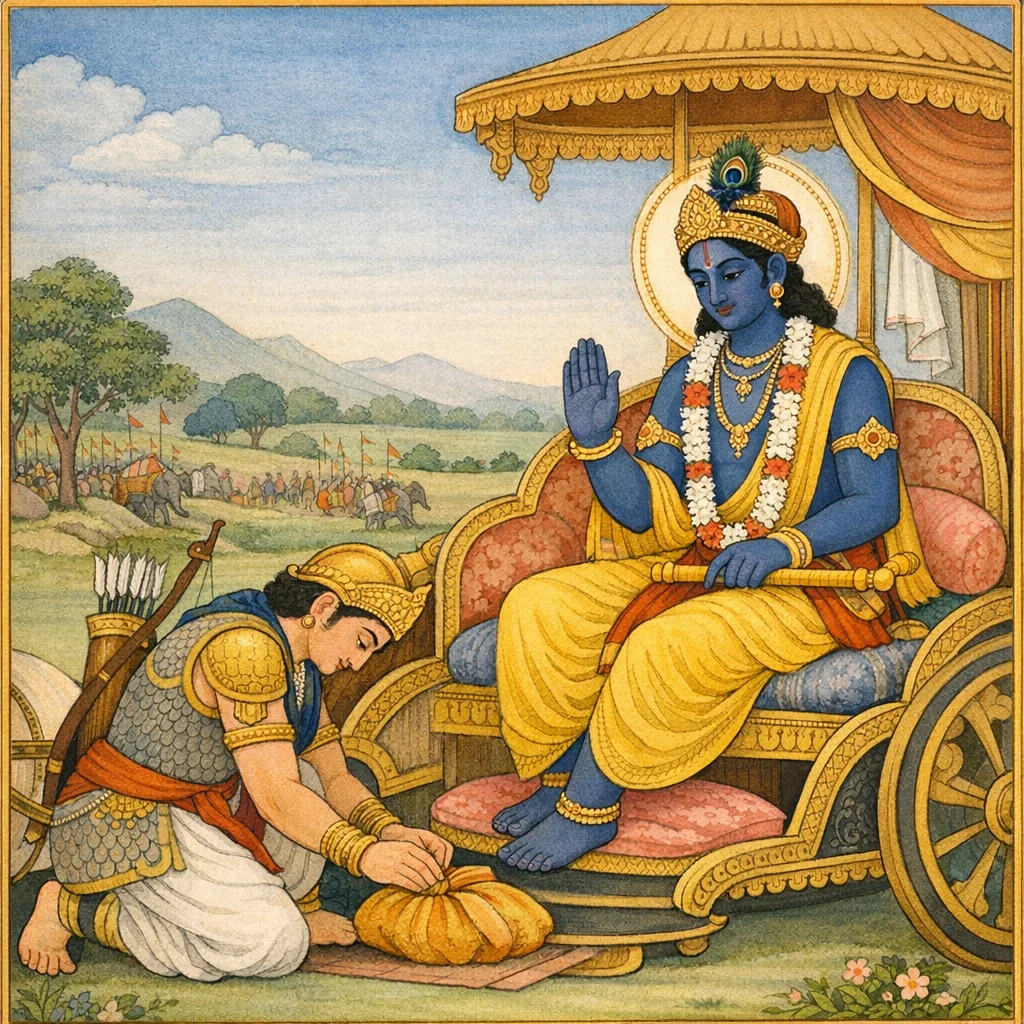
Those who, thinking of Me alone, worship Me on every side—of them, ever steadfast, I carry (secure) their yoga and kṣema (acquisition and protection).
Those persons who, without another (exclusive), contemplate Me and worship Me attentively—of those always engaged, I bear their ‘yoga-and-kṣema’ (attainment and safeguarding).
“yoga-kṣema” is often glossed as ‘getting what is not yet obtained and preserving what is obtained.’ Some interpret it inwardly as spiritual integration and stability; others as providential support in life. The verse is central for bhakti traditions emphasizing divine care.
FAQs
Exclusive contemplation reduces rumination and divided priorities; the promise of ‘support’ can function as a trust-based antidote to anxiety.
The verse expresses a relational metaphysics: the ultimate is not only the ground of being but also responsive within devotion, ensuring continuity of the devotee’s path.
After describing the limits of merit-based heaven (9.20–21), it offers an alternative: steady devotion that is not dependent on finite karmic results.
It can be applied as a principle of focused commitment: when one organizes life around a central ethical-spiritual aim, necessary supports (skills, habits, community) are more likely to be sustained.
Read Bhagavad Gita in the Vedapath app
Scan the QR code to open this directly in the app, with audio, word-by-word meanings, and more.