
Bhagavad Gita — Dhyana Yoga, Shloka 15
Atma Samyama Yoga
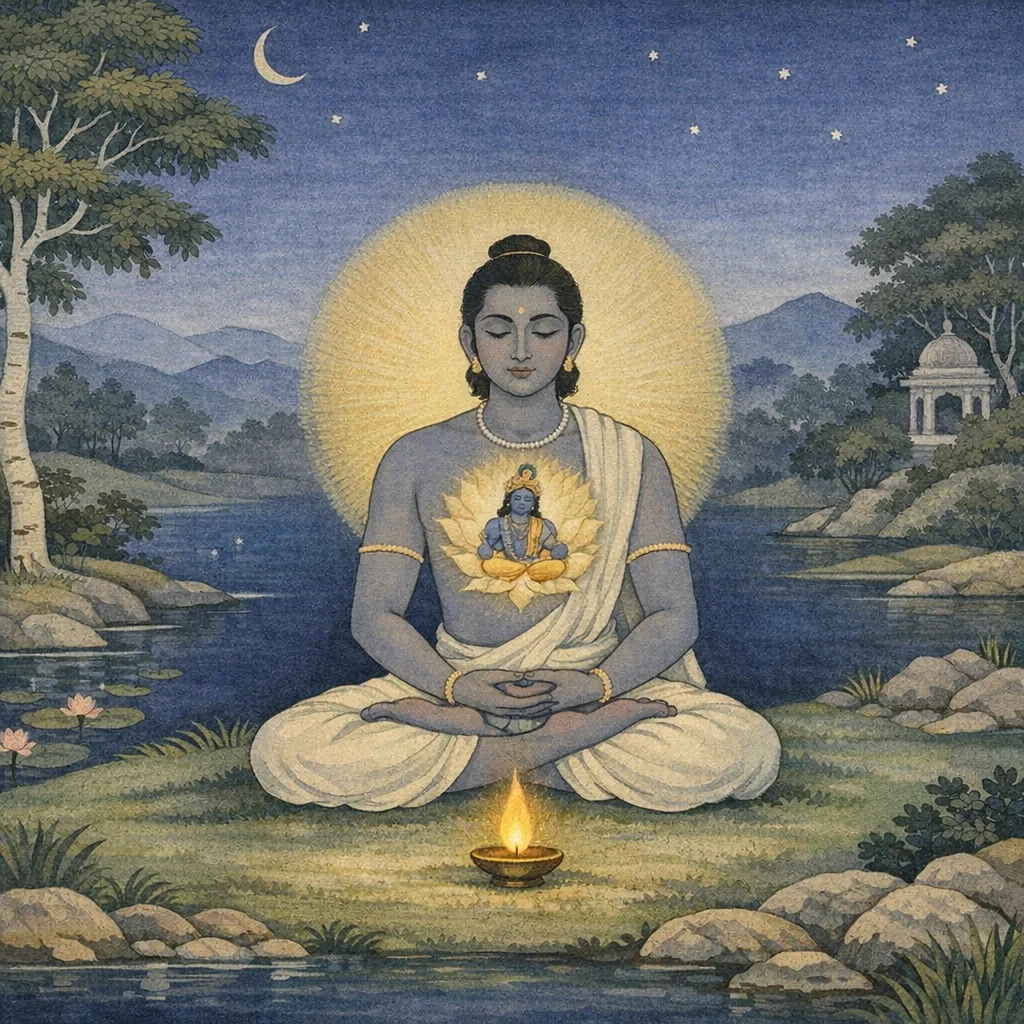
युञ्जन्नेवं सदात्मानं योगी नियतमानसः । शान्तिं निर्वाणपरमां मत्संस्थामधिगच्छति ॥ ६.१५ ॥
yuñjann evaṃ sadātmānaṃ yogī niyata-mānasaḥ | śāntiṃ nirvāṇa-paramāṃ mat-saṃsthām adhigacchati || 6.15 ||

このように常に自己を瑜伽に結び、心を調御したヨーギーは、我に安住し、涅槃を究竟とする寂静に到達する。
इस प्रकार निरन्तर आत्मा को योग में लगाता हुआ, संयत मन वाला योगी मेरी प्राप्ति में स्थित, निर्वाण-परमा शान्ति को प्राप्त होता है।
Thus, continually disciplining himself, the yogin of restrained mind attains peace whose culmination is nirvāṇa, abiding in me.
‘Nirvāṇa’ is sometimes translated in explicitly Buddhist terms, but in the Gītā it functions more generally as ‘cessation/extinguishing’ of afflictive agitation, linked here with ‘abiding in me’ (mat-saṃsthā), which anchors it within the Gītā’s theistic/Upaniṣadic horizon.
FAQs
The ‘peace’ described can be read as deep stabilization: reduced rumination and affective turbulence through sustained attentional training and ethical regulation.
Nirvāṇa here indicates the extinguishing of disturbances rooted in craving and aversion, culminating in a stable relation to the ultimate reality identified with Krishna.
This verse summarizes the outcome of the preceding meditation instructions (6.10–6.14), stating the telos of the practice in both experiential (peace) and doctrinal (abiding in me) terms.
Frame contemplative practice around a clear end: not extraordinary experiences, but durable calm, decreased reactivity, and alignment with one’s highest commitments.