
Shloka 4
Akshara Brahma Yoga — Akshara Brahma Yoga
अधिभूतं क्षरो भावः पुरुषश्चाधिदैवतम् । अधियज्ञोऽहमेवात्र देहे देहभृतां वर ॥ ८.४ ॥
adhibhūtaṁ kṣaro bhāvaḥ puruṣaś cādhidaivatam | adhiyajño ’ham evātra dehe dehabhṛtāṁ vara || 8.4 ||

滅びゆく存在の相はアディブータ(adhibhūta)と呼ばれ、宇宙のプルシャ(Purusha)はアディダイヴァ(adhidaiva)と呼ばれる。そしてこの身において、アディヤジュニャ(Adhiyajña)とはまさに我のみである、身を帯びる者の中の最勝者よ。
The perishable state of being is called adhibhūta; the cosmic Person is called adhidaiva; and I alone am adhiyajña here in this body, O best of embodied beings.
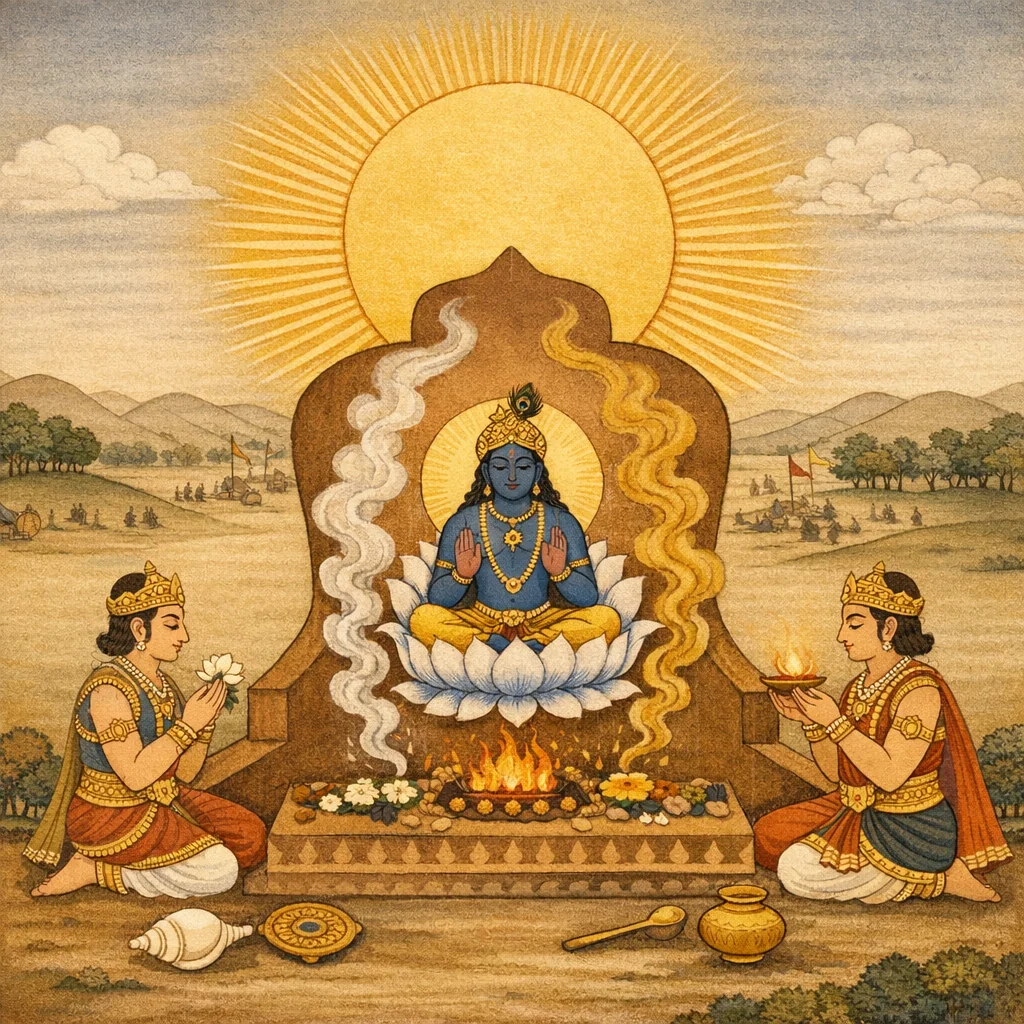
Kṛṣṇa identifies: adhibhūta as the perishable mode of existence; adhidaiva as puruṣa, the presiding cosmic principle; and adhiyajña as Kṛṣṇa himself, immanent 'here' within the body as the locus where sacrificial meaning is grounded.
The main interpretive divergence concerns 'puruṣa' as adhidaiva: it may be read as Hiraṇyagarbha/cosmic mind, as a class of presiding deities, or as the Lord’s cosmic aspect. 'Adhiyajña' is often taken as the indwelling divine who receives and enables sacrifice, supporting an internalized (yogic) reading of yajña.
FAQs
The verse can be read as integrating bodily life into spiritual practice: the body becomes a site for disciplined meaning and intention rather than a mere obstacle.
It distinguishes levels of reality—perishable phenomena (adhibhūta), presiding cosmic order (adhidaiva), and the foundational sacred principle enabling sacrifice (adhiyajña).
It completes the definitional set requested by Arjuna (8.1–8.2) and prepares the shift to the practice of remembrance (8.5 onward).
Encourages viewing daily actions (work, care, study) as value-centered 'offerings'—structured by intention and accountability—without requiring ritual literalism.