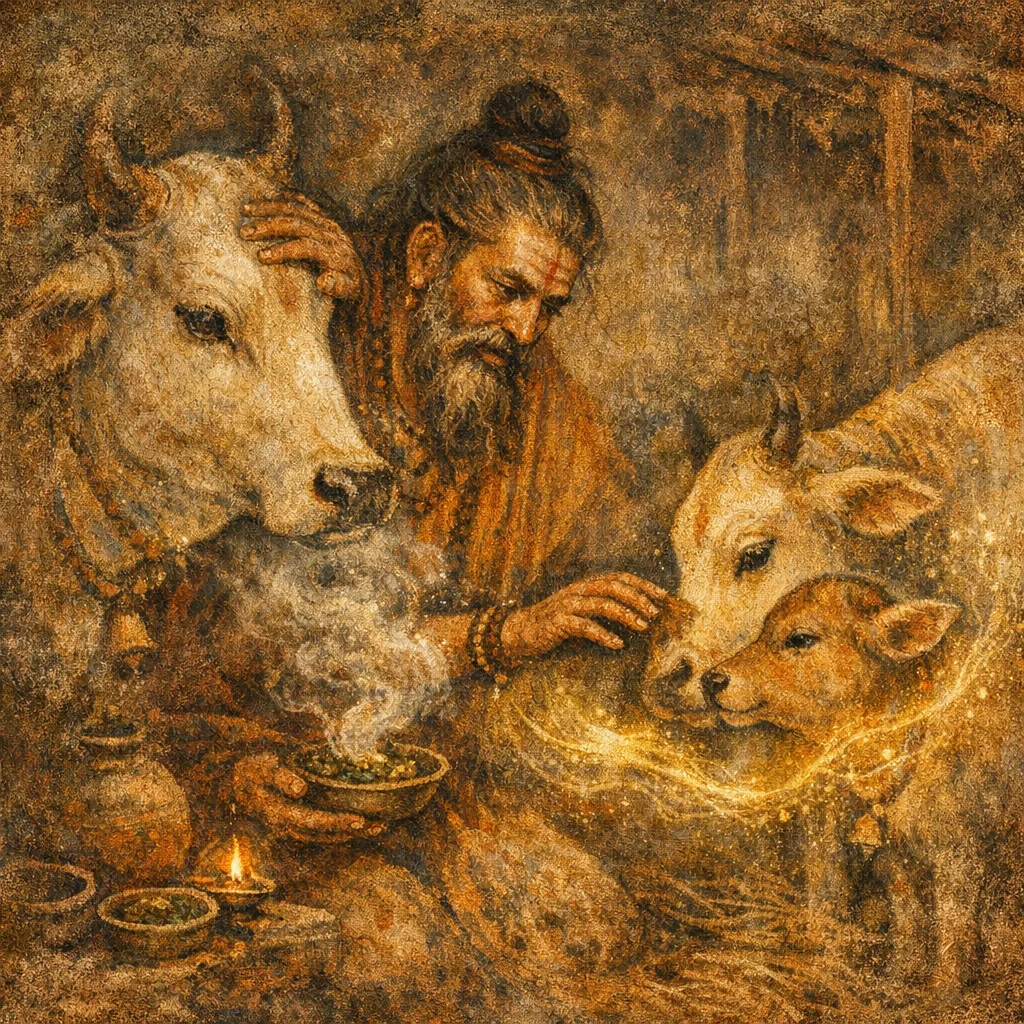
Sukta 70
Rishi: Atharvanic tradition (household/cattle charm corpus)
Devata: Aghnyā (the cow as sacral being) / manas-binding efficacy
Chandas: Mixed/expanded Anuṣṭubh-like (Atharvanic prose-verse cadence with repeated yathā clauses)
Mantras
Mantra 1
अघ्न्याः। यथा मांसं यथा सुरा यथाक्षा अधिदेवने । यथा पुंसो वृषण्यत स्त्रियां निहन्यते मनः । एवा ते अघ्न्ये मनोऽधि वत्से नि हन्यताम्
O Cow inviolable: as meat, as surā, as dice in the gaming-hall; as the mind of a man in heat is fastened upon a woman—so, O Aghnyā, let thy mind be fastened firmly upon thy calf.
Mantra 2
यथा हस्ती हस्तिन्याः पदेन पदमुद्युजे। यथा पुंसो वृषण्यत स्त्रियां निहन्यते मनः । एवा ते अघ्न्ये मनोऽधि वत्से नि हन्यताम्
As the bull-elephant follows, step with step, the track of the cow-elephant; as the mind of a man in heat is fastened upon a woman—so, O Aghnyā, let thy mind be fastened upon thy calf.
Mantra 3
यथा प्रधिर्यथोपधिर्यथा नभ्यं प्रधावधि । यथा पुंसो वृषण्यत स्त्रियां निहन्यते मनः । एवा ते अघ्न्ये मनोऽधि वत्से नि हन्यताम्
As rim and tire, as the nave is set fast upon the felly; as the mind of a man in heat is fastened upon a woman—so, O Aghnyā, let thy mind be fastened upon thy calf.
Frequently Asked Questions
It is used when a cow refuses her calf or will not let it suckle; the repeated refrain aims to fix the cow’s attention and affection on the calf so nursing begins and continues.
These are graded examples of strong, hard-to-break fixation—desire, habitual attraction, instinctive following, and firm mechanical fastening—so the mantra can ‘model’ the same firmness in maternal bonding.
No specific herb is prescribed in the text; it primarily works as a spoken bandhana charm. Practitioners may add symbolic supports (a cord, wheel-wood token, or calf-track dust), but these are optional.