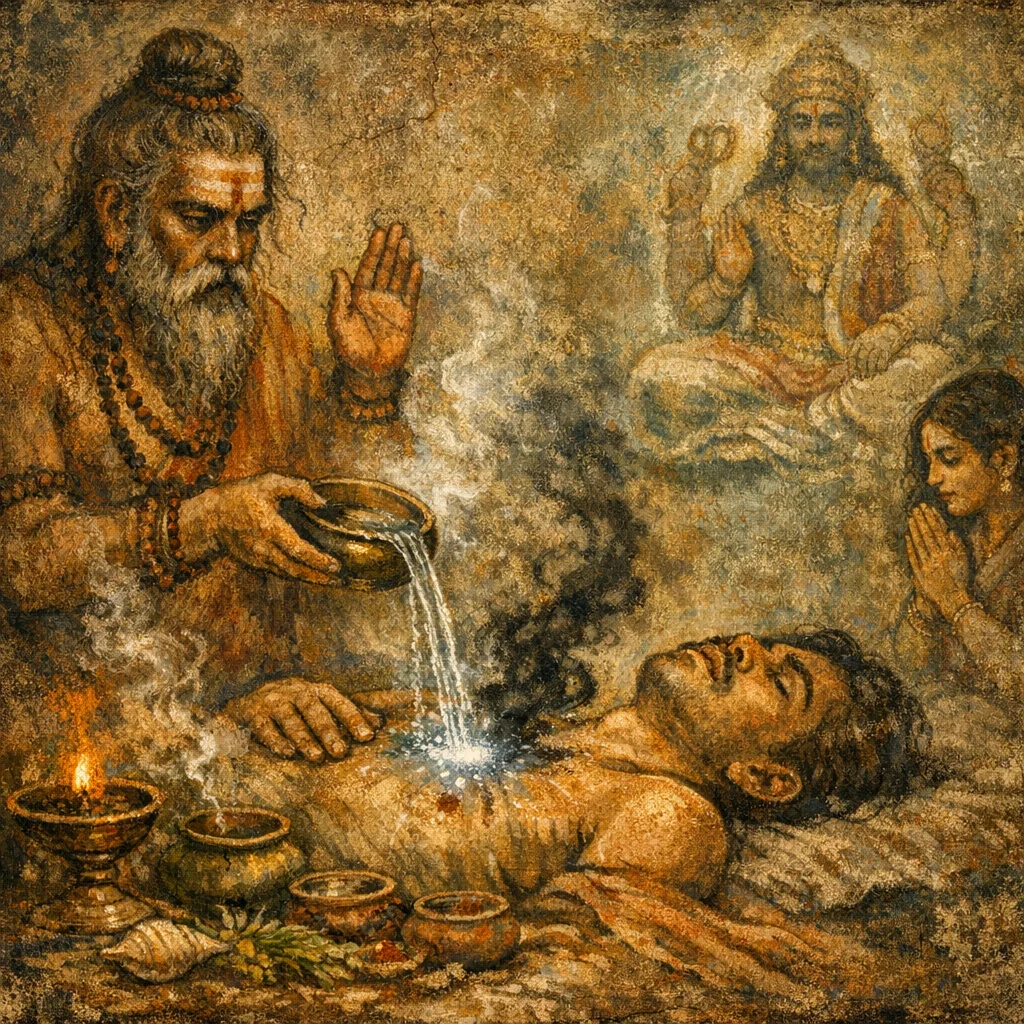
Sukta 132
Rishi: Atharvanic tradition (unspecified in excerpt)
Devata: Smara (Kāma); Varuṇa as authorizing power; Waters as supporting medium
Chandas: Mixed/irregular (Atharvanic charm-style; not securely determinable from excerpt alone)
Mantras
Mantra 1
स्मरः। यं देवाः स्मरमसिञ्चन्नप्स्व१न्तः शोशुचानं सहाध्या। तं ते तपामि वरुणस्य धर्मणा
Smara—whom the Gods poured in, within the waters, burning therewithin, together and over all—him I scorch for thee by Varuṇa’s ordinance.
Mantra 2
यं विश्वे देवाः स्मरमसिञ्चन्नप्स्व१न्तः शोशुचानं सहाध्या। तं ते तपामि वरुणस्य धर्मणा
Whom all the Gods poured in as Smara, within the waters, burning therewithin, together and over all—him I scorch for thee by Varuṇa’s ordinance.
Mantra 3
यमिन्द्राणी स्मरमसिञ्चदप्स्व१न्तः शोशुचानं सहाध्या। तं ते तपामि वरुणस्य धर्मणा
Whom Indrāṇī poured in as Smara, within the waters, burning therewithin, together and over all—him I scorch for thee by Varuṇa’s ordinance.
Mantra 4
यमिन्द्राग्नी स्मरमसिञ्चतामप्स्व१न्तः शोशुचानं सहाध्या। तं ते तपामि वरुणस्य धर्मणा
Him—Smará—let Indra and Agni sprinkle down within the waters, him that is burning, together with his seat. That one I scorch for thee by Varuṇa’s ordinance.
Mantra 5
यं मित्रावरुणौ स्मरमसिञ्चतामप्स्व१न्तः शोशुचानं सहाध्या। तं ते तपामि वरुणस्य धर्मणा
Him—Smará—let Mitra and Varuṇa sprinkle down within the waters, him that is burning, together with his seat. That one I scorch for thee by Varuṇa’s ordinance.
Frequently Asked Questions
It treats desire (Smara/Kāma) as a controllable force that can be poured into water and then activated as an inner ‘burning’ directed at a target, under Varuṇa’s binding ordinance (dharma).
The waters are the ritual medium that receives Smara, holds his power, and transmits it—making the charm portable and ‘infusable’ rather than purely verbal.
Varuṇa’s dharma functions as a legal-like cosmic authorization: the charm claims its compulsion is enforced by sovereign order and bond, not just personal desire.