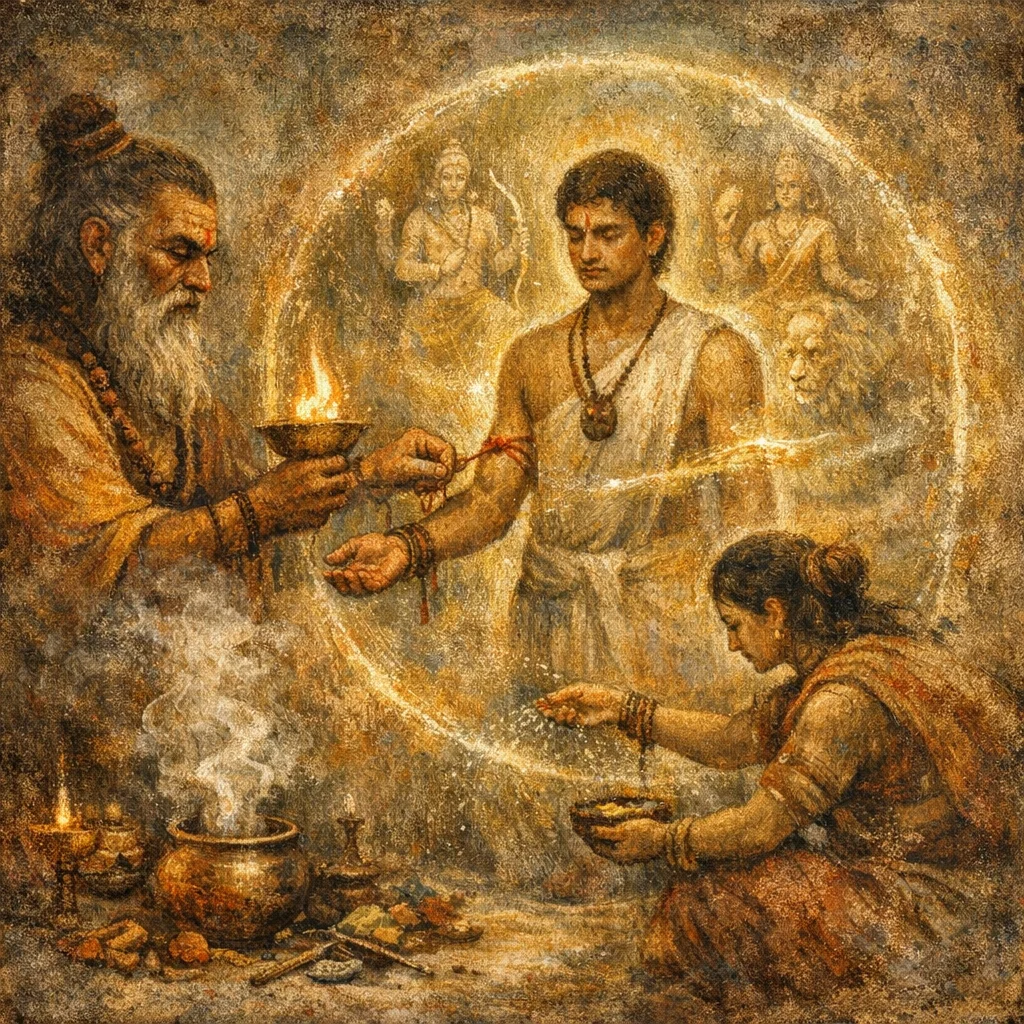
Sukta 16
Rishi: Atharvanic tradition (anonymous/collective)
Devata: Abhaya; Savitar; Indra (Śacīpati)
Chandas: Anuṣṭubh (compressed, charm-like)
Mantras
Mantra 1
अभयम्। असपत्नं पुरस्तात् पश्चान्नो अभयं कृतम्। सविता मा दक्षिणत उत्तरान्मा शचीपतिः
Fearlessness—rival-less in front, behind for us is fearlessness made. Let Savitar guard me from the south; from the north let the Lord of Śacī guard me.
Mantra 2
दिवो मादित्या रक्षन्तु भूम्या रक्षन्त्वग्नयः । इन्द्राग्नी रक्षतां मा पुरस्तादश्विनावभितः शर्म यच्छताम्। तिरश्चीनघ्न्या रक्षतु जातवेदा भूतकृतो मे सर्वतः सन्तु वर्म
From heaven let the Ādityas protect me; from earth let the Fires protect. Let Indra and Agni protect me from the front; let the Aśvins on either side bestow shelter. Let the crosswise inviolable guardian protect; let Jātavedas—let the makers of beings—be armor for me from every side.
Frequently Asked Questions
“Abhaya” means fearlessness and safety. Here it is treated as a power that can be established around a person so that anxiety, threats, and hostile pressure do not gain entry.
The sukta builds protection by mapping guardians onto space. By naming directions, it symbolically closes the approaches through which danger or rivalry might ‘arrive,’ turning the surroundings into a secured perimeter.
No. The text works as a mantra-only protective charm. If desired, a simple cord or cloth can be treated as a symbolic ‘varman’ (armor), but it is optional.