
Shloka 13
Sankhya Yoga — Sankhya Yoga
देहिनोऽस्मिन्यथा देहे कौमारं यौवनं जरा । तथा देहान्तरप्राप्तिर्धीरस्तत्र न मुह्यति ॥ २.१३ ॥
dehino 'smin yathā dehe kaumāraṃ yauvanaṃ jarā | tathā dehāntara-prāptir dhīras tatra na muhyati || 2.13 ||

Sebagaimana sang diri yang bersemayam dalam tubuh ini melewati masa kanak-kanak, masa muda, dan masa tua, demikian pula ia memperoleh tubuh yang lain; orang yang teguh (dhīra) tidak terdelusi oleh hal itu.
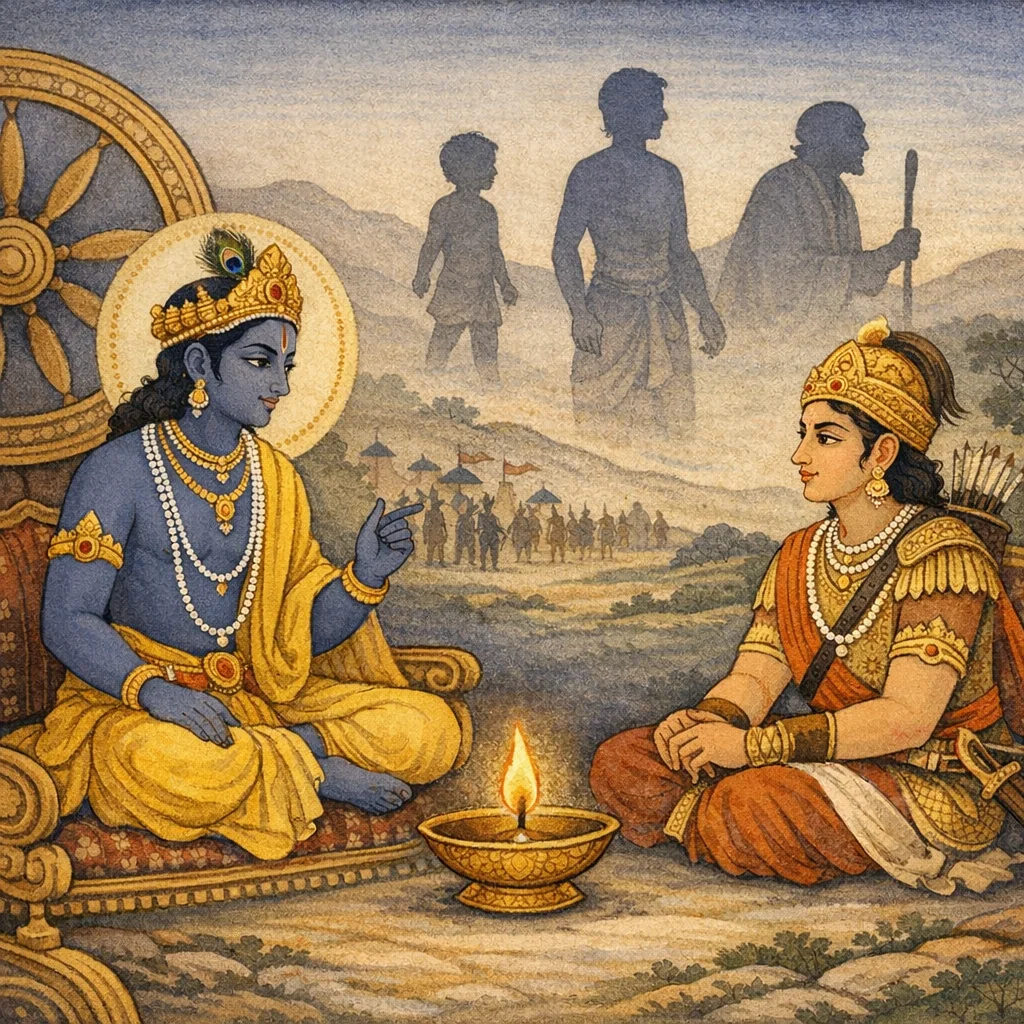
As the embodied self passes in this body through childhood, youth, and old age, so it passes into another body; the steadfast are not deluded by this.
‘Just as, for the embodied one in this body, there is childhood, youth, and old age, so too there is the acquisition of another body; the resolute person is not confused about this.’
The analogy argues from observable bodily change to a broader claim about embodiment. Some interpreters emphasize reincarnation; others emphasize the underlying philosophical point: continuity of the ‘dehin’ amid changing states.
FAQs
The verse uses a familiar developmental sequence to normalize change and reduce fear, encouraging a stable perspective during upheaval.
It presents the embodied self as continuous while bodily conditions change, supporting doctrines of transmigration or, more minimally, the self’s distinction from bodily states.
It strengthens Krishna’s argument against debilitating grief by offering an analogy that makes the self/body distinction intelligible.
It can be read as guidance to maintain composure through life transitions—aging, role changes, or identity shifts—by not equating self-worth with transient conditions.