
Shloka 7
Purushottama Yoga — Purushottama Yoga
ममैवांशो जीवलोके जीवभूतः सनातनः । मनःषष्ठानीन्द्रियाणि प्रकृतिस्थानि कर्षति ॥ १५.७ ॥
mamaivāṁśo jīvaloke jīvabhūtaḥ sanātanaḥ | manaḥ-ṣaṣṭhānīndriyāṇi prakṛti-sthāni karṣati || 15.7 ||

Jiwa individu yang kekal di dunia makhluk hidup sesungguhnya adalah bagian dari-Ku. Berdiam dalam Prakṛti, ia menarik kepada dirinya indria-indria—dengan pikiran sebagai yang keenam.
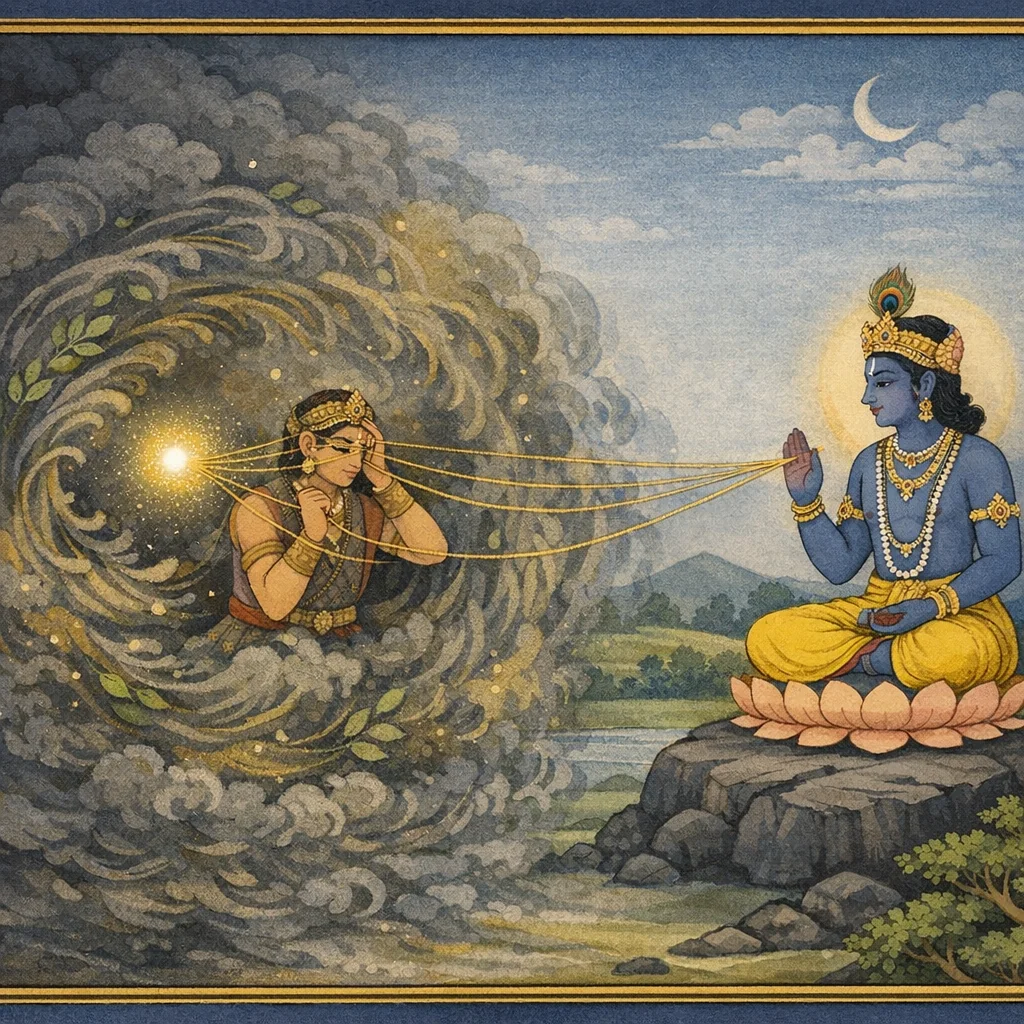
The eternal individual soul in the world of living beings is indeed a part of Mine; abiding in Prakṛti, it draws to itself the senses—of which the mind is the sixth.
In the realm of living beings, the eternal living self is a portion of Me; situated in nature (prakṛti), it exerts effort by drawing along the senses, with mind as the sixth.
Most recensions read essentially as here. Interpretive differences typically concern (a) whether 'aṁśa' (“portion/part”) implies ontological identity or a dependent manifestation (debated across Vedānta schools), and (b) the nuance of 'karṣati'—rendered as “draws/attracts,” “drags along,” or “struggles with” the mind and senses while embodied in prakṛti.
FAQs
The verse frames ordinary experience as shaped by the mind and senses operating within prakṛti. It can be read as describing how attention and desire are pulled toward sensory objects, with the mind coordinating the senses; this “drawing along” suggests the felt effort and restlessness of embodied cognition.
It presents the jīva as ‘eternal’ and in some sense derived from or belonging to the divine (“a portion of Me”), while also functioning within prakṛti through mind and senses. Philosophically, it supports a layered model: an enduring conscious principle associated with a psycho-physical complex, raising questions about identity, dependence, and participation in the supreme.
Chapter 15 discusses the structure of worldly existence and the means of understanding the highest reality (puruṣottama). This verse helps explain how the living being becomes an embodied agent: the jīva, though enduring, is linked to nature through mind and senses, which conditions its worldly life.
As a practical lens, it encourages observing how the mind and senses shape one’s habits and choices. Practices such as mindfulness, ethical restraint, and reflective inquiry can be viewed as ways to reduce compulsive sensory pull and to clarify the distinction between awareness (self) and changing mental-sensory processes.