
Bhagavad Gita — Karma Sannyasa Yoga, Shloka 18
Karma Sannyasa Yoga
विद्याविनयसंपन्ने ब्राह्मणे गवि हस्तिनि । शुनि चैव श्वपाके च पण्डिताः समदर्शिनः ॥ ५.१८ ॥
vidyā-vinaya-sampanne brāhmaṇe gavi hastini | śuni caiva śva-pāke ca paṇḍitāḥ sama-darśinaḥ || 5.18 ||

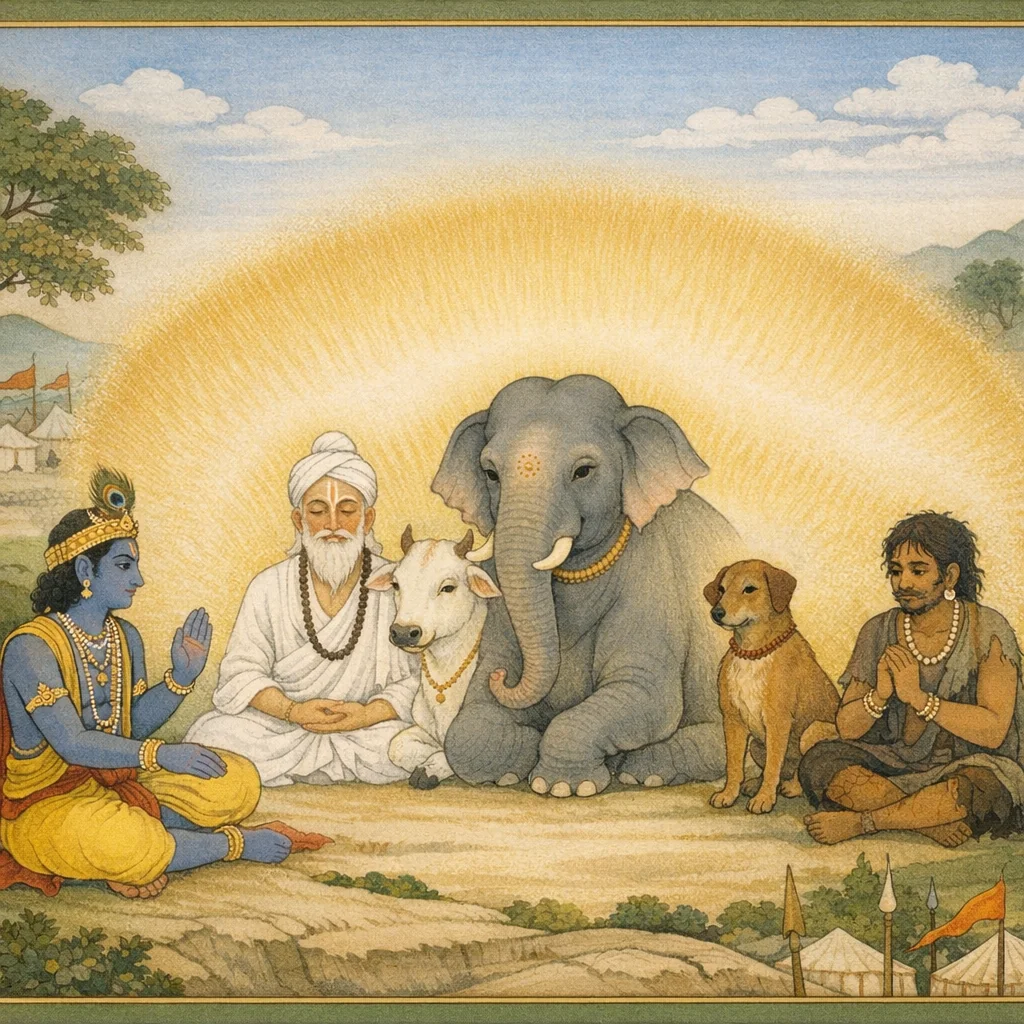
Para bijak memandang dengan penglihatan yang sama: seorang brāhmaṇa yang berilmu dan rendah hati, seekor sapi, seekor gajah, seekor anjing, dan bahkan seorang caṇḍāla (pemakan anjing).
The wise see with equal vision a learned and humble brāhmaṇa, a cow, an elephant, a dog, and even an outcaste (dog-eater).
Those who are learned (paṇḍitāḥ) are equal-seeing (sama-darśinaḥ) toward a brāhmaṇa endowed with learning and humility, toward a cow and an elephant, and toward a dog and a śvapāka.
Most recensions agree closely on wording and sense. Traditional translations often render śvapāka as “outcaste” or “dog-eater,” reflecting a historical social category; academic renderings tend to preserve the term while noting its caste-marked connotation. Interpretively, devotional and Advaita commentaries commonly read “equal vision” as insight into the same ātman/Brahman in all beings, while some theistic readings emphasize impartial regard grounded in God’s presence in all.
FAQs
The verse can be read as describing a trained perception: the mind reduces reactive bias (attraction/aversion) based on status, appearance, or utility. “Equal vision” indicates emotional steadiness and cognitive reframing—responding to beings without habitual prejudice while still recognizing practical differences when action requires it.
Many Indian philosophical readings treat the verse as grounded in the sameness of the self (ātman) in all embodied beings. The “wise” perceive an underlying unity that is not altered by external attributes (learning, species, or social category), supporting a non-dual or at least non-partial metaphysical outlook.
Chapter 5 discusses renunciation and disciplined action. This verse illustrates the ethical and perceptual outcome of wisdom: the renouncer-in-action is not driven by socially conditioned hierarchies but by insight and steadiness, aligning with the chapter’s emphasis on inner freedom while living in the world.
As a practical ethic, it supports impartial respect and reduced bias in interpersonal life—e.g., treating people across education levels, occupations, and social backgrounds with consistent dignity. It can also guide professional contexts (teaching, healthcare, leadership) toward fairness while maintaining appropriate role-based responsibilities.