
Bhagavad Gita — Karma Sannyasa Yoga, Shloka 10
Karma Sannyasa Yoga
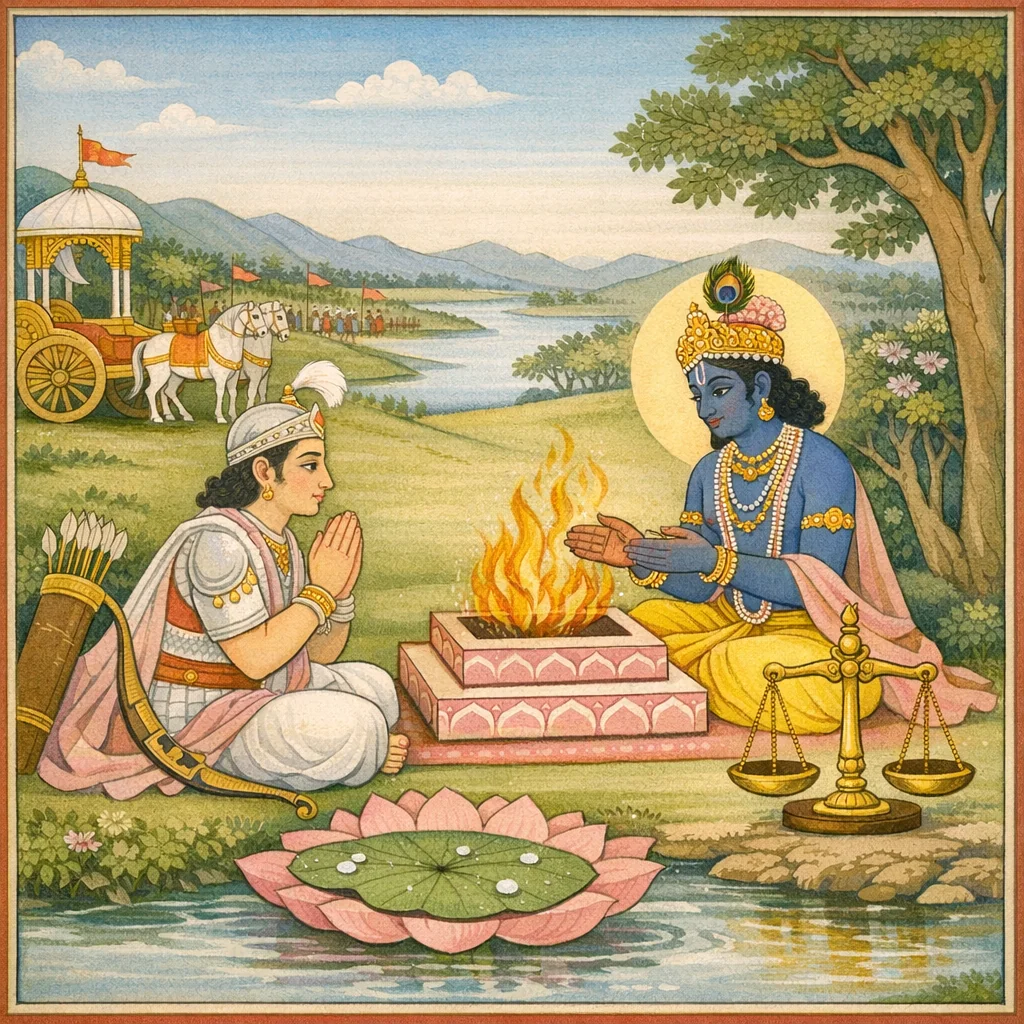
कायेन मनसा बुद्ध्या केवलैरिन्द्रियैरपि । योगिनः कर्म कुर्वन्ति सङ्गं त्यक्त्वात्मशुद्धये ॥ ५.११ ॥
kāyena manasā buddhyā kevalair indriyair api | yoginaḥ karma kurvanti saṅgaṃ tyaktvātmaśuddhaye || 5.11 ||

Para yogi melakukan tindakan dengan tubuh, pikiran, buddhi (kecerdasan rohani), bahkan dengan indria semata, dengan meninggalkan keterikatan, demi penyucian diri.
योगीजन शरीर, मन, बुद्धि तथा केवल इन्द्रियों के द्वारा भी आसक्ति को त्यागकर आत्मशुद्धि के लिए कर्म करते हैं।
Yogins perform action with body, mind, intellect, and even with the senses alone, having abandoned attachment, for the purification of the self (inner instrument).
“Ātmaśuddhi” is interpreted in commentarial traditions as purification of the mind (antaḥkaraṇa) rather than purification of an already-pure ātman. The phrase “kevalaiḥ indriyaiḥ” is often taken to include routine, minimal, or role-bound actions—performed without egoic investment.
FAQs
The verse frames ethical, disciplined action as a method of self-regulation: habits of attention, impulse control, and reflective judgment are strengthened when actions are done without craving for reward.
It supports a soteriological model where action, when rightly oriented, prepares the practitioner for liberating knowledge by refining the mind that apprehends reality.
Chapter 5 argues that renunciation and yoga converge: yogins may remain active, using action itself as a means to inner clarity rather than as a source of bondage.
Choose one routine duty and perform it daily with consistency and without seeking recognition; track whether this reduces reactivity and increases steadiness.