
Bhagavad Gita — Gunatraya Vibhaga Yoga, Shloka 14
Gunatraya Vibhaga Yoga
यदा सत्त्वे प्रवृद्धे तु प्रलयं याति देहभृत् । तदोत्तमविदां लोकानमलान्प्रतिपद्यते ॥ १४.१४ ॥
yadā sattve pravṛddhe tu pralayaṁ yāti dehabhṛt | tadottamavidāṁ lokān amalān pratipadyate || 14.14 ||

Bila sattva sedang dominan lalu sang makhluk berjasad mencapai pralaya (kematian), saat itu ia meraih alam-alam yang suci milik para mengetahui Yang Tertinggi.
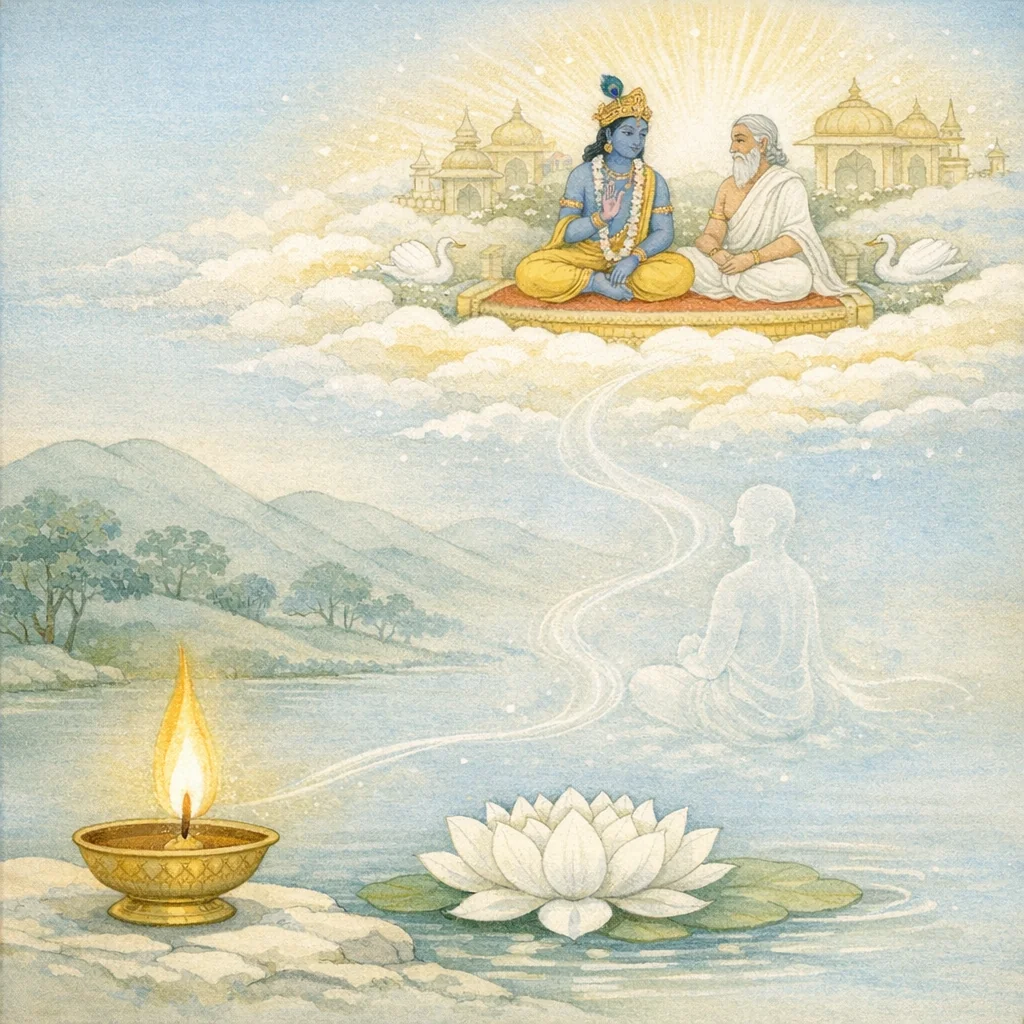
When the embodied one meets dissolution (death) while sattva is predominant, then he attains the pure worlds of the knowers of the highest.
If the bearer of the body reaches death at a time when sattva has increased, then he attains the stainless realms of those who know the highest.
‘Pralaya’ is commonly rendered as ‘death’ here (contextual dissolution of the body). ‘Lokān’ may be taken cosmologically (post-mortem realms) or ethically (a higher condition of experience); academic translations often keep the cosmological sense while noting its doctrinal framing.
FAQs
The verse encodes a value claim: cultivating clarity and balance is portrayed as shaping one’s deepest dispositions, especially at life’s transitions.
Within karmic-rebirth frameworks, the dominant guṇa at death influences post-mortem trajectory; sattva is linked with higher, ‘purified’ conditions associated with wisdom.
After listing signs of guṇa dominance, the chapter connects dominance to outcomes across lifetimes, consistent with classical Indian theories of moral causation.
Even without adopting literal cosmology, it can be read as emphasizing how long-term cultivation of clarity and insight shapes the ‘quality’ of one’s life-course and legacy.