
Shloka 17
Akshara Brahma Yoga — Akshara Brahma Yoga
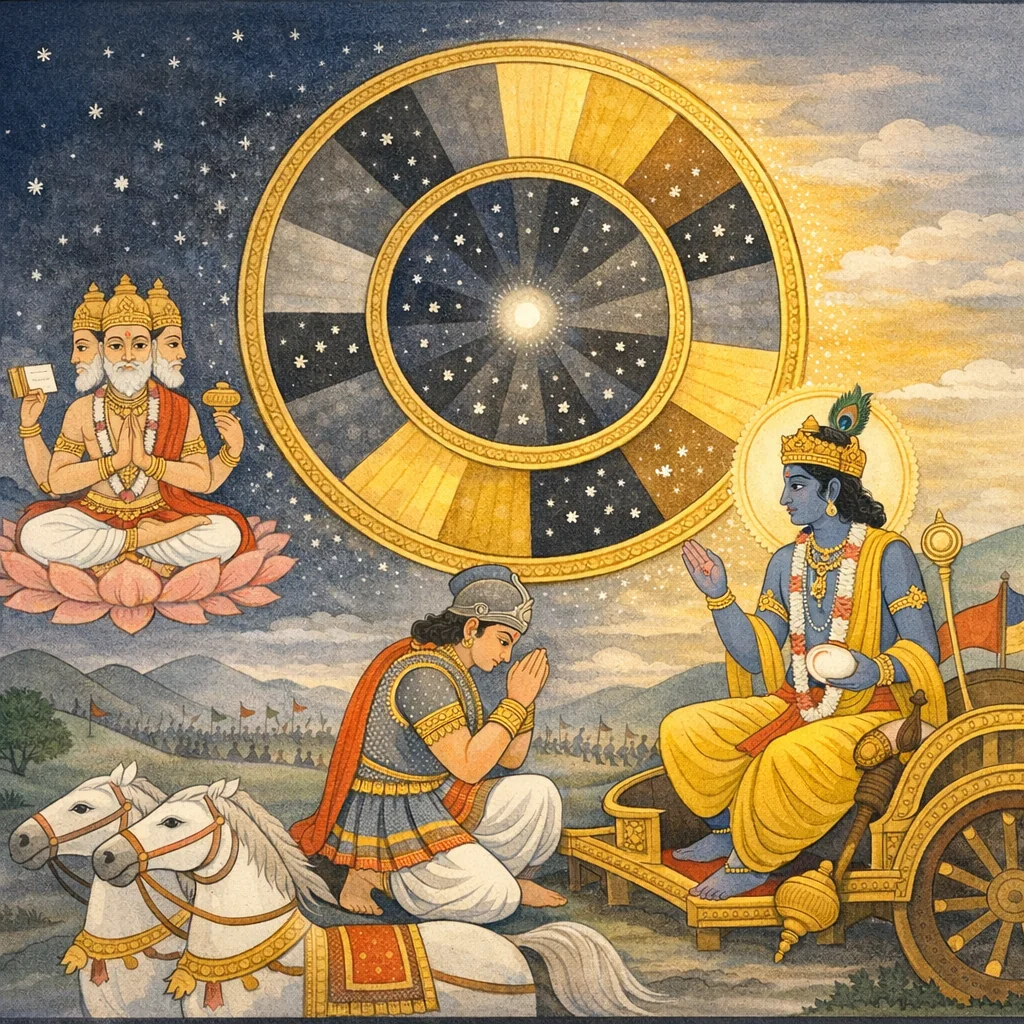
सहस्रयुगपर्यन्तमहर्यद्ब्रह्मणो विदुः । रात्रिं युगसहस्रान्तां तेऽहोरात्रविदो जनाः ॥ ८.१७ ॥
sahasra-yuga-paryantam ahar yad brahmaṇo viduḥ | rātriṁ yuga-sahasrāntāṁ te ’ho-rātra-vido janāḥ || 8.17 ||

Mereka yang mengetahui bahwa satu siang Brahmā berlangsung sampai seribu yuga, dan satu malam pun seribu yuga—merekalah yang memahami hakikat siang dan malam.
ब्रह्मा का एक दिन हजार युगों तक का होता है और एक रात भी हजार युगों की होती है—जो लोग इसे जानते हैं, वे ही दिन-रात के तत्त्व को जाननेवाले हैं।
Those who know day and night understand that Brahmā’s day lasts a thousand yugas, and his night also ends after a thousand yugas.
यह श्लोक सांख्य-पुराणिक काल-मान (yuga-scale cosmology) से संगत बैठता है; कुछ आधुनिक व्याख्याएँ इसे प्रतीकात्मक रूप से ‘दीर्घ सृष्टि-प्रलय चक्र’ के संकेत के रूप में पढ़ती हैं, न कि गणितीय खगोल-निरूपण के रूप में।
FAQs
Expands the time-horizon, relativizing personal concerns and encouraging detachment from short-term anxieties.
Introduces cyclic cosmology in which creation and dissolution occur on immense temporal scales.
Prepares for the next verses describing manifestation and dissolution across Brahmā’s day and night.
Useful as a contemplative reminder of long-term cycles—supporting patience and humility.