Prapathaka 6
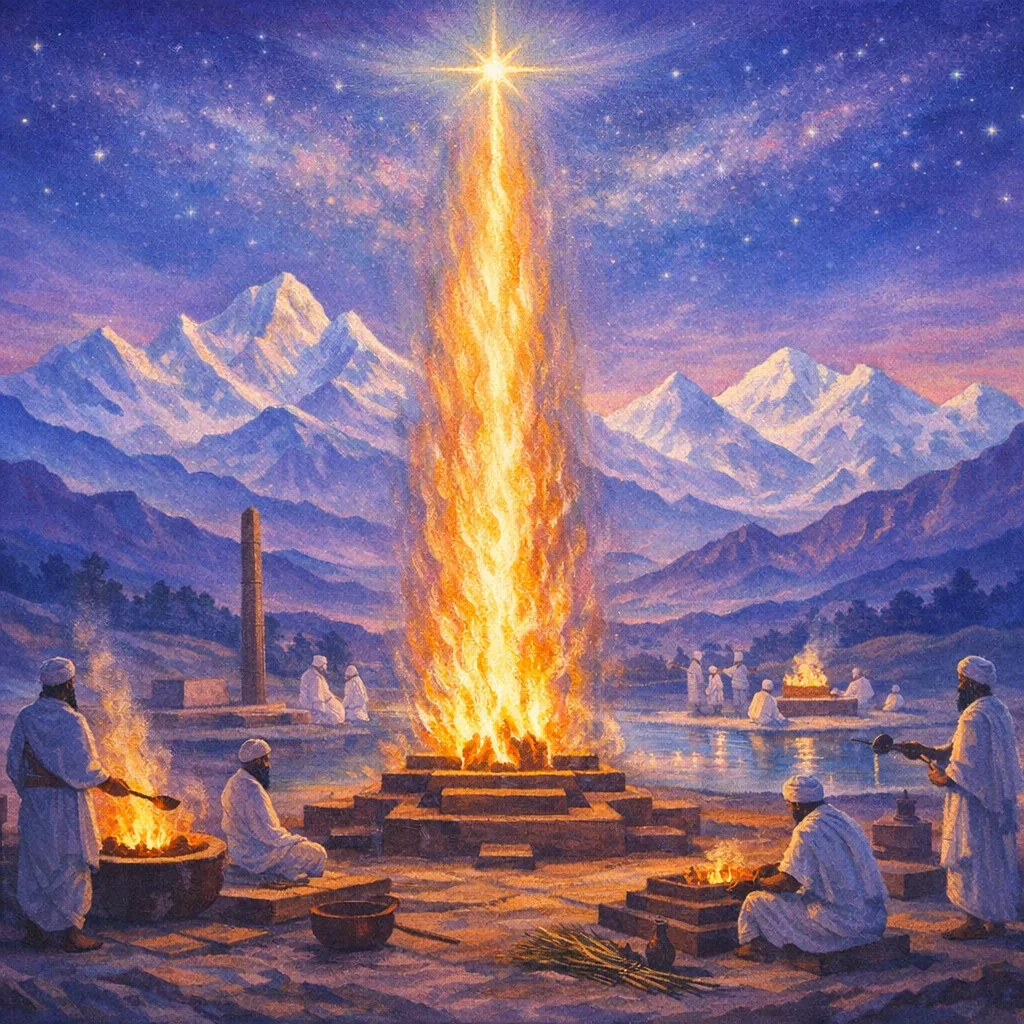
Agnicayana / Śrauta Soma-sacrifice continuum: the construction, consecration, and functional activation of the fire-altar (citi) and its fires, with ancillary offerings and formulae that integrate the altar into the larger Soma-yajña economy (especially the Uttara-vedi/Āhavanīya complex).
Kṛṣṇa Yajurveda 6.6 belongs to the Agnicayana stratum in which the altar is not merely built but ritually “made to work” as a living body of Agni. The chapter’s prose–mantra texture coordinates technical acts (placing, joining, sprinkling, anointing, kindling, and offering) with identifications that map bricks, layers, and fires onto cosmic and social orders. Agni is installed as the mediator who stabilizes space (quarters), time (seasons), and speech (chandas), while the sacrificer is reconstituted through the altar’s anatomy. The liturgy repeatedly negotiates boundaries—inside/outside, pure/impure, human/divine—by means of apotropaic and integrative formulae, ensuring that the newly constituted Āhavanīya is fit to receive oblations and to carry them to the gods. The prapāṭhaka thus exemplifies late-Vedic ritual hermeneutics: material operations are inseparable from semantic “bandhu” linkages that authorize efficacy.
Anuvakas
Anuvakas for this prapathaka are loading. Please check back soon.