
Shloka 2
Bhakti Yoga — Bhakti Yoga
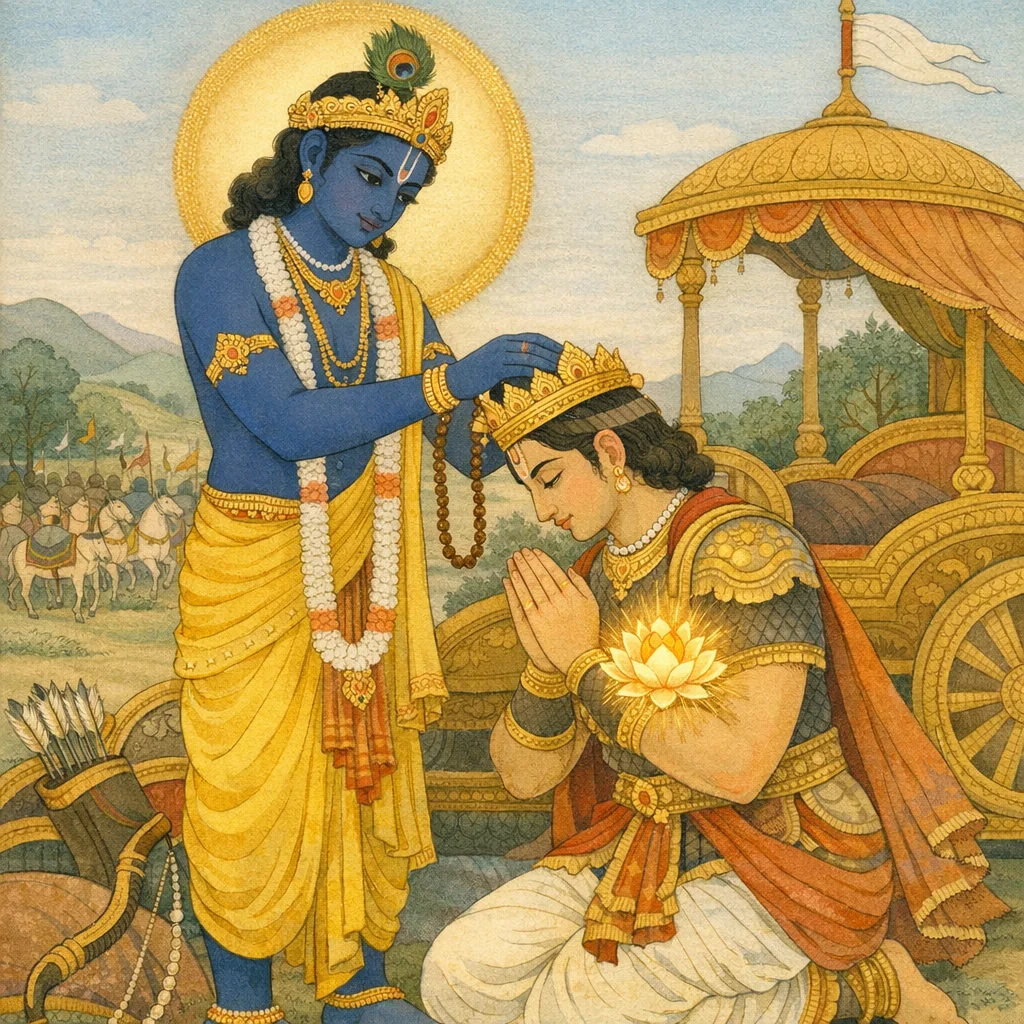
श्रीभगवानुवाच । मय्यावेश्य मनो ये मां नित्ययुक्ता उपासते श्रद्धया परयोपेतास्ते मे युक्ततमा मताः ॥ १२.२ ॥
śrī-bhagavān uvāca | mayy āveśya mano ye māṁ nitya-yuktā upāsate śraddhayā parayopetās te me yuktatamā matāḥ || 12.2 ||

श्रीभगवान ने कहा: जो नित्य युक्त होकर, परम श्रद्धा से युक्त, मन को मुझमें स्थिर करके मेरी उपासना करते हैं—वे मेरे द्वारा सबसे अधिक युक्त (योग में स्थित) माने जाते हैं।
The Blessed Lord said: Those devotees who, ever steadfast, worship Me with supreme faith, fixing their mind on Me—those are considered by Me to be the most united (in Yoga).
The Lord said: Those who, having directed their mind into Me, worship Me—constantly disciplined, endowed with highest faith—are regarded by Me as the most integrated (yuktatamāḥ).
Most traditional renderings emphasize ‘personal devotion’ (upāsanā of ‘Me’ as Īśvara). A more literal academic reading highlights the yogic register of ‘yukti’ (integration/discipline) and the psychological act of ‘āveśya’ (placing/immersing the mind). No major variant is implied here beyond interpretive emphasis.
FAQs
The verse describes sustained attentional absorption: the mind is repeatedly oriented toward a chosen ideal (Krishna/Īśvara), supported by stable commitment (nitya-yuktā) and deep trust (parā śraddhā).
It frames the highest ‘yukti’ as devotion to the personal divine, implying that relational worship can be a complete path to realization, not merely a preliminary practice.
This answers Arjuna’s question (12.1) about which practitioners are superior: those devoted to the personal Lord or those contemplating the imperishable unmanifest.
As a practice-model: choose a value or sacred focus, return attention to it consistently, and let trust/meaning stabilize motivation in daily routines.