
Shloka 5
Purushottama Yoga — Purushottama Yoga
निर्मानमोहा जितसङ्गदोषा अध्यात्मनित्या विनिवृत्तकामाः । द्वन्द्वैर्विमुक्ताः सुखदुःखसंज्ञैर्गच्छन्त्यमूढाः पदमव्ययं तत् ॥१५.५॥
nirmāna-mohā jita-saṅga-doṣā adhyātma-nityā vinivṛtta-kāmāḥ | dvandvair vimuktāḥ sukha-duḥkha-saṃjñair gacchanty amūḍhāḥ padam avyayaṃ tat ||15.5||

અહંકાર અને મોહથી રહિત, આસક્તિનો દોષ જીતેલા, અધ્યાત્મમાં નિત્યનિષ્ઠ, ઇચ્છાઓ શમેલી, અને સુખ-દુઃખ નામના દ્વંદ્વોથી મુક્ત—એવા અમૂઢ જન તે અવ્યય પદને પ્રાપ્ત કરે છે.
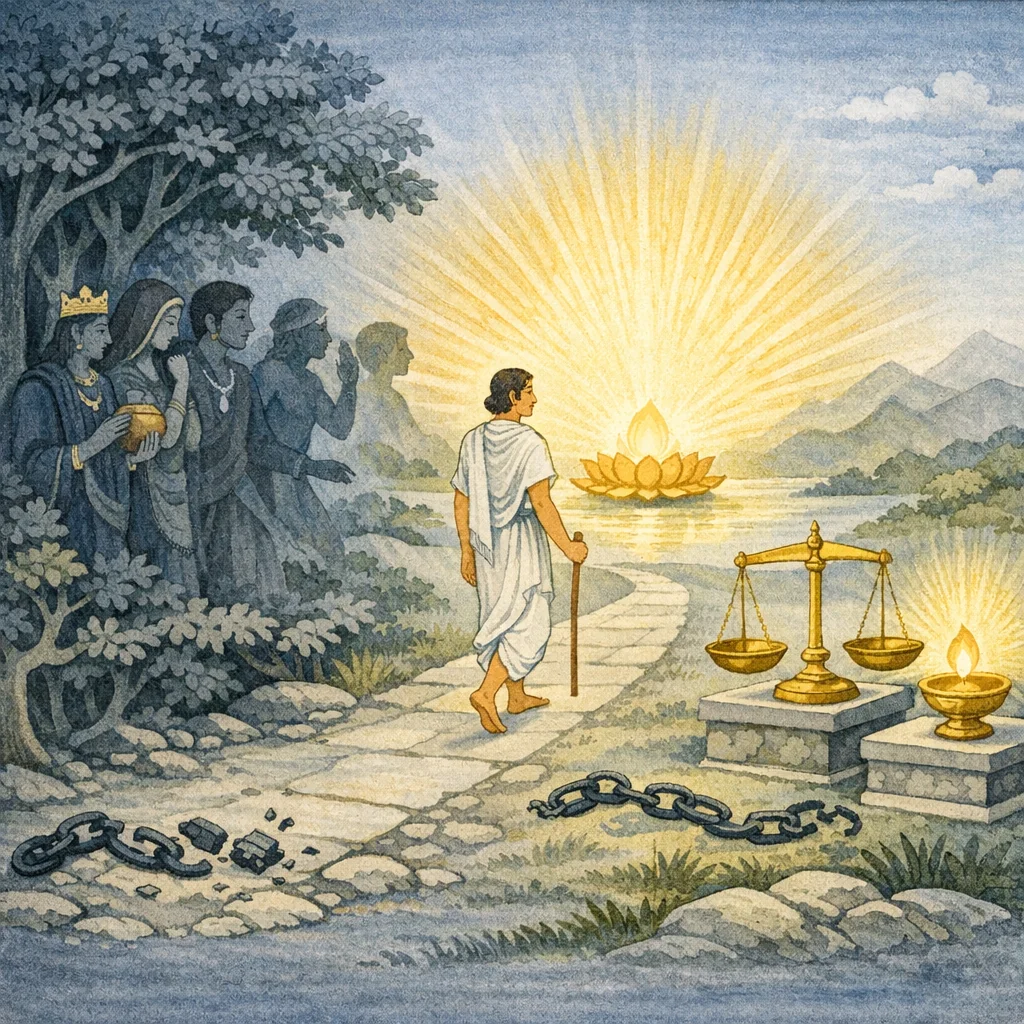
Those who are free from pride and delusion, who have conquered the defect of attachment, who are ever devoted to the Self (spiritual knowledge), whose desires have ceased, and who are liberated from the pairs of opposites known as pleasure and pain—such undeluded persons reach that imperishable state.
Free from self-conceit and bewilderment, having overcome the fault inherent in attachment, constantly oriented to the inner self, with desires turned back (ceased), released from the dualities designated as pleasure and pain—those not deluded go to that imperishable abode.
Most recensions read substantially the same. Translation differences typically concern (a) saṅga-doṣa: rendered as “defect of attachment” (ethical-psychological) versus “fault caused by association/attachment” (more literal), and (b) adhyātma-nityā: interpreted devotionally as “constantly engaged in spiritual practice” or philosophically as “constantly grounded in the self/inner domain.” The verse is often linked by commentators to the soteriological ‘path’ to the avyaya-pada (‘imperishable state/abode’).
FAQs
The verse outlines a psychological profile associated with liberation: reduced ego-inflation (nirmāna), diminished cognitive distortion or confusion (amohā), loosening of compulsive attachment (jita-saṅga-doṣā), and affective balance in response to pleasure and pain (dvandvair vimuktāḥ). It can be read as a description of stabilized attention and emotion regulation grounded in sustained self-reflection (adhyātma-nityā).
Metaphysically, it presents prerequisites for reaching the ‘imperishable state/abode’ (padam avyayam), commonly associated with liberation (mokṣa) or realization of the highest principle. The verse implies that bondage is sustained by delusion, ego-identification, desire, and dualistic valuation; release involves their cessation or transcendence.
Chapter 15 uses the metaphor of an inverted aśvattha tree to depict conditioned existence and its entanglements. Verse 5 functions as a practical-ethical bridge: it specifies the dispositions and disciplines by which one becomes fit to move beyond that entanglement and ‘go’ toward the imperishable.
In contemporary terms, it can be applied as guidance for reducing ego-driven behavior, examining attachments that drive distress, cultivating reflective practices (study, meditation, ethical self-discipline), and developing steadiness amid changing experiences of comfort and discomfort—without requiring withdrawal from ordinary responsibilities.