
Bhagavad Gita — Moksha Sannyasa Yoga, Shloka 22
Moksha Sannyasa Yoga
यत्तु कृत्स्नवदेकस्मिन्कार्ये सक्तमहैतुकम् । अतत्त्वार्थवदल्पं च तत्तामसमुदाहृतम् ॥ १८.२२ ॥
yat tu kṛtsnavad ekasmin kārye saktam ahaitukam | atattvārthavad alpaṁ ca tat tāmasam udāhṛtam || 18.22 ||

પરંતુ જે જ્ઞાન એક જ કાર્ય (અથવા વસ્તુ)માં બધું જ છે એમ માની તેમાં આસક્ત થઈ જાય છે, જે અયુક્ત/કારણરહિત છે, જે તત્ત્વાર્થથી રહિત અને અલ્પ છે—તે તામસ કહેવાય છે.
परन्तु जो ज्ञान एक ही कार्य (या वस्तु) में सब कुछ मानकर आसक्त हो जाता है, जो अयुक्त/कारण-रहित है, जो तत्त्वार्थ से रहित और तुच्छ है—वह तामस कहा गया है।
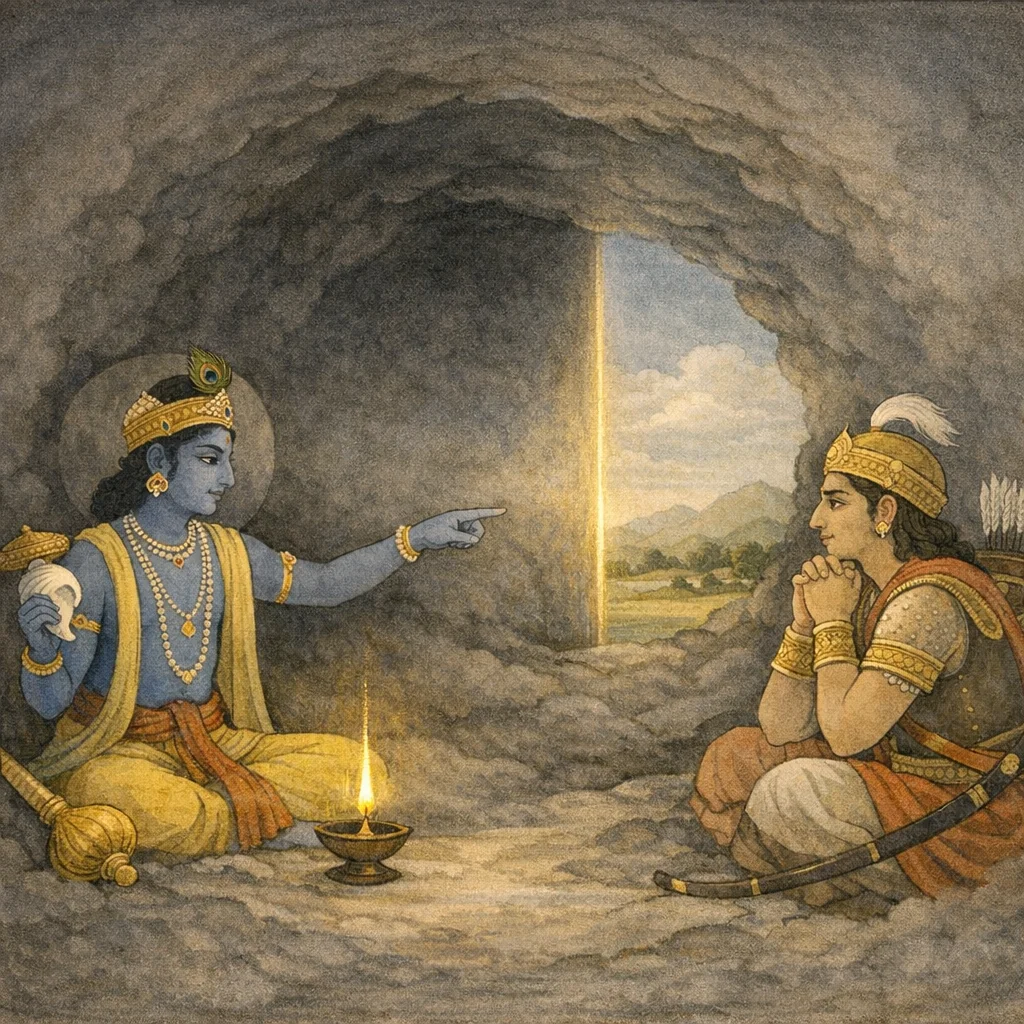
But that which is attached to one single effect/undertaking as if it were the whole, without proper grounding, lacking insight into reality, and narrow—that is declared tamasic.
Traditional translations often interpret ‘ekasmin kārye’ as fixation on a single aspect or method, mistaking it for the entirety. Academic renderings keep the semantic range of kārya (‘effect’, ‘task’, ‘project’) and read the verse as a critique of dogmatic, poorly reasoned cognition.
FAQs
Tamasic knowledge is described as rigid fixation: treating one limited viewpoint as total, with weak reasoning and poor reality-testing. It resembles cognitive narrowing and confirmation bias.
It indicates a mode of knowing dominated by tamas—obscuration—where the structure of reality is not adequately apprehended, preventing insight into deeper principles.
Completing the triad on knowledge, it sets up how action and agency will likewise be classified by clarity, restlessness, and inertia.
It cautions against absolutizing a single metric, ideology, or technique as the whole truth, encouraging broader evidence, reflection, and intellectual humility.