
Bhagavad Gita — Moksha Sannyasa Yoga, Shloka 11
Moksha Sannyasa Yoga
न हि देहभृता शक्यं त्यक्तुं कर्माण्यशेषतः । यस्तु कर्मफलत्यागी स त्यागीत्यभिधीयते ॥ १८.११ ॥
na hi deha-bhṛtā śakyaṃ tyaktuṃ karmāṇy aśeṣataḥ | yas tu karma-phala-tyāgī sa tyāgīty abhidhīyate || 18.11 ||

દેહધારી મનુષ્ય માટે સર્વ કર્મોનો સંપૂર્ણ ત્યાગ કરવો શક્ય નથી; પરંતુ જે કર્મફળનો ત્યાગ કરે છે, તેને જ ‘ત્યાગી’ કહેવાય છે.
देहधारी मनुष्य के लिए समस्त कर्मों का पूर्णतः त्याग करना संभव नहीं है; जो कर्मफल का त्याग करता है, वही त्यागी कहा जाता है।
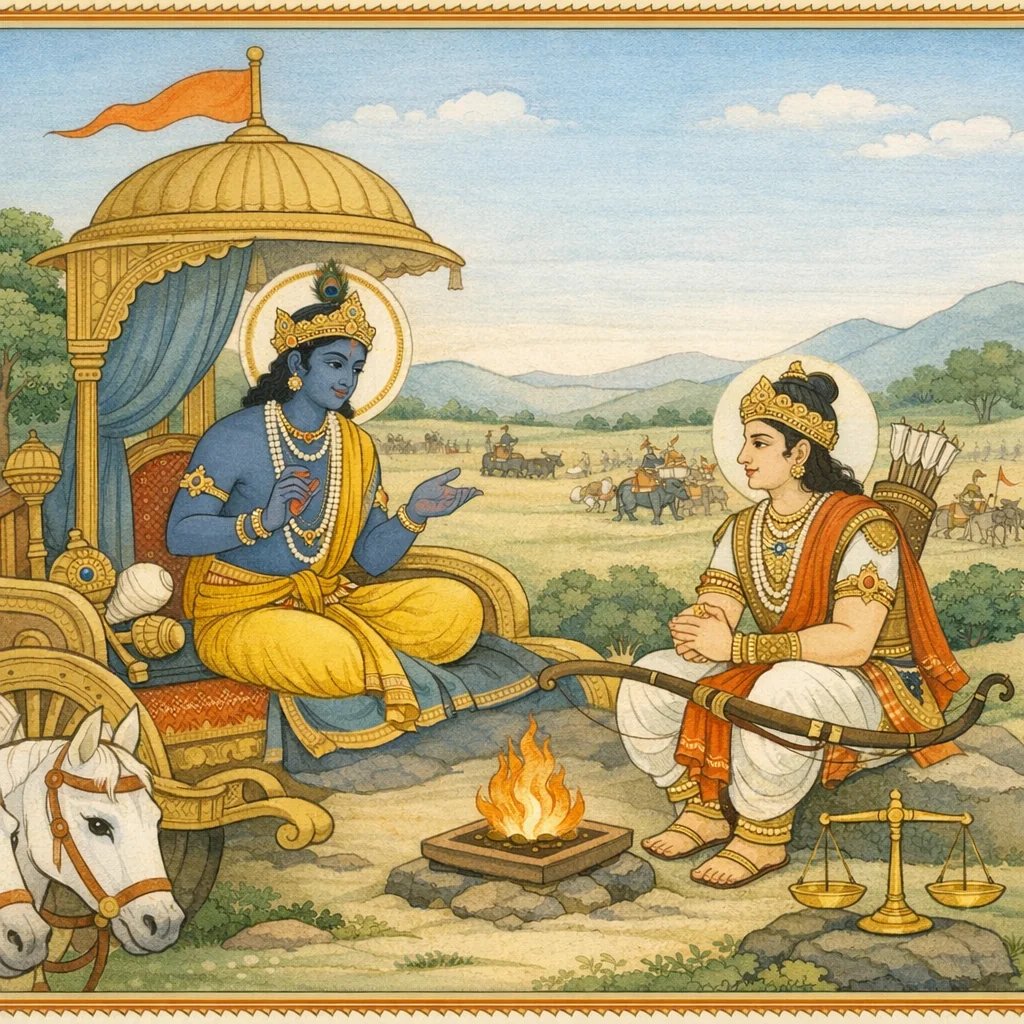
For one who bears a body, it is not possible to abandon actions entirely; rather, the one who relinquishes the fruits of action is called a renouncer.
Traditional expositions often use this to reconcile household life with spiritual practice: ‘renunciation’ is redefined as inner relinquishment. Academic renderings emphasize practical anthropology: embodied life entails activity.
FAQs
It reframes spiritual discipline away from suppression of activity toward changing one’s relationship to outcomes—reducing compulsive reward-seeking.
Action belongs to embodied existence and the guṇas; liberation-oriented practice targets attachment to results, which is a key mechanism of karmic continuity.
This verse supports the chapter’s broader argument that renunciation is primarily internal (tyāga of fruit/attachment), not mere external withdrawal.
In ordinary life, one cannot avoid acting; the practical discipline is to work responsibly while loosening fixation on promotion, applause, or control.
Ask anything about this verse
Curious about the meaning, context, or a word? Ask, and continue the conversation in the Vedapath app.
A free Google sign-in keeps your chat saved across web and the app.
Read Bhagavad Gita in the Vedapath app
Scan the QR code to open this directly in the app, with audio, word-by-word meanings, and more.