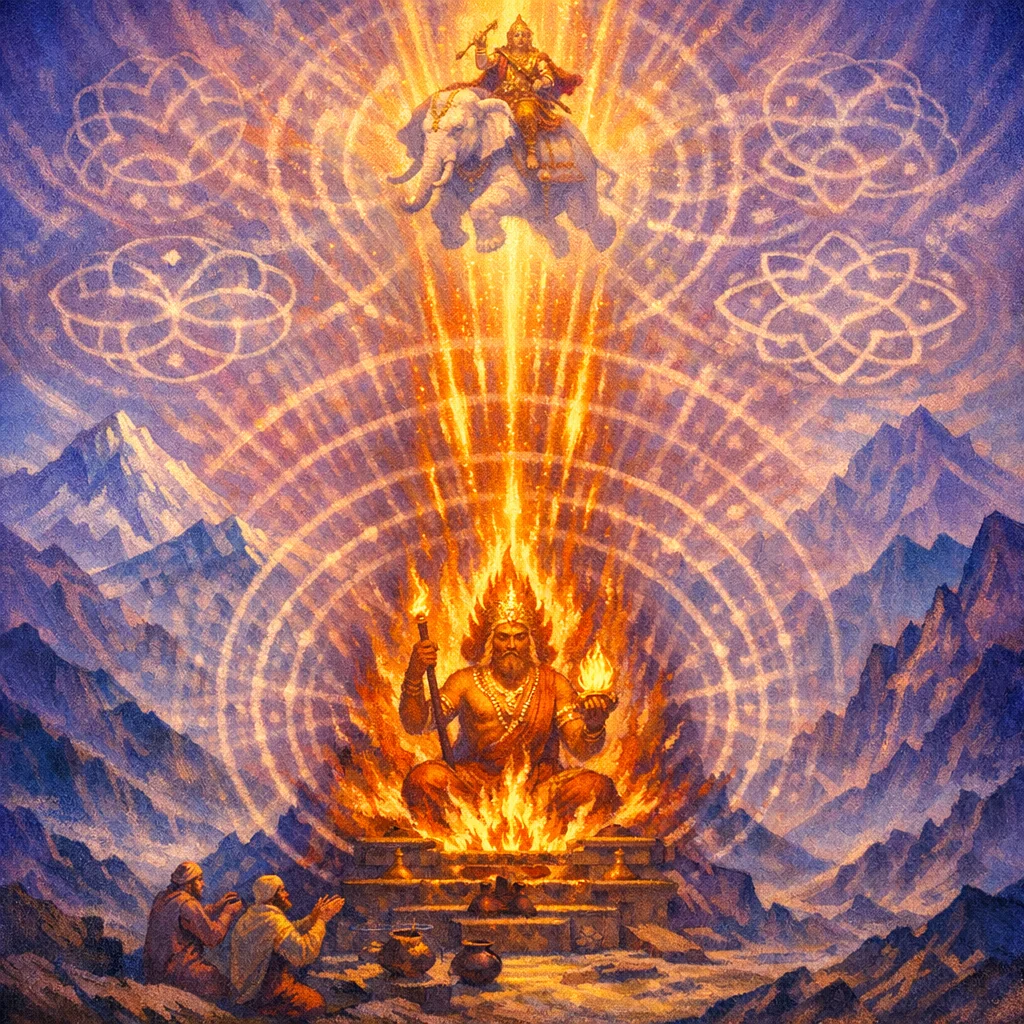
Dashati 1
Agni’s manifold presence invoked to establish and empower the sacrifice
Agni
Invocatory and energizing—urgent ‘come-hither’ movement with ritual brightness
R̥ṣi attribution is not provided in the input; these verses are RV-derived in many recensions but dashati-level r̥ṣi identification should be taken from the Anukramaṇī of the relevant Sāmaveda śākhā.
La présence multiple d’Agni est invoquée pour établir et rendre efficace le sacrifice : il est le feu très ancien et toujours renouvelé, allumé par la louange et l’oblation ; les trois feux rituels (gārhapatya, āhavanīya, dakṣiṇa) ne font qu’un seul Agni divin. En appui, on appelle aussi la force alliée d’Indra, dont l’arrivée est mise en mouvement par le chant hymnique. La parole sacrée (vacas, brahman) et l’acte rituel juste « font venir » la divinité : Agni se rend présent comme porteur de l’offrande et puissance sacerdotale, croissant par la stotra et l’āhuti.
Mantras
Mantra 1
विश्वेभिरग्ने अग्निभिरिमं यज्ञमिदं वचः चनो घाः सहसा यहो
Avec tous tes feux, Agni, viens à ce sacrifice et à cet hymne qui est le nôtre ; viens à nous avec puissance, ô Vigoureux.
Mantra 2
ऊर्ज्जो नपातमा हुवे ऽग्निं पावकशोचिषम् अस्मिन्यज्ञे स्वध्वरे
Ūrjo napātam — Agni — j’invoque, Agni à l’éclat purificateur ; qu’il soit présent en ce sacrifice, en ce rite bien ordonné (svadhvara).
Mantra 3
स नो मित्रमहस्त्वमग्ने शुक्रेण शोचिषा देवैरा सत्सि बर्हिषि
Ô Agni, ami bienfaisant, sois pour nous un bien : de ta flamme lumineuse, viens avec les dieux et assieds-toi sur le barhis, l’herbe sacrée.
Frequently Asked Questions
It repeatedly calls Agni to the sacrifice in all his forms and explains, by implication, that praise and offering make him present and powerful within the rite.
Indra is invited as a supportive, praise-delighting deity—his arrival is ‘carried’ by the hymn, complementing Agni who carries the oblations.
It points to Agni’s manifold manifestations used in sacrifice—especially the household and altar fires—understood as one divine Agni functioning in different stations.