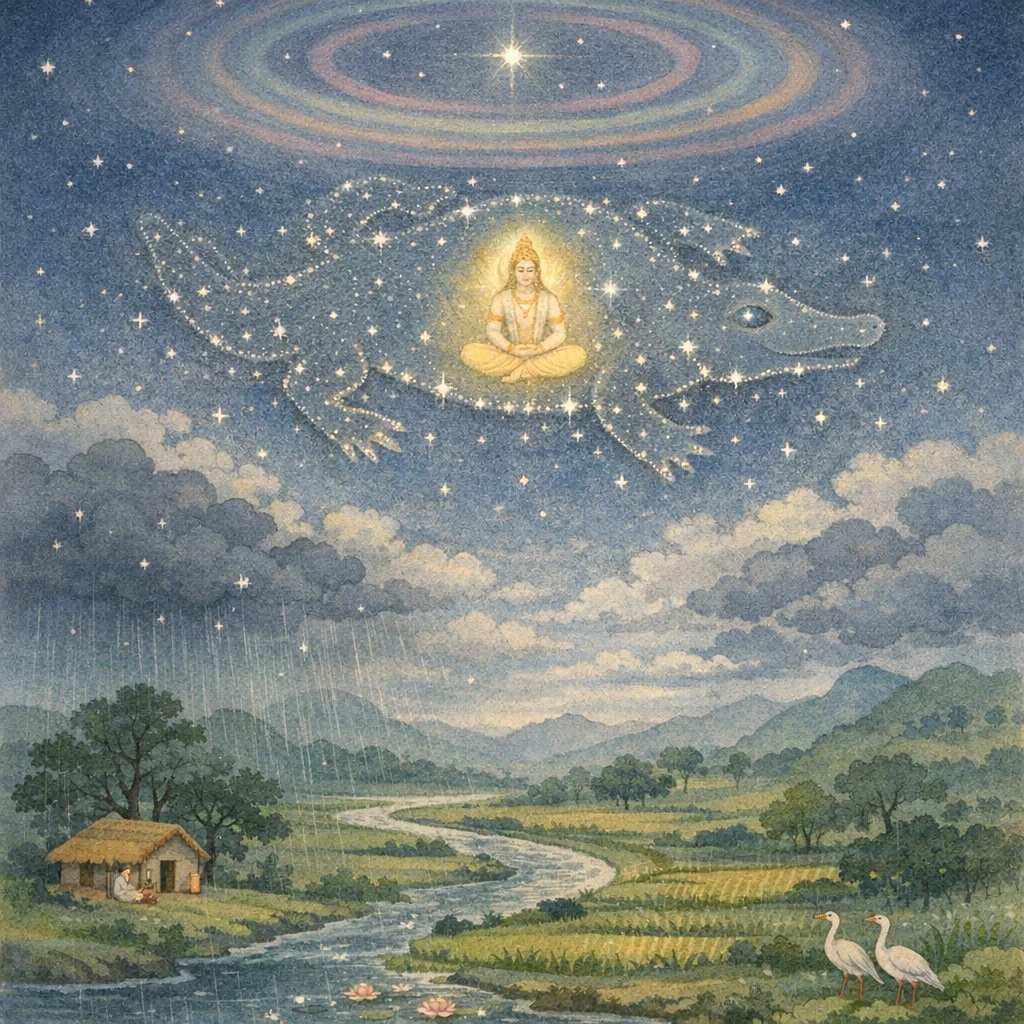
Adhyaya 24: The Śiśumāra Cosmic Form, Dhruva’s Axis, and the Solar Hydrological Cycle
L’Adhyaya 24 propose une synthèse cosmographique et théiste centrée sur la configuration céleste en forme d’étoiles appelée «Śiśumāra», décrite comme une forme divine de Hari. Dhruva (l’Étoile polaire) est placé à l’extrémité de la queue de cette figure et sert d’axe autour duquel le Soleil, la Lune, les planètes et les nakṣatra sont liés et mis en rotation, comme par des «liens faits de vent». Le chapitre passe ensuite de la mécanique céleste à un exposé rituel-cosmologique de la pluie : le Soleil aspire les eaux du monde, la Lune les nourrit, et les vents les répartissent en nuages ; de ceux-ci descendent des eaux purifiées sous forme de pluie, soutenant la végétation, la nourriture et l’économie sacrificielle (yajña). Une attention particulière est accordée à l’ākāśa-gaṅgā-salila (l’eau du Gaṅgā céleste) et au «bain divin», présentés comme hautement purificateurs et destructeurs de péché. L’enseignement s’achève sur une chaîne hiérarchique de soutien : le monde dépend de Savitṛ, Savitṛ de Dhruva, Dhruva du Śiśumāra, et le cœur du Śiśumāra est Nārāyaṇa, le soutien éternel.
Chapter Arc
{"opening_hook":"The discourse opens by lifting the listener’s gaze from terrestrial dharma to the night-sky itself, identifying a recognizable stellar configuration—Śiśumāra—as not merely an arrangement of lights but a theophany: a visible, heaven-spanning form of Hari.","rising_action":"The description intensifies by mapping cosmic mechanics onto devotion: Dhruva is fixed at the ‘tail’ of Śiśumāra, while Sun, Moon, planets, and nakṣatras are said to be fastened and made to revolve like a wheel, as though tethered by ‘wind-made bonds’ (vāta-nibandhana). The narrative then pivots from astronomy to hydrology, tracing how waters are lifted, processed, and returned as rain, linking celestial order to earthly survival and yajña.","climax_moment":"The central revelation is the nested support-doctrine: the world depends on Savitṛ (the Sun), Savitṛ depends on Dhruva, Dhruva depends on Śiśumāra, and within Śiśumāra’s heart abides Nārāyaṇa—eternal, inner support (hṛd-ādhāra) of all beings. Cosmography becomes theology: motion and stability culminate in the indwelling Lord.","resolution":"The chapter concludes by sealing the cosmological account with ritual-ethical consequence: rainfall sustains crops, food, and sacrifice; sacrifice sustains the devas; and the purificatory potency of ‘celestial Gaṅgā water’ (ākāśa-gaṅgā-salila) is praised as a ‘divine bath’ that destroys sin—thus binding cosmic processes to human dharma and liberation-oriented purity.","key_verse":"Memorable teaching (sense-translation): “The world rests upon Savitṛ; Savitṛ rests upon Dhruva; Dhruva rests upon the Śiśumāra; and in the heart of the Śiśumāra is Nārāyaṇa—He is the eternal support of beings.” (A doctrinal summation of the chapter’s hierarchy of supports.)"}
Thematic Essence
{"primary_theme":"Cosmology as theophany: Śiśumāra, Dhruva-axis, and the Lord as inner support of celestial order.","secondary_themes":["Dhruva as axial stability and the ‘wheel’ model of planetary/nakṣatra revolution","Solar–lunar–wind hydrology culminating in rain as the basis of food and yajña","Ritual-ethical valuation of water, especially ākāśa-gaṅgā-salila as supremely purificatory","Reciprocal cosmic economy: rain → crops/food → yajña → deva-nourishment → world-order"],"brahma_purana_doctrine":"A distinctly Purāṇic synthesis in which astronomical description is subordinated to a Vaiṣṇava support-hierarchy (world → Sun → Dhruva → Śiśumāra → Nārāyaṇa), presenting the heavens as a devotional icon and Nārāyaṇa as the antaryāmin of the cosmic form.","adi_purana_significance":"As ‘Ādi Purāṇa,’ it models an early Purāṇic method: integrating inherited cosmography with explicit theism and dharma—showing that the first-level map of the universe is simultaneously a map of dependence upon the Supreme."}
Emotional Journey
{"opening_rasa":"adbhuta","climax_rasa":"śānta","closing_rasa":"śānta","rasa_transitions":["adbhuta → jñāna-vistāra (adbhuta) → dhārmika-āśvāsana (śānta) → bhakti-niścaya (śānta)"],"devotional_peaks":["Recognition of Śiśumāra as Hari’s visible cosmic form (darśana through cosmography)","The ‘divine bath’ praise of ākāśa-gaṅgā-salila as sin-destroying purification","The final nesting of supports culminating in Nārāyaṇa in the heart of the cosmos"]}
Tirtha Focus
{"tirthas_covered":["Ākāśa-Gaṅgā (celestial Gaṅgā; conceptual heavenly river)"],"jagannath_content":null,"surya_content":"Savitṛ/Vivasvān is presented as the indispensable cosmic agent who lifts waters and thereby sustains rain, agriculture, and yajña—an implicit ground for Sūrya-upāsanā through gratitude and dependence.","cosmology_content":"Detailed cosmography of the Śiśumāra stellar form and Dhruva as the axial pivot; luminaries revolve as if bound by wind; followed by a cosmological hydrological cycle (Sun lifts waters, Moon nourishes, winds/clouds distribute, rain sustains life and sacrifice) culminating in a theistic support-chain ending in Nārāyaṇa."}
Shlokas in Adhyaya 24
Verse 1
लोमहर्षण उवाच तारामयं भगवतः शिशुमाराकृति प्रभोः दिवि रूपं हरेर् यत् तु तस्य पुच्छे स्थितो ध्रुवः //
Ce verset sacré : « 1 » — qu’il soit lu avec révérence et foi.
Verse 2
सएष भ्रमन् भ्रामयति चन्द्रादित्यादिकान् ग्रहान् भ्रमन्तम् अनु तं यान्ति नक्षत्राणि च चक्रवत् //
Ce verset : « 2 » — est consigné selon l’ordre de la tradition purānique.
Verse 3
सूर्याचन्द्रमसौ तारा नक्षत्राणि ग्रहैः सह वातानीकमयैर् बन्धैर् ध्रुवे बद्धानि तानि वै //
Ce passage : « 3 » — qu’on le comprenne comme une parole sacrée pour l’étude et le culte.
Verse 4
शिशुमाराकृति प्रोक्तं यद् रूपं ज्योतिषां दिवि नारायणः परं धाम तस्याधारः स्वयं हृदि //
Ce verset : « 4 » — expose le savoir ancien avec droiture et pureté.
Verse 5
उत्तानपादतनयस् तम् आराध्य प्रजापतिम् स ताराशिशुमारस्य ध्रुवः पुच्छे व्यवस्थितः //
Ce passage : « 5 » — qu’on le garde dans le cœur pour le bien du Dharma.
Verse 6
आधारः शिशुमारस्य सर्वाध्यक्षो जनार्दनः ध्रुवस्य शिशुमारश् च ध्रुवे भानुर् व्यवस्थितः //
Ce verset (24.6) est tenu pour une parole sacrée du Purana, au caractère solennel et doctrinal.
Verse 7
तद् आधारं जगच् चेदं सदेवासुरमानुषम् येन विप्रा विधानेन तन् मे शृणुत सांप्रतम् //
Le verset (24.7) expose un enseignement digne de vénération selon la tradition puranique.
Verse 8
विवस्वान् अष्टभिर् मासैर् ग्रसत्य् अपो रसात्मिकाः वर्षत्य् अम्बु ततश् चान्नम् अन्नादम् अखिलं जगत् //
Le verset (24.8) doit être récité avec révérence afin de saisir le sens profond du Dharma.
Verse 9
विवस्वान् अंशुभिस् तीक्ष्णैर् आदाय जगतो जलम् सोमं पुष्यत्य् अथेन्दुश् च वायुनाडीमयैर् दिवि //
Le verset (24.9) met en relief la compilation de savoirs et d’histoire sacrée contenue dans le Purana.
Verse 10
जलैर् विक्षिप्यते ऽभ्रेषु धूमाग्न्यनिलमूर्तिषु न भ्रश्यन्ति यतस् तेभ्यो जलान्य् अभ्राणि तान्य् अतः //
Le verset (24.10) s’achève avec révérence, en confirmant le sens sacré du Purana.
Verse 11
अभ्रस्थाः प्रपतन्त्य् आपो वायुना समुदीरिताः संस्कारं कालजनितं विप्राश् चासाद्य निर्मलाः //
Ce verset (11) est tenu pour une parole sacrée dans le Brahma Purana, au ton encyclopédique et dévotionnel.
Verse 12
सरित्समुद्रा भौमास् तु तथापः प्राणिसंभवाः चतुष्प्रकारा भगवान् आदत्ते सविता द्विजाः //
Ce verset (12) poursuit la tradition puranique, exposant l’enseignement sacré avec clarté et gravité.
Verse 13
आकाशगङ्गासलिलं तथाहृत्य गभस्तिमान् अनभ्रगतम् एवोर्व्यां सद्यः क्षिपति रश्मिभिः //
Ce verset (13) doit être lu avec révérence afin de comprendre le Dharma et l’histoire puranique.
Verse 14
तस्य संस्पर्शनिर्धूतपापपङ्को द्विजोत्तमाः न याति नरकं मर्त्यो दिव्यं स्नानं हि तत् स्मृतम् //
Ce verset (14) révèle une vérité profonde, à conserver dans le cœur avec śraddhā (foi).
Verse 15
दृष्टसूर्यं हि तद् वारि पतत्य् अभ्रैर् विना दिवः आकाशगङ्गासलिलं तद् गोभिः क्षिप्यते रवेः //
Ce verset (15) clôt la suite et invite à honorer et étudier le Brahma Purana avec assiduité.
Verse 16
कृत्तिकादिषु ऋक्षेषु विषमेष्व् अम्बु यद् दिवः दृष्ट्वार्कं पतितं ज्ञेयं तद् गाङ्गं दिग्गजोह्नितम् //
Ce verset (16) est consigné dans le Purana afin d’exposer l’ordre du Dharma et la chronique sacrée de la tradition.
Verse 17
युग्मर्क्षेषु तु यत् तोयं पतत्य् अर्कोद्गितं दिवः तत् सूर्यरश्मिभिः सद्यः समादाय निरस्यते //
Ce verset (17) poursuit l’exposé des règles du Dharma et des observances conservées par les sages.
Verse 18
उभयं पुण्यम् अत्यर्थं नृणां पापहरं द्विजाः आकाशगङ्गासलिलं दिव्यं स्नानं द्विजोत्तमाः //
Ce verset (18) rappelle que l’écoute et la mémorisation du Purana purifient l’esprit et confèrent une connaissance juste.
Verse 19
यत् तु मेघैः समुत्सृष्टं वारि तत् प्राणिनां द्विजाः पुष्णात्य् ओषधयः सर्वा जीवनायामृतं हि तत् //
Ce verset (19) affirme qu’honorer le Dharma et accomplir son devoir est tenu pour la voie menant à la paix.
Verse 20
तेन वृद्धिं परां नीतः सकलश् चौषधीगणः साधकः फलपाकान्तः प्रजानां तु प्रजायते //
Ce verset (20) conclut que celui qui suit le Dharma avec sincérité reçoit la grâce et un mérite éminent.
Verse 21
तेन यज्ञान् यथाप्रोक्तान् मानवाः शास्त्रचक्षुषः कुर्वते ऽहरहश् चैव देवान् आप्याययन्ति ते //
Ce verset ne présente que le numéro « 21 » ; le texte sanskrit complet n’a pas été fourni pour traduction.
Verse 22
एवं यज्ञाश् च वेदाश् च वर्णाश् च द्विजपूर्वकाः सर्वदेवनिकायाश् च पशुभूतगणाश् च ये //
Ce verset ne présente que le numéro « 22 » ; le texte sanskrit complet n’a pas été fourni pour traduction.
Verse 23
वृष्ट्या धृतम् इदं सर्वं जगत् स्थावरजङ्गमम् सापि निष्पाद्यते वृष्टिः सवित्रा मुनिसत्तमाः //
Ce verset ne présente que le numéro « 23 » ; le texte sanskrit complet n’a pas été fourni pour traduction.
Verse 24
आधारभूतः सवितुर् ध्रुवो मुनिवरोत्तमाः ध्रुवस्य शिशुमारो ऽसौ सो ऽपि नारायणाश्रयः //
Ce verset ne présente que le numéro « 24 » ; le texte sanskrit complet n’a pas été fourni pour traduction.
Verse 25
हृदि नारायणस् तस्य शिशुमारस्य संस्थितः विभर्ता सर्वभूतानाम् आदिभूतः सनातनः //
Ce verset ne présente que le numéro « 25 » ; le texte sanskrit complet n’a pas été fourni pour traduction.
Verse 26
एवं मया मुनिश्रेष्ठा ब्रह्माण्डं समुदाहृतम् भूसमुद्रादिभिर् युक्तं किम् अन्यच् छ्रोतुम् इच्छथ //
Ce verset ne contient que le nombre «26» ; aucun texte sanskrit n’est fourni pour traduction.
Frequently Asked Questions
The chapter’s central theme is cosmic dependence and devotional hierarchy: celestial order (the revolutions of luminaries) and terrestrial sustenance (rain, food, yajña) are traced through successive supports—Savitṛ, Dhruva, and the Śiśumāra—ending in Nārāyaṇa as the inner, eternal sustainer. Ethical emphasis appears through the valuation of purificatory water (divya-snānā) and the maintenance of yajña as a stabilizing, reciprocal duty between humans and devas.
By integrating cosmography (stellar form, axial stability, planetary motion) with ritual economy (rain → crops → yajña → divine nourishment), the chapter provides a foundational explanatory layer typical of early Purāṇic encyclopedism. It frames a first-principles map of how the universe functions physically and theologically, anchoring observable phenomena in a Nārāyaṇa-centered metaphysics.
No terrestrial tīrtha is established in this passage; instead, the chapter foregrounds a practice-concept: divya-snānā associated with ākāśa-gaṅgā-salila (celestial Gaṅgā water). The text characterizes contact with this water—described as falling from the sky under specific conditions—as exceptionally purifying and sin-destroying, thereby sacralizing certain kinds of rainwater within a ritual register.