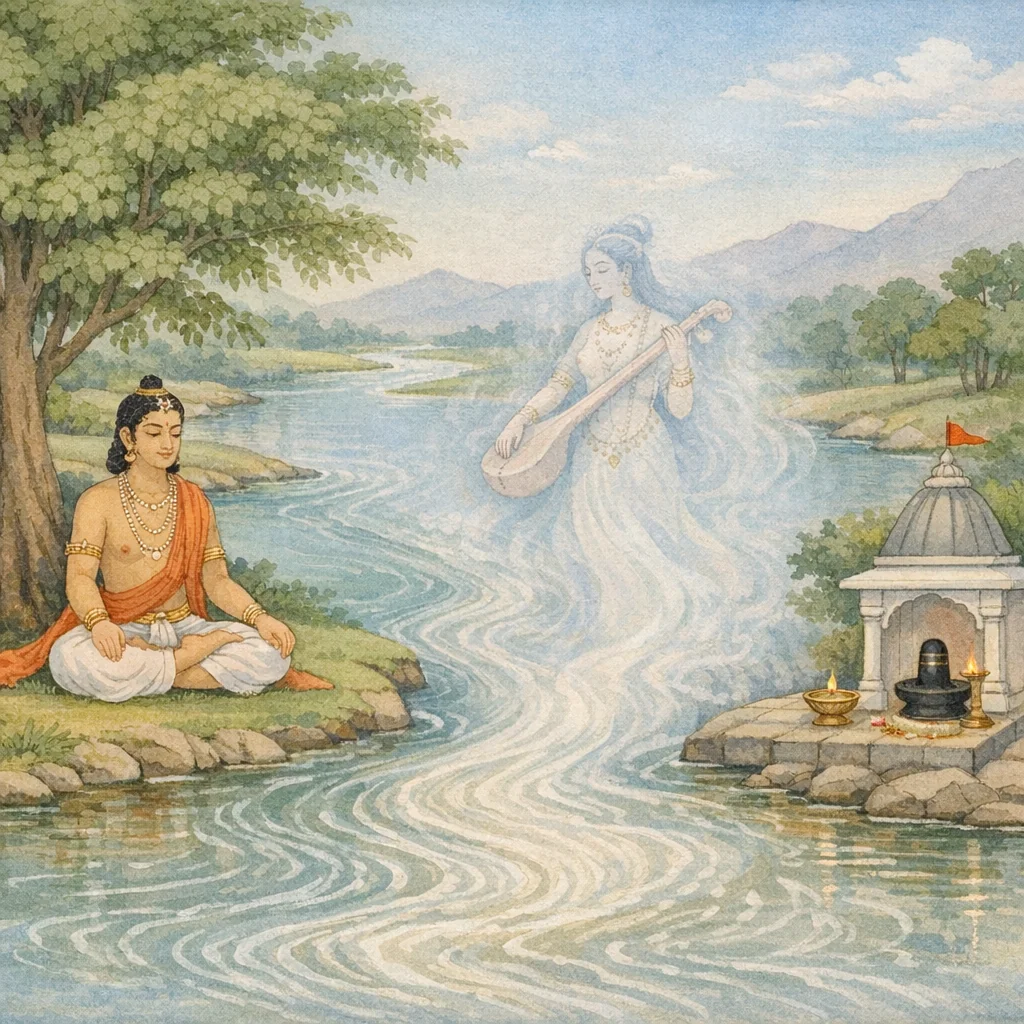
Adhyaya 101: Purūravas Tīrtha and the Sarasvatī–Gaṅgā Confluence: Visibility, Curse, and Boon
L’Adhyāya 101 établit l’étiologie sacrée du tīrtha nommé Purūravasam, en soulignant la puissance purificatrice du souvenir et du darśana direct. Dans l’assemblée de Brahmā, le roi Purūravas rencontre l’éclatante Urvaśī et apprend que cette forme splendide est en vérité Sarasvatī, fille de Brahmā, qui mystérieusement « vient et s’en va », alternant entre visibilité et invisibilité. Par l’entremise d’Urvaśī, Sarasvatī accepte d’accompagner le roi, déclenchant une suite d’événements qui aboutit à une malédiction divine et à son atténuation partielle : parmi les mortels, Sarasvatī devient dṛśyā–adṛśyā, et l’on dit qu’elle rejoint la Gaṅgā à une confluence précise. Purūravas accomplit alors des austérités et vénère Śiva sous le nom de Siddheśvara en ce lieu, obtenant par la grâce de la Gaṅgā l’accomplissement de ses désirs. Le chapitre fixe ainsi le nom et la valeur rituelle de Purūravasam, identifie le Sarasvatī-saṅgama comme Brahma-tīrtha et présente Siddheśvara comme la divinité tutélaire exauçant les vœux du sanctuaire.
Chapter Arc
{"opening_hook":"The chapter opens in Brahmā’s sabhā with a sudden flash of beauty and wonder: Purūravas beholds the radiant Urvaśī and is drawn into a mystery of identity and presence—who is this dazzling figure, and why does she appear and vanish?","rising_action":"Curiosity becomes pursuit: Purūravas learns (through the courtly mediation of Urvaśī) that the splendor is Sarasvatī herself, Brahmā’s daughter, marked by a strange rhythm of visibility/invisibility. The king’s request and Sarasvatī’s consent set the narrative in motion toward the riverine landscape, where divine movement becomes sacred geography.","climax_moment":"The etiological revelation: a curse-and-boon logic explains Sarasvatī’s dṛśyā–adṛśyā condition among mortals and fixes her meeting with Gaṅgā at a specific saṅgama. The confluence is declared Brahma-tīrtha, and the chapter’s central teaching crystallizes—smaraṇa and darśana of the tīrtha destroy sin, with direct encounter implicitly supreme.","resolution":"Purūravas performs tapas and worship at the saṅgama, venerating Śiva as Siddheśvara; by Gaṅgā’s prasāda his desires are fulfilled. The site’s ritual identity is sealed: the saṅgama is Brahma-tīrtha, Siddheśvara is the wish-bestowing presiding deity, and the place-name Purūravasam is established as a lasting tīrtha-mahātmya.","key_verse":null}
Thematic Essence
{"primary_theme":"Tīrtha-mahātmya and sacred etiology of Purūravasam (Sarasvatī–Gaṅgā saṅgama as Brahma-tīrtha)","secondary_themes":["Smaraṇa vs darśana: graded efficacy of contact with sacred space","Dṛśyā–adṛśyā divinity: curse–boon as explanation for intermittent visibility","River-confluence theology: sanctity generated by meeting of śaktis","Śaiva integration: Siddheśvara as wish-bestowing guardian of the tīrtha"],"brahma_purana_doctrine":"A distinctive tīrtha-doctrine is asserted: even mere remembrance of Purūravasam destroys sin, while the confluence’s direct darśana and worship (especially of Siddheśvara) yields kāmya-phala—desire-fulfillment—through Gaṅgā’s prasāda.","adi_purana_significance":"As ‘Adi Purāṇa,’ the text models how primordial divine narratives become mapped onto terrestrial geography: a courtly episode in Brahmā’s sphere is converted into a permanent ritual topography (name, deity, saṅgama, and promised fruits), exemplifying Purāṇic world-making."}
Emotional Journey
{"opening_rasa":"अद्भुत (adbhuta)","climax_rasa":"अद्भुत (adbhuta)","closing_rasa":"शान्त (shanta)","rasa_transitions":["adbhuta → शृङ्गार (shringara) → adbhuta → भयानक (bhayanaka) → शान्त (shanta)"],"devotional_peaks":["Purūravas’s turn from fascination to reverent petition once Sarasvatī’s identity is revealed","The declaration of the saṅgama as Brahma-tīrtha (sacral naming as a bhakti-peak)","Purūravas’s tapas and worship of Siddheśvara culminating in boon and inner settling (śānti)"]}
Tirtha Focus
{"tirthas_covered":["पुरूरवस-तीर्थ / पुरूरवसम् (Purūravasam Tīrtha)","सरस्वती-गङ्गा-सङ्गम (Sarasvatī–Gaṅgā confluence)","ब्रह्मतीर्थ (Brahma-tīrtha)","सिद्धेश्वर-स्थान (Siddheśvara shrine/site)"],"jagannath_content":null,"surya_content":null,"cosmology_content":null}
Shlokas in Adhyaya 101
Verse 1
ब्रह्मोवाच पुरूरवसम् आख्यातं तीर्थं वेदविदो विदुः स्मरणाद् एव पापानां नाशनं किं तु दर्शनात् //
Cette section n’indique que le numéro « 1 » et ne donne pas le sanskrit ; merci de fournir le verset complet pour une traduction exacte.
Verse 2
पुरूरवा ब्रह्मसदः प्राप्य तत्र सरस्वतीम् यदृच्छया देवनदीं हसन्तीं ब्रह्मणो ऽन्तिके तां दृष्ट्वा रूपसंपन्नाम् उर्वशीं प्राह भूपतिः //
Ce passage n’affiche que le numéro « 2 » sans le texte sanskrit ; veuillez fournir le verset complet pour une traduction fidèle.
Verse 3
राजोवाच केयं रूपवती साध्वी स्थितेयं ब्रह्मणो ऽन्तिके सर्वासाम् उत्तमा योषिद् दीपयन्ती सभाम् इमाम् //
Cette entrée ne contient que le numéro « 3 » sans le sanskrit ; merci de fournir le verset complet pour une traduction correcte.
Verse 4
ब्रह्मोवाच उर्वशी प्राह राजानम् इयं देवनदी शुभा सरस्वती ब्रह्मसुता नित्यम् एति च याति च तच् छ्रुत्वा विस्मितो राजा आनयेमां ममान्तिकम् //
Ce passage n’indique que le numéro « 4 » sans texte sanskrit ; veuillez fournir le verset complet pour une traduction fidèle.
Verse 5
ब्रह्मोवाच उर्वशी पुनर् अप्य् आह राजानं भूरिदक्षिणम् //
Ce verset (n° 5) est tenu pour une parole sacrée du Purāṇa, au caractère solennel et normatif.
Verse 6
उर्वश्य् उवाच आनीयते महाराज तस्याः सर्वं निवेद्य च //
Ce verset (n° 6) présente un enseignement digne de vénération selon l’antique tradition purānique.
Verse 7
ब्रह्मोवाच ततस् तां प्राहिणोत् तत्र राजा प्रीत्या तदोर्वशीम् सा गत्वा राजवचनं न्यवेदयद् अथोर्वशी //
Ce verset (n° 7) doit être récité avec dévotion et respect, comme une parole sacrée des Écritures.
Verse 8
सरस्वत्य् अपि तन् मेने उर्वश्या यन् निवेदितम् सा तथेति प्रतिज्ञाय प्रायाद् यत्र पुरूरवाः //
Ce verset (n° 8) résume un savoir ancien transmis par le Purāṇa.
Verse 9
सरस्वत्यास् ततस् तीरे स रेमे बहुलाः समाः सरस्वान् अभवत् पुत्रो यस्य पुत्रो बृहद्रथः //
Ce verset (n° 9) est une compilation de parole sacrée destinée à guider l’érudit comme le dévot.
Verse 10
तां गच्छन्तीं नृपगृहं नित्यम् एव सरस्वतीम् सरस्वन्तं ततो लक्ष्म ज्ञात्वान्येषु तथा कृतम् //
Ce verset porte «10» comme numéro d’ordre dans ce chapitre, afin de guider la récitation et l’étude.
Verse 11
तस्यै ददाव् अहं शापं भूया इति महानदी मच्छापभीता वागीशा प्रागाद् देवीं च गौतमीम् //
Ce passage porte le numéro «11», poursuivant la numérotation du chapitre, afin de soutenir l’interprétation et la pratique du dharma.
Verse 12
कमण्डलुभवां पूतां मातरं लोकपावनीम् तापत्रयोपशमनीम् ऐहिकामुष्मिकप्रदाम् //
La mention «12» conserve l’ordre de la parole sacrée du Purāṇa, convenant à la récitation et à l’étude savante.
Verse 13
सा गत्वा गौतमीं देवीं प्राह मच्छापम् आदितः गङ्गापि माम् उवाचेदं विशापां कर्तुम् अर्हसि //
Le numéro «13» indique la place de la strophe dans le chapitre, afin que la référence et l’interprétation soient exactes.
Verse 14
न युक्तं यत् सरस्वत्याः शापं त्वं दत्तवान् असि स्त्रीणाम् एष स्वभावो वै पुंस्कामा योषितो यतः //
Cette numérotation «14» relève de la tradition des textes anciens, afin de préserver la pureté de la transmission de la parole sacrée.
Verse 15
स्वभावचपला ब्रह्मन् योषितः सकला अपि त्वं कथं तु न जानीषे जगत्स्रष्टाम्बुजासन //
Le verset (101.15) ne contient pas le texte sanskrit; veuillez fournir l’original afin d’en proposer une traduction fidèle, sacrée et savante.
Verse 16
विडम्बयति कं वा न कामो वापि स्वभावतः ततो विशापम् अवदं दृश्यापि स्यात् सरस्वती //
Le verset (101.16) ne comporte pas le sanskrit; merci de transmettre le texte source pour une traduction exacte et respectueuse.
Verse 17
तस्माच् छापान् नदी मर्त्ये दृश्यादृश्या सरस्वती यत्रैषा संगता देवी गङ्गायां शापविह्वला //
Le verset (101.17) est dépourvu du texte sanskrit; veuillez fournir la source pour une traduction exacte au registre sacré.
Verse 18
तत्र प्रायान् नृपवरो धार्मिकः स पुरूरवाः तपस् तप्त्वा समाराध्य देवं सिद्धेश्वरं हरम् //
Le verset (101.18) ne fournit pas le sanskrit; merci d’envoyer l’original afin d’éviter toute altération du sens.
Verse 19
सर्वान् कामान् अथावाप गङ्गायाश् च प्रसादतः ततः प्रभृति तत् तीर्थं पुरूरवसम् उच्यते //
Le verset (101.19) ne comporte pas le texte sanskrit; veuillez transmettre l’original pour une traduction exacte et solennelle.
Verse 20
सरस्वतीसंगमं च ब्रह्मतीर्थं तद् उच्यते सिद्धेश्वरो यत्र देवः सर्वकामप्रदं तु तत् //
Ce verset ne présente que le numéro « 20 » sans texte sanskrit ; il est donc impossible d’en traduire le sens.
Frequently Asked Questions
The chapter’s central theme is tīrtha-mahātmya grounded in sacred topography: sin-destruction through smaraṇa and darśana of a named pilgrimage site, and the efficacy of tapas and deity-worship (Śiva as Siddheśvara) at a river confluence to obtain legitimate aims (kāma) under divine sanction.
Adhyāya 101 establishes the Sarasvatī–Gaṅgā saṅgama as Brahma-tīrtha and connects it to the named site Purūravasam. Its significance lies in providing an etiology for Sarasvatī’s intermittent visibility among mortals and in identifying the confluence as a locus where Śiva (Siddheśvara) grants boons, thereby integrating Vaiṣṇava-agnostic tīrtha praise with Śaiva ritual presence.
The chapter implies pilgrimage to Purūravasam/Brahma-tīrtha for purification—beginning with smaraṇa and culminating in darśana—and models a practice of austerity (tapas) and worship of Siddheśvara Śiva at the Sarasvatī–Gaṅgā confluence to seek ‘sarvakāma’ fulfillment, framed as obtained through Gaṅgā’s prasāda.