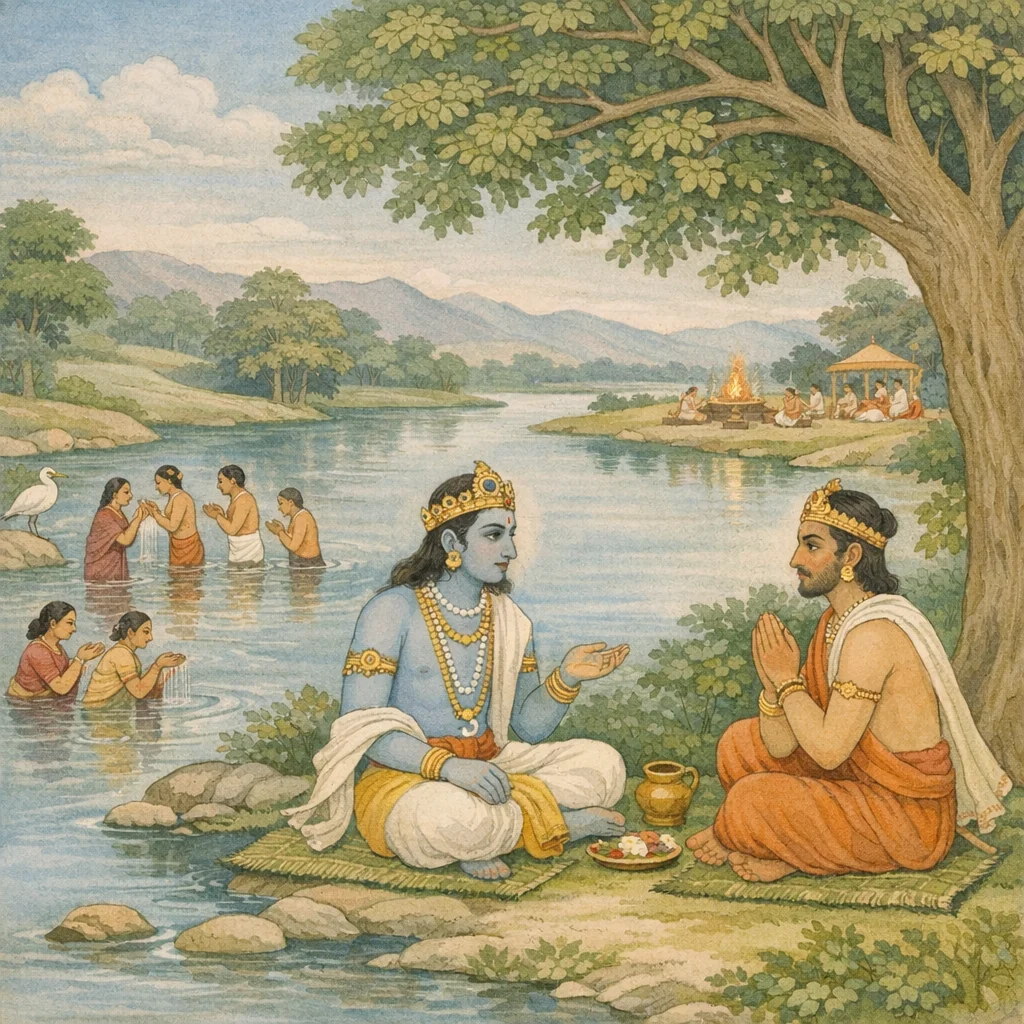
Adhyaya 88: Janasthana Tirtha: Varuna’s Teaching on Karma, Bhukti, and Mukti
L’Adhyaya 88 expose un enseignement de géographie sacrée à travers une enquête philosophique sur le rapport entre bhukti (jouissance mondaine) et mukti (délivrance). Le roi Janaka, issu de la lignée de Vaivasvata et marié à Guṇārṇavā—fille de Varuṇa, Apāṃpati—s’adresse à son purohita Yājñavalkya avec une question majeure du dharma : comment obtenir la libération « aisément » sans l’épreuve sévère du renoncement total. Yājñavalkya le renvoie à Varuṇa, qui enseigne une voie reconnue par les Veda : la délivrance se comprend par la « porte du karma », et non par une doctrine simpliste de non-action. Varuṇa ancre ensuite cette soteriologie dans la terre sainte, louant Bhāratavarṣa—en particulier la région de Daṇḍaka—et élevant la Gautamī Gaṅgā au rang de tīrtha suprême, où yajña, dāna et l’observance rituelle procurent à la fois bhukti et mukti. Le chapitre s’achève par la nomination et la glorification de Janasthāna, étendue de quatre yojana, mémorisée comme le siège sacrificiel des Janaka : le souvenir pieux, le pèlerinage, le bain, les offrandes et les rites aux ancêtres y effacent les fautes et accordent les buts désirés ainsi que la délivrance.
Chapter Arc
{"opening_hook":"A practical dharma-crisis opens the chapter: King Janaka asks how mokṣa can be attained “easily,” without the crushing hardship of total renunciation—framing a tension between royal life (bhukti) and liberation (mukti).","rising_action":"Yājñavalkya refuses a simplistic answer and redirects Janaka to Varuṇa (Apāṃpati), whose authority as Vedic lord of waters and dharma-guardian raises the stakes: the question is not merely personal but doctrinal—whether liberation can be grounded in Vedic action rather than flight from action.","climax_moment":"Varuṇa’s central teaching: mokṣa is intelligible through the “gateway of karma,” and the Veda does not endorse a naïve non-action doctrine; properly ordered Vedic duty (especially within the āśrama system, with gārhasthya highlighted) can yield both bhukti and mukti when performed as dharma rather than as craving.","resolution":"The philosophical resolution is sealed by sacred geography: Varuṇa praises Bhāratavarṣa and the Daṇḍaka region, exalting the Gautamī Gaṅgā as a premier liberating tīrtha; the chapter culminates by naming and glorifying Janasthāna—four yojanas wide—as the Janakas’ yajña-seat where remembrance, pilgrimage, bathing, dāna, and pitṛ-rites destroy sin and grant desired ends and liberation.","key_verse":"“Liberation is not won by mere non-action; it is approached through the gate of Vedic karma—when duty is performed as ordained, it bestows both enjoyment and release.” (Teaching-summary of Varuṇa; chapter’s doctrinal refrain)"}
Thematic Essence
{"primary_theme":"Karma as the Vedic gateway reconciling bhukti and mukti (tīrtha-grounded soteriology).","secondary_themes":["Āśrama-dharma as structured ‘gateways’ of karma, with gārhasthya praised","Gautamī Gaṅgā (Godāvarī) as a premier liberating river-tīrtha","Bhāratavarṣa/Daṇḍaka praise as moral-sacred geography","Janasthāna as yajña-sad of the Janakas; merit through snāna, dāna, pitṛ-tarpaṇa, smaraṇa"],"brahma_purana_doctrine":"This chapter insists that mokṣa is not opposed to Vedic action: karma, when performed as śāstra-ordained duty (and intensified through tīrtha-sevā), becomes a soteriological instrument yielding both bhukti and mukti—rejecting a simplistic ‘non-action alone’ claim.","adi_purana_significance":"As ‘Adi Purāṇa,’ it models the Purāṇic synthesis: philosophical inquiry (mokṣa) is resolved not abstractly but by embedding dharma in place—Bhāratavarṣa and the Gautamī network—showing how primordial teaching becomes lived practice through pilgrimage and rite."}
Emotional Journey
{"opening_rasa":"चिन्ता (a shade of karuṇa/śānta-adjacent concern)","climax_rasa":"शान्त","closing_rasa":"अद्भुत","rasa_transitions":["चिन्ता → जिज्ञासा → शान्त → अद्भुत → शान्त"],"devotional_peaks":["Varuṇa’s pronouncement that Vedic karma can open to mokṣa (a stabilizing śānta peak)","The exaltation of Gautamī Gaṅgā as a liberating river where yajña and dāna bear soteriological fruit","The naming of Janasthāna and the promise that smaraṇa, snāna, dāna, and pitṛ-kriyā remove sin and grant liberation"]}
Tirtha Focus
{"tirthas_covered":["भारतवर्ष (Bhāratavarṣa)","दण्डक (Daṇḍaka region/forest tract)","गौतमी गङ्गा (Gautamī Gaṅgā / Godāvarī)","जनस्थान-तीर्थ (Janasthāna Tīrtha)","गङ्गातीर (riverbank setting for rites)"],"jagannath_content":null,"surya_content":null,"cosmology_content":null}
Shlokas in Adhyaya 88
Verse 1
ब्रह्मोवाच तस्माद् अप्य् अपरं तीर्थं जनस्थानम् इति श्रुतम् चतुर्योजनविस्तीर्णं स्मरणान् मुक्तिदं नृणाम् //
Il ne s’agit ici que du numéro «1» du chapitre 88 ; le vers sanskrit manque, donc pas de traduction possible.
Verse 2
वैवस्वतान्वये जातो राजाभूज् जनकः पुरा सो ऽपांपतेस् तु तनुजाम् उपयेमे गुणार्णवाम् //
Ce passage ne donne que le numéro «2» ; sans le sanskrit complet, aucune traduction au ton sacré n’est possible.
Verse 3
धर्मार्थकाममोक्षाणां जनकां जनको नृपः अनुरूपगुणत्वाच् च तस्य भार्या गुणार्णवा //
Ici, seul le numéro «3» est indiqué ; veuillez fournir le vers sanskrit complet afin d’en donner une traduction fidèle et sacrée.
Verse 4
याज्ञवल्क्यश् च विप्रेन्द्रस् तस्य राज्ञः पुरोहितः तम् अपृच्छन् नृपश्रेष्ठो याज्ञवल्क्यं पुरोहितम् //
Le verset 88.4 n’est indiqué dans la source que par «4» ; le texte sanskrit complet n’est pas fourni pour traduction.
Verse 5
जनक उवाच भुक्तिमुक्ती उभे श्रेष्ठे निर्णीते मुनिसत्तमैः दासीदासेभतुरगरथाद्यैर् भुक्तिर् उत्तमा //
Le verset 88.5 n’est donné dans l’original que sous la forme «5» ; sans le sanskrit complet, la traduction fidèle est impossible.
Verse 6
किंत्व् अन्तविरसा भुक्तिर् मुक्तिर् एका निरत्यया भुक्तेर् मुक्तिः श्रेष्ठतमा भुक्त्या मुक्तिं कथं व्रजेत् //
Pour 88.6, la source n’indique que «6» ; aucun texte sanskrit n’est fourni pour être traduit.
Verse 7
सर्वसङ्गपरित्यागान् मुक्तिप्राप्तिः सुदुःखतः तद् ब्रूहि द्विजशार्दूल सुखान् मुक्तिः कथं भवेत् //
Le 88.7 est noté uniquement «7» ; faute de texte sanskrit, aucune traduction ne peut être proposée.
Verse 8
याज्ञवल्क्य उवाच अपांपतिस् तव गुरुः श्वशुरः प्रियकृत् तथा तं गत्वा पृच्छ नृपते उपदेक्ष्यति ते हितम् //
Pour 88.8, la source ne donne que «8» ; veuillez fournir le texte sanskrit intégral afin d’en proposer une traduction exacte.
Verse 9
याज्ञवल्क्यश् च जनको राजानं वरुणं तदा गत्वा चोचतुर् अव्यग्रौ मुक्तिमार्गं यथाक्रमम् //
Le verset (9) du Brahma Purana expose un sens sacré et un savoir ancien.
Verse 15
चतुर्णाम् आश्रमाणां च गार्हस्थ्यं पुण्यदं स्मृतम् तस्माद् भुक्तिश् च मुक्तिश् च भवतीति मतिर् मम //
Le verset (15) du Brahma Purana enseigne le Dharma et l’ordre du monde avec solennité.
Verse 16
ब्रह्मोवाच एतच् छ्रुत्वा तु जनको याज्ञवल्क्यश् च बुद्धिमान् वरुणं पूजयित्वा तु पुनर् वचनम् ऊचतुः //
Le verset (16) poursuit l’exposé de la vérité ancienne et de la révérence envers le Dharma.
Verse 17
को देशः किं च तीर्थं स्याद् भुक्तिमुक्तिप्रदायकम् तद् वदस्व सुरश्रेष्ठ सर्वज्ञो ऽसि नमो ऽस्तु ते //
Le verset (17) donne une orientation au chercheur du Dharma, en honorant la tradition ancienne.
Verse 18
वरुण उवाच पृथिव्यां भारतं वर्षं दण्डकं तत्र पुण्यदम् तस्मिन् क्षेत्रे कृतं कर्म भुक्तिमुक्तिप्रदं नृणाम् //
Le verset (18) conclut en louant le Dharma et le fruit méritoire d’une pratique sincère.
Verse 19
तीर्थानां गौतमी गङ्गा श्रेष्ठा मुक्तिप्रदा नृणाम् तत्र यज्ञेन दानेन भोगान् मुक्तिम् अवाप्स्यति //
Le verset 88.19 n’est indiqué que par « 19 » ; le texte sanskrit complet n’est pas fourni pour une traduction fidèle.
Verse 20
ब्रह्मोवाच याज्ञवल्क्यश् च जनको वाचं श्रुत्वा ह्य् अपांपतेः वरुणेन ह्य् अनुज्ञातौ स्वपुरीं जग्मतुस् तदा //
Le verset 88.20 n’est donné que comme « 20 » ; sans le sanskrit complet, la traduction exacte est impossible.
Verse 21
अश्वमेधादिकं कर्म चकार जनको नृपः याजयाम् आस विप्रेन्द्रो याज्ञवल्क्यश् च तं नृपम् //
Le verset 88.21 est indiqué seulement par « 21 » ; faute de texte sanskrit, son sens ne peut être traduit.
Verse 22
गङ्गातीरं समाश्रित्य यज्ञान् मुक्तिम् अवाप राट् तथा जनकराजानो बहवस् तत्र कर्मणा //
Le verset 88.22 ne contient que « 22 » ; sans le sanskrit complet, le sens ne peut être traduit.
Verse 23
मुक्तिं प्रापुर् महाभागा गौतम्याश् च प्रसादतः ततः प्रभृति तत् तीर्थं जनस्थानेति विश्रुतम् //
Le verset 88.23 est donné seulement comme « 23 » ; veuillez fournir le texte sanskrit afin d’en faire une traduction exacte.
Verse 24
जनकानां यज्ञसदो जनस्थानं प्रकीर्तितम् चतुर्योजनविस्तीर्णं स्मरणात् सर्वपापनुत् //
Ce verset (n° 24) est énoncé dans le Purana, en préservant sa dignité sacrée et son sens encyclopédique avec clarté.
Verse 25
तत्र स्नानेन दानेन पितॄणां तर्पणेन तु तीर्थस्य स्मरणाद् वापि गमनाद् भक्तिसेवनात् //
Ce verset (n° 25) poursuit l’exposé selon la tradition puranique, en honorant le Dharma et la sacralité du récit.
Verse 26
सर्वान् कामान् अवाप्नोति मुक्तिं च समवाप्नुयात् //
Ce verset (n° 26) condense un sens profond en une formulation sacrée, afin que le lecteur le saisisse avec clarté et respect.
Frequently Asked Questions
The chapter centers on mokṣa-access through Vedic karma: it addresses Janaka’s concern that full renunciation is difficult and presents Varuṇa’s doctrine that properly performed Vedic action—supported by yajña, dāna, and āśrama-dharma—can yield both bhukti (legitimate prosperity/enjoyment) and mukti (liberation).
Janasthāna is glorified as a four-yojana sacred expanse identified as the Janakas’ sacrificial seat (yajña-sad). Its distinctive claim is that mere remembrance, as well as pilgrimage, bathing, gifting, pitṛ-tarpaṇa, and devotional service there, removes sin and grants desired aims culminating in liberation.
The chapter recommends yajña and dāna at the Gautamī Gaṅgā, and at Janasthāna it prescribes tīrtha-based observances: snāna (bathing), dāna (charitable giving), pitṛ-tarpaṇa (ancestral offerings), smaraṇa (remembrance of the tīrtha), gamana (pilgrimage/going there), and bhakti-sevā (devotional attendance).