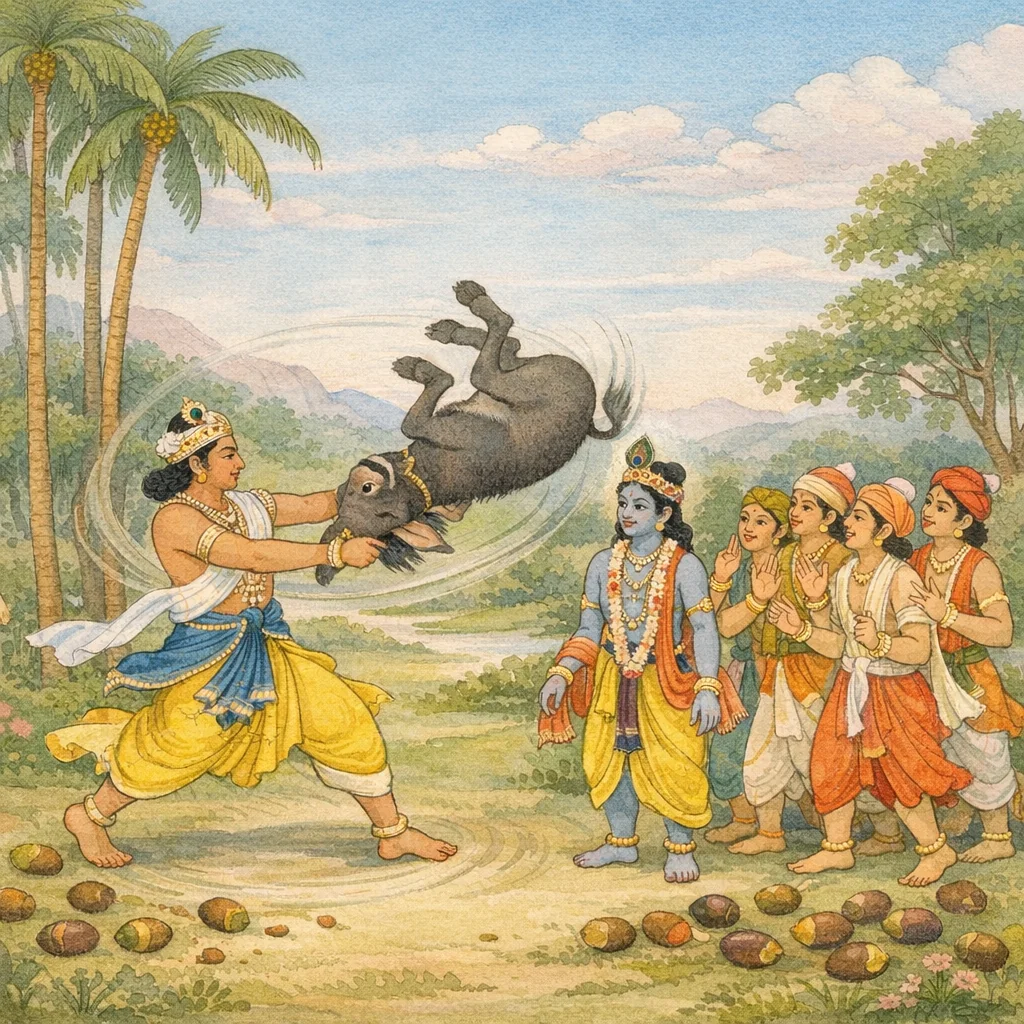
Adhyaya 186: Balarama and Krishna Slay Dhenuka in the Tālavana
L’Adhyāya 186, raconté par Vyāsa, relate un épisode pastoral et héroïque où une forêt fertile est délivrée d’une présence démoniaque. Rāma (Saṃkarṣaṇa/Balabhadra) et Kṛṣṇa, gardant les vaches avec les jeunes bouviers, pénètrent dans l’agréable Tālavana, une palmeraie riche en fruits mûrs et parfumés. Les bouviers expliquent que ce lieu est délaissé depuis longtemps, car il est gardé par le démon Dhenuka, un daitya destructeur à forme d’âne, mangeur de chair. Répondant au désir des enfants, Rāma et Kṛṣṇa secouent les palmiers pour faire tomber les fruits, ce qui attise la colère de Dhenuka. Un affrontement s’ensuit : le démon-âne est saisi, tournoyé, mis à mort, puis jeté dans le bois. D’autres démons-ânes accourent, mais les deux frères les abattent aisément. Ainsi, la palmeraie est purifiée et rendue à sa fécondité ; les fruits jonchent le sol, et les troupeaux broutent l’herbe fraîche sans crainte, signe du rétablissement de l’ordre dans le paysage pastoral.
Chapter Arc
{"opening_hook":"Vyāsa’s narration opens in a serene Vraja-pastoral register: Kṛṣṇa and Rāma, moving with the cowherd boys amid grazing cattle, are drawn toward the alluring Tālavana—fragrant, heavy with ripe tāla (palm) fruits—immediately setting desire (for fruit) against a forbidden, feared space.","rising_action":"The boys explain why the grove has been abandoned: it is occupied by Dhenuka, a donkey-formed daitya who makes the forest lethal. The tension rises as the brothers deliberately enter anyway and begin shaking the palms, turning innocent play into a conscious challenge to adharma’s territorial claim.","climax_moment":"Dhenuka’s furious charge is met by Saṃkarṣaṇa’s overwhelming strength: the ass-demon is seized, whirled, and slain, then hurled down so that the impact and agitation of the grove causes fruits to rain like a storm—an emblem of dharma restored through decisive, effortless divine force.","resolution":"Dhenuka’s allied donkey-demons arrive in succession and are dispatched by the two brothers; the Tālavana is purified and reopened. The earth lies strewn with palm fruits, fresh grass becomes safe for grazing, and the cowherds’ fear is replaced by abundance and free movement—order reestablished in the pastoral landscape.","key_verse":null}
Thematic Essence
{"primary_theme":"Vraja-līlā as landscape-liberation: the cleansing of Tālavana through the slaying of Dhenuka.","secondary_themes":["Abundance withheld by fear: how adharma turns fertile nature into forbidden territory","Divine play (līlā) that is also social protection: satisfying the boys’ desire while restoring safety","Effortless avatāra-heroism: the demon’s might collapses before bala and dharma","Re-sanctification of space: from haunted grove to communal pasture and orchard"],"brahma_purana_doctrine":"A recurring Purāṇic doctrinal motif is reinforced: when daitya-force occupies a region, the avatāra’s intervention is not merely martial but ecological and communal—restoring rightful access to nature’s gifts and reestablishing dharmic order in lived geography.","adi_purana_significance":"As an ‘Ādi Purāṇa’ layer within a text famed for mapping sacred space, this episode models how sacred history explains why a place becomes safe, fruitful, and fit for human and bovine life—myth functioning as an origin-story for a reclaimed landscape."}
Emotional Journey
{"opening_rasa":"शृङ्गार (śṛṅgāra)","climax_rasa":"वीर (vīra)","closing_rasa":"शान्त (śānta)","rasa_transitions":["śṛṅgāra → अद्भुत (adbhuta) → भयानक (bhayānaka) → vīra → adbhuta → śānta"],"devotional_peaks":["The fearless entry of Kṛṣṇa and Saṃkarṣaṇa into a demon-held grove—bhakti as trust in divine protection","The moment Dhenuka is whirled and cast down—darśana of irresistible divine bala restoring dharma","The transformed grove—abundance and safety as a tangible ‘phala’ (fruit) of divine presence"]}
Tirtha Focus
{"tirthas_covered":["तालवन (Tālavana)"],"jagannath_content":null,"surya_content":null,"cosmology_content":null}
Shlokas in Adhyaya 186
Verse 1
व्यास उवाच गाः पालयन्तौ च पुनः सहितौ रामकेशवौ भ्रममाणौ वने तत्र रम्यं तालवनं गतौ //
Cette section ne contient que le numéro «1» et ne fournit pas le texte sanskrit à traduire.
Verse 2
तच् च तालवनं नित्यं धेनुको नाम दानवः नृगोमांसकृताहारः सदाध्यास्ते खराकृतिः //
Cette entrée n’indique que le numéro «2», sans le texte sanskrit correspondant à traduire.
Verse 3
तत्र तालवनं रम्यं फलसंपत्समन्वितम् दृष्ट्वा स्पृहान्विता गोपाः फलादाने ऽब्रुवन् वचः //
Ici, seul le numéro «3» apparaît, sans le verset sanskrit permettant la traduction.
Verse 4
गोपा ऊचुः हे राम हे कृष्ण सदा धेनुकेनैव रक्ष्यते भूप्रदेशो यतस् तस्मात् त्यक्तानीमानि सन्ति वै //
Ce passage ne contient que le numéro «4» et ne fournit pas le texte sanskrit original à traduire.
Verse 5
फलानि पश्य तालानां गन्धमोदयुतानि वै वयम् एतान्य् अभीप्सामः पात्यन्तां यदि रोचते //
Ce verset (numéro 5) est tenu pour une parole sacrée dans la tradition des Purāṇa.
Verse 6
इति गोपकुमाराणां श्रुत्वा संकर्षणो वचः कृष्णश् च पातयाम् आस भुवि तालफलानि वै //
Ce verset (numéro 6) expose un sens sacré et doit être récité avec révérence.
Verse 7
तालानां पततां शब्दम् आकर्ण्यासुरराट् ततः आजगाम स दुष्टात्मा कोपाद् दैतेयगर्दभः //
Ce verset (numéro 7) est transmis selon l’usage ancien afin d’enseigner le Dharma.
Verse 8
पद्भ्याम् उभाभ्यां स तदा पश्चिमाभ्यां च तं बली जघानोरसि ताभ्यां च स च तेनाप्य् अगृह्यत //
Ce verset (numéro 8) appartient à un exposé ancien qui unit savoir et foi.
Verse 9
गृहीत्वा भ्रामणेनैव चाम्बरे गतजीवितम् तस्मिन्न् एव प्रचिक्षेप वेगेन तृणराजनि //
Ce verset (numéro 9) doit être écouté et récité l’esprit paisible afin de recevoir la sagesse du Dharma.
Verse 10
ततः फलान्य् अनेकानि तालाग्रान् निपतन् खरः पृथिव्यां पातयाम् आस महावातो ऽम्बुदान् इव //
Ce verset (10) est tenu pour sacré dans le Purāṇa et en expose le sens selon la tradition ancienne.
Verse 11
अन्यान् अप्य् अस्य वै ज्ञातीन् आगतान् दैत्यगर्दभान् कृष्णश् चिक्षेप तालाग्रे बलभद्रश् च लीलया //
Le verset (11) est une parole pure et poursuit l’exposé du savoir ancien selon l’ordre du Purāṇa.
Verse 12
क्षणेनालंकृता पृथ्वी पक्वैस् तालफलैस् तदा दैत्यगर्दभदेहैश् च मुनयः शुशुभे ऽधिकम् //
Le verset (12) énonce une vérité profonde afin que savants et dévots comprennent selon le Dharma.
Verse 13
ततो गावो निराबाधास् तस्मिंस् तालवने द्विजाः नवशष्पं सुखं चेरुर् यत्र भुक्तम् अभूत् पुरा //
Le verset (13) poursuit l’éclaircissement de principes anciens, en préservant la dignité du Purāṇa.
Frequently Asked Questions
The chapter foregrounds the restoration of dharmic order through the removal of a predatory, disruptive force from a shared ecological commons. By clearing Tālavana of Dhenuka and his kin, the narrative frames divine power as protective governance that enables nonviolent livelihood—safe grazing, communal access to food resources, and the reestablishment of normal pastoral life.
Within the Brahma Purana’s encyclopedic purview, this episode functions as a paradigmatic mythic unit: it encodes a foundational motif of early Purāṇic narration—divine intervention that reorders space, removes adharma from a locality, and renders the landscape socially usable. Such localized restorations help structure the Purāṇic world as an ordered, narratively mapped terrain rather than an undifferentiated wilderness.
No explicit tīrtha-māhātmya, vrata, or formal rite is instituted in this adhyāya. The text instead emphasizes a practical-sacral transformation of place: Tālavana shifts from a demon-guarded exclusion zone to a safe pastoral grove, implying purification-through-divine-action rather than prescribing a named pilgrimage observance.