
Shloka 4
Purushottama Yoga — Purushottama Yoga
ततः पदं तत्परिमार्गितव्यं यस्मिन्गता न निवर्तन्ति भूयः । तमेव चाद्यं पुरुषं प्रपद्ये यतः प्रवृत्तिः प्रसृता पुराणी ॥
tataḥ padaṁ tat parimārgitavyaṁ yasmin gatā na nivartanti bhūyaḥ | tam eva cādyaṁ puruṣaṁ prapadye yataḥ pravṛttiḥ prasṛtā purāṇī ||

Alors, ce séjour doit être recherché, où, une fois parvenus, on ne revient plus. En ce seul Personne primordiale je prends refuge, de qui s’est déployée cette antique activité (du monde).
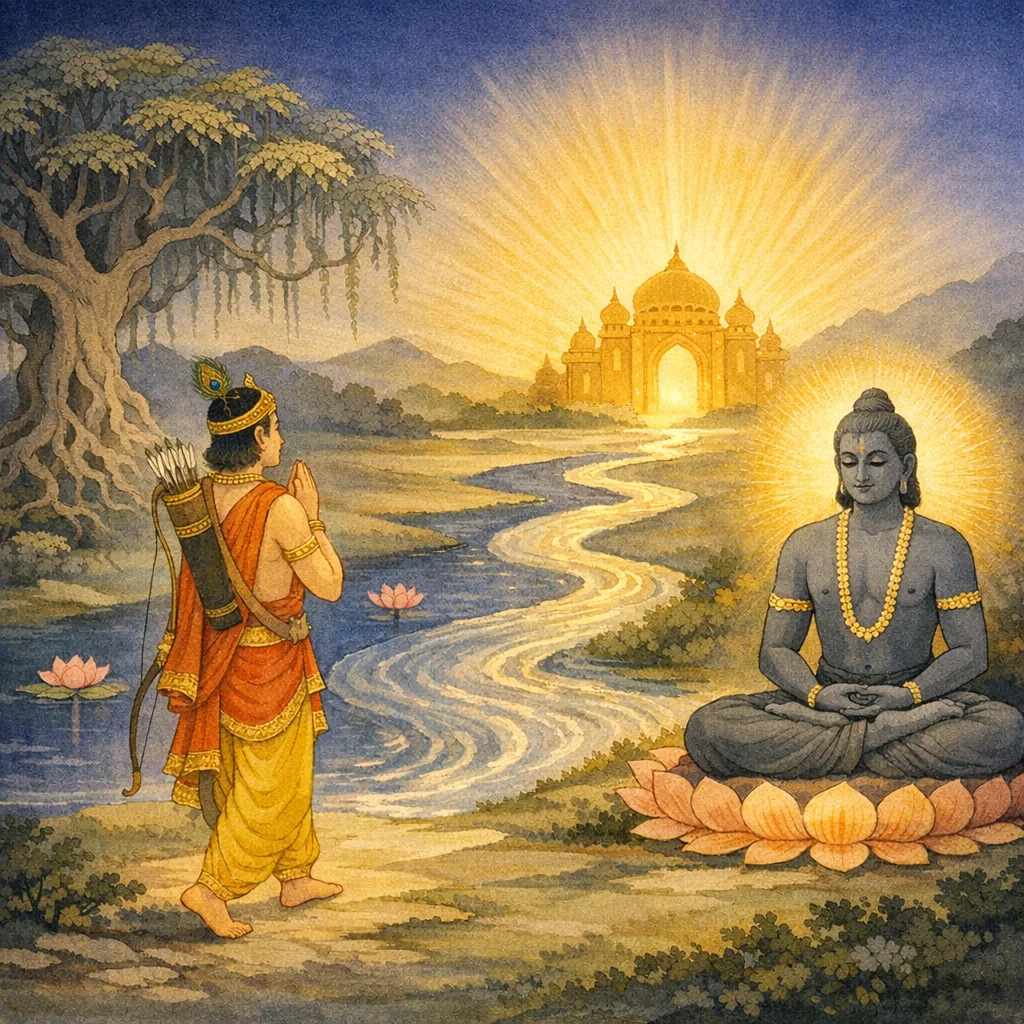
Then that goal (abode) should be sought, having gone where people do not return again; taking refuge in that primal Person alone, from whom this ancient activity (of the world) has flowed forth.
Therefore that ‘station’ is to be thoroughly sought, reaching which one does not return again; one should take refuge in that very primordial Person, from whom the ancient forward-streaming activity has spread out.
Most received recensions agree on the sense: after abandoning mistaken identification with the ‘inverted tree’ (15.1–3), one should seek the irreversible ‘pada’ (state/abode) and take refuge in the ādi-puruṣa (primordial person). Translational differences mainly concern (a) padaṁ as ‘abode’ vs ‘state/goal’, and (b) pravṛttiḥ as ‘world-process/manifest activity’ vs ‘action’ in a moral sense. The line is often read theistically (refuge in God) but can also be framed philosophically as orientation to the unconditioned source beyond cyclic return.
FAQs
The verse frames liberation as a decisive reorientation of attention and commitment: instead of being absorbed in shifting experiences, one ‘seeks’ a stable ground (pada) and adopts a stance of reliance (prapadye). In psychological terms, it emphasizes sustained inquiry and letting-go of repetitive patterns that lead back to the same cycles of dissatisfaction.
Metaphysically, ‘non-return’ indicates transcendence of saṁsāra (recurrent conditioned existence). The ‘primordial person’ (ādya puruṣa) functions as the ultimate source from which manifestation (pravṛtti) unfolds. The verse thus links soteriology (release) with cosmology (origin), presenting the Absolute as both the ground of the world-process and the terminus of spiritual seeking.
In Chapter 15, the world is depicted through the metaphor of an aśvattha tree with roots above and branches below (15.1–3), representing entanglement in conditioned life. Verse 15.4 marks the pivot: after ‘cutting’ attachment conceptually and ethically, one should seek the ultimate state and take refuge in the source beyond the metaphorical tree.
For contemporary readers, the verse can be applied as a disciplined search for what is enduring—through contemplative practice, ethical clarity, and critical self-examination—paired with humility about one’s limits (refuge/commitment). It encourages choosing a coherent ultimate orientation (philosophical or devotional) rather than remaining caught in repetitive, short-term pursuits.