
Shloka 6
Karma Yoga — Karma Yoga
कर्मेन्द्रियाणि संयम्य य आस्ते मनसा स्मरन् । इन्द्रियार्थान्विमूढात्मा मिथ्याचारः स उच्यते ॥ ३.६ ॥
karmendriyāṇi saṃyamya ya āste manasā smaran | indriyārthān vimūḍhātmā mithyācāraḥ sa ucyate || 3.6 ||

Celui qui, maîtrisant les organes de l’action, demeure assis en se remémorant par l’esprit les objets des sens — cet être à l’âme égarée est appelé un hypocrite.
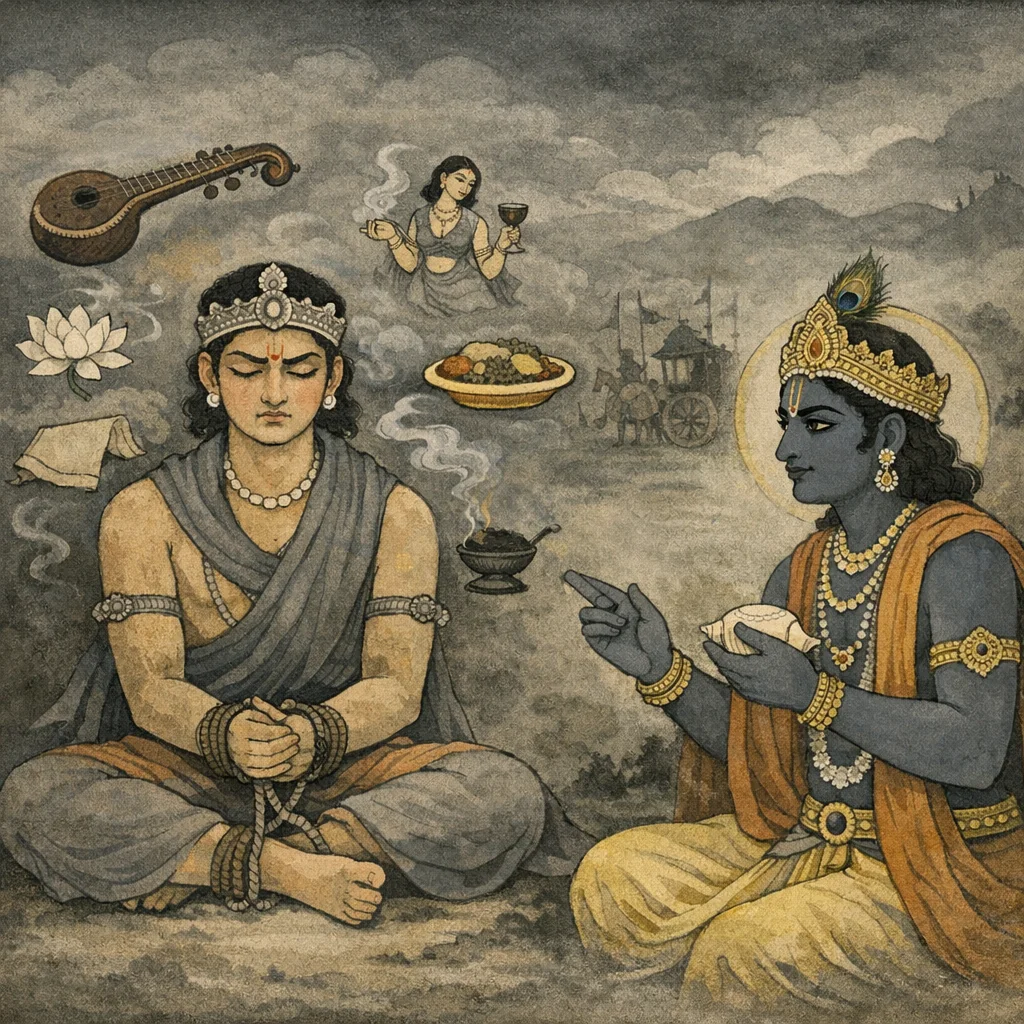
One who restrains the organs of action but sits dwelling in the mind on sense-objects—such a deluded person is called a hypocrite.
Restraining the organs of action, the one who remains (inactive) while mentally recalling sense-objects—such a person, of confused self-understanding, is said to be of false conduct.
‘Mithyācāra’ is often rendered ‘hypocrite,’ but more literally denotes ‘false/inauthentic practice.’ The emphasis is on inner consistency: external restraint without cognitive-emotional transformation is incomplete.
FAQs
The verse identifies a split between outward behavior and inward preoccupation. It suggests that sustainable self-control requires working with attention and desire, not only suppressing behavior.
It implies that bondage is maintained at the level of identification and craving; mere physical restraint does not dissolve the underlying dispositions (saṃskāras) that perpetuate cyclic patterns.
Krishna cautions Arjuna against equating renunciation with simply not acting; the quality of mind and motive is central to the Gītā’s account of discipline.
In ethics and self-improvement, performative restraint (appearing disciplined) can coexist with compulsive attention to the very things one claims to renounce. The verse recommends integrity: align habits, intentions, and attention-training.