
Shloka 30
Karma Yoga — Karma Yoga
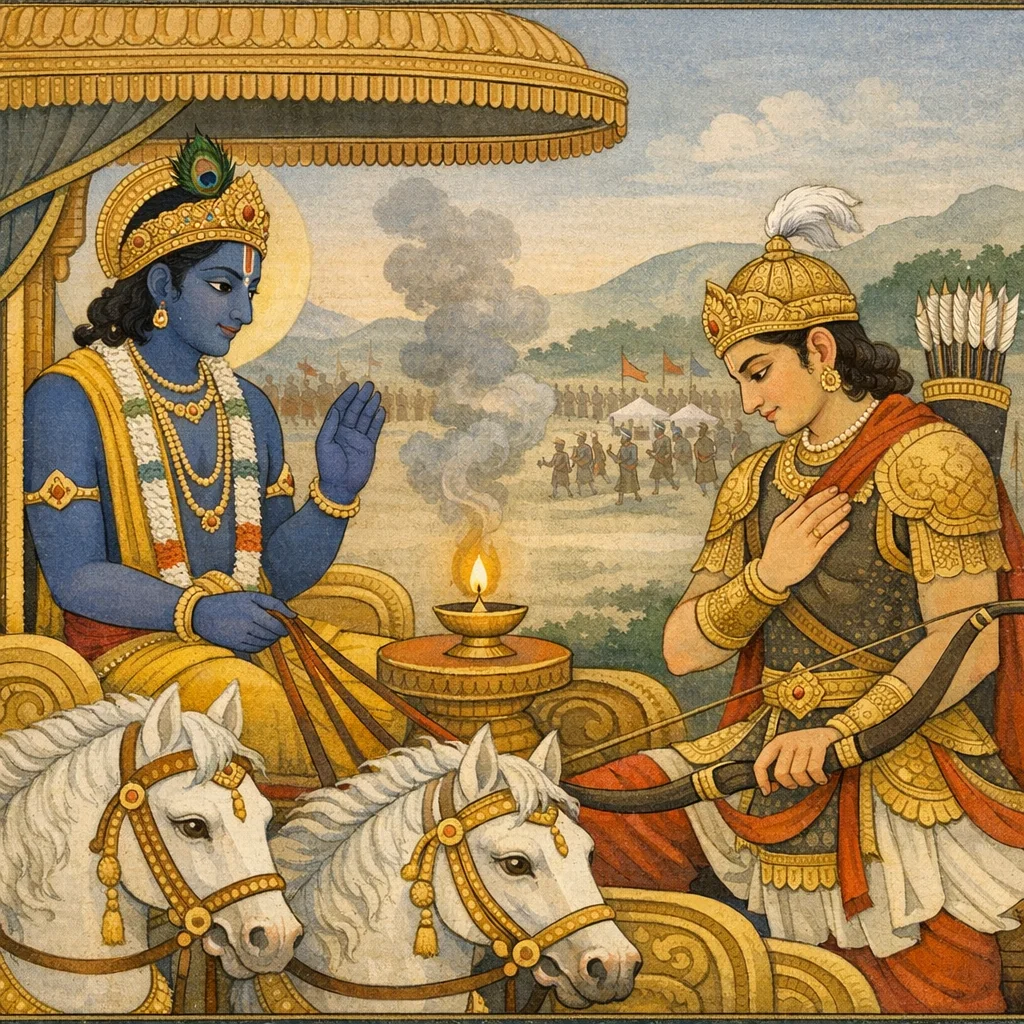
मयि सर्वाणि कर्माणि संन्यस्याध्यात्मचेतसा । निराशीर्निर्ममो भूत्वा युध्यस्व विगतज्वरः ॥ ३.३० ॥
mayi sarvāṇi karmāṇi saṁnyasyādhyātma-cetasā | nirāśīr nirmamo bhūtvā yudhyasva vigata-jvaraḥ || 3.30 ||

En Me remettant toutes les actions, l’esprit établi dans l’ātman, sans attente et sans sentiment de possession, accomplis ton devoir, délivré de la fièvre intérieure.
Renouncing all actions in Me, with mind focused on the self, free from expectation and possessiveness, engage in your duty free from inner fever (anxiety).
Having deposited all actions in Me, with inwardly oriented awareness, without hope and without ‘mine-ness,’ perform your role, free from agitation.
Yudhyasva is contextually ‘perform your warrior-duty’; in non-graphic terms it can be read as ‘engage resolutely in your obligation.’ ‘Jvara’ is often interpreted as mental agitation rather than physical illness.
FAQs
It offers a method for reducing performance anxiety: shift focus from personal gain to principled action, letting outcomes be secondary.
Action becomes a form of devotion or alignment with the ultimate, dissolving egoic ownership while maintaining ethical responsibility.
Krishna applies the guṇa/doership teaching directly to Arjuna’s predicament: engage in duty with an inwardly renunciant attitude.
Treat work as service to a larger purpose (community, truth, God, or values), minimizing possessiveness and reducing stress.