
Bhagavad Gita — Karma Sannyasa Yoga, Shloka 11
Karma Sannyasa Yoga
युक्तः कर्मफलं त्यक्त्वा शान्तिमाप्नोति नैष्ठिकीम् । अयुक्तः कामकारेण फले सक्तो निबध्यते ॥ ५.१२ ॥
yuktaḥ karmaphalaṃ tyaktvā śāntim āpnoti naiṣṭhikīm | ayuktaḥ kāmakāreṇa phale sakto nibadhyate || 5.12 ||

Le yogin, ayant renoncé au fruit de l’action, atteint la paix suprême et stable ; l’homme non uni, poussé par le désir, s’attachant au fruit, se trouve lié.
युक्त पुरुष कर्मफल का त्याग करके नैष्ठिकी शान्ति को प्राप्त होता है; अयुक्त पुरुष कामना के वशीभूत होकर फल में आसक्त होकर बँध जाता है।
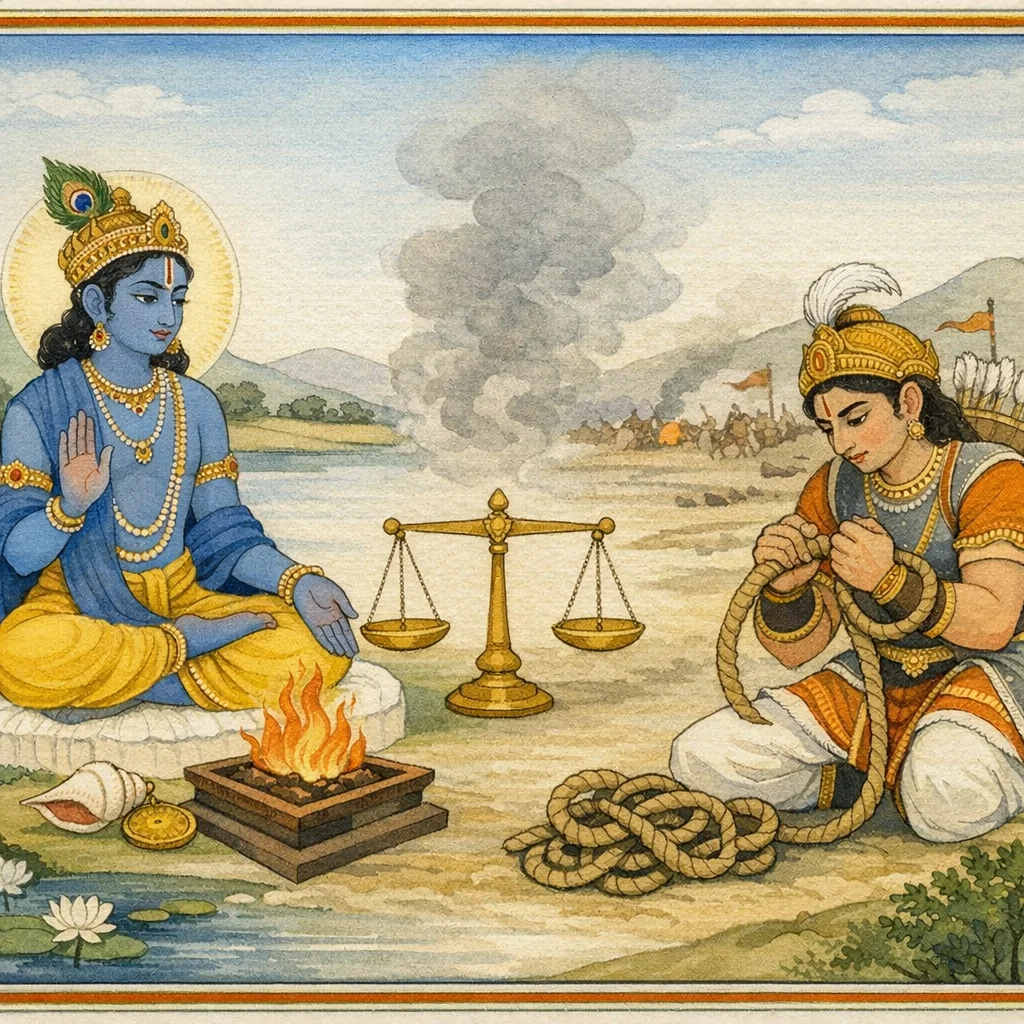
The disciplined person, having abandoned the fruit of action, attains steadfast peace; the undisciplined person, driven by desire, becomes bound through attachment to results.
“Naiṣṭhikī śānti” is read as stable, enduring tranquility (sometimes linked to liberation-adjacent steadiness). The contrast is ethical-psychological rather than fatalistic: bondage is explained through desire-driven fixation on outcomes.
FAQs
The verse distinguishes intrinsic engagement from outcome-fixation: letting go of results reduces anxiety and compulsive comparison, supporting stable well-being.
Bondage is portrayed as a function of desire and attachment (a causal chain often elaborated in Indian soteriology), while peace arises when action is decoupled from possessiveness over outcomes.
It summarizes the practical core of karma-yoga in Chapter 5: renunciation is operationalized as dropping claim over results rather than ceasing activity.
Set process-based goals (quality of effort, ethical standards) instead of only outcome-based goals; evaluate yourself primarily on adherence to process.